Identity Crisis and Nostr
Abstract
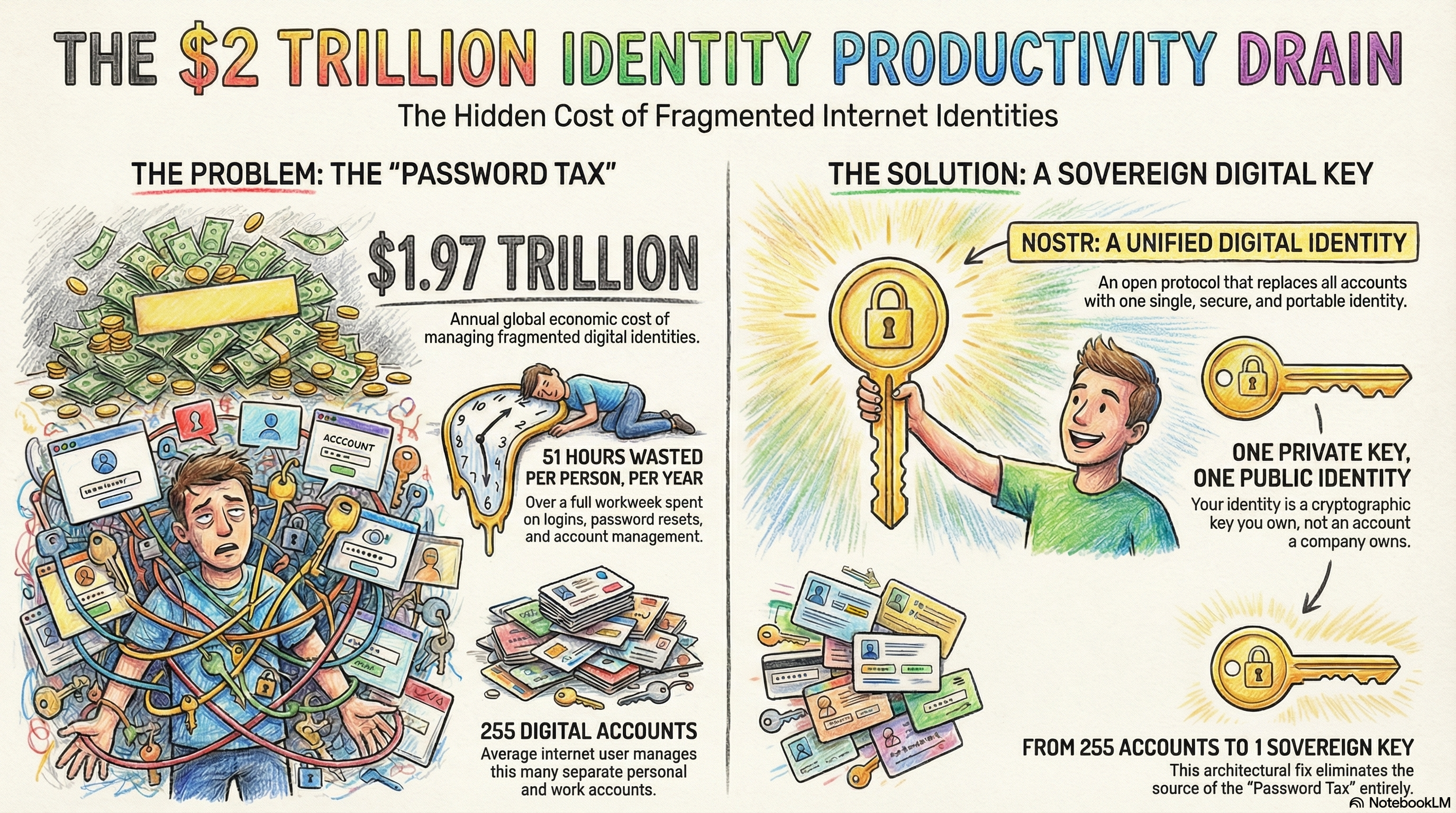
The internet’s foundational architecture, lacking a native identity layer, has precipitated a systemic crisis of fragmented identity. The ubiquitous “User Account” model, an ad-hoc solution reliant on siloed username/password databases, is now a source of massive economic waste and a significant cybersecurity vulnerability. This paper quantifies the economic burden of this fragmented identity model, which we term the “Password Tax,” at approximately 1.8 trillion USD annually. We argue that this model is unsustainable and propose the Nostr protocol as a viable, decentralized, and economically superior alternative. Nostr, a simple, open protocol, enables a universal, portable, and secure identity layer for the internet, capable of replacing the archaic user account system. Through a cryptographic key pair, Nostr provides a “Sovereign Key” that decouples identity from data storage, offering a path to a more secure, efficient, and censorship-resistant internet. The paper examines the technical underpinnings of Nostr, its economic implications, and its potential to become the de-facto identity layer for the next generation of the web.
I. Introduction: The Original Sin of the Internet Architecture
The Hypertext Transfer Protocol (HTTP), the bedrock of the World Wide Web, was conceived as a stateless medium for document retrieval. Its architects envisioned a distributed library, not a global platform for commerce, finance, and social interaction. This foundational design choice resulted in a critical omission: a native, protocol-level identity layer. The TCP/IP and HTTP suites can identify “where” (IP addresses) and “what” (resources), but not “who.”
This architectural flaw, which can be described as the “Original Sin” of the web, compelled early developers to create impromptu solutions for user identification and access control. The result was the “User Account” model, a system where each server maintains a local database mapping a username to a password. This makeshift solution, replicated across millions of servers over three decades, has evolved into a systemic crisis that undermines the security, usability, and integrity of the digital ecosystem.
The core problem of the contemporary internet is the forced fragmentation of identity. Every application, website, and service compels users to create a new, isolated account, each with its own arbitrary and often conflicting password policies. This paper posits that this fragmented paradigm is both mathematically and psychologically untenable. As an individual’s digital footprint expands to hundreds of distinct relationships, the reliance on superficial fixes like password managers and two-factor authentication (2FA) becomes increasingly burdensome and ultimately fails to address the root cause of the problem.
This paper will demonstrate that a decentralized, protocol-based identity system is not merely a desirable feature but an economic and security imperative. We will quantify the economic waste generated by the current model and present the Nostr protocol as a robust, inevitable solution.
II. The Economic Impact of Fragmented Identity: A Quantitative Analysis
To understand the scale of the problem, we introduce the concept of the “Password Tax”—a measure of the global economic value lost to the friction of managing fragmented digital identities. This tax is not levied by any government but is an inherent cost of the internet’s flawed architecture. We can quantify this cost by calculating the Total Human Hours Wasted (THHW) and converting it to a monetary value.
It is important to note that this paper is NOT trying to assess the dollar impact of fraud and identity theft due to the fragmented ID model. While we believe a unified identity layer like Nostr will significantly reduce such incidents, we cannot preemptively quantify these numbers as of today. The goal of this research is solely to put a number on the wastage of time and the dollar burden purely from the perspective of identity maintenance.
A. Variables
- Global Internet Population (\$U\$): As of 2024, the International Telecommunication Union (ITU) estimates approximately 5.5 billion people are online [2].
- Average Accounts per Person (\$A\$): Recent cybersecurity research indicates that the average person has approximately 255 accounts (168 personal and 87 work-related) [1].
- Time Burden Assumption (\$T\$): We assume a conservative friction cost of 1 minute per account per month. This encompasses time spent on typing credentials, managing 2FA, password resets, creating new accounts, and the cognitive overhead of account management.
B. Calculation of Time Wasted
First, we calculate the annual time lost per individual:
\$\$ \text{Time per Person} = 255 \text{ accounts} \times 1 \text{ min/month} \times 12 \text{ months} = 3,060 \text{ minutes/year} \$\$
\$\$ 3,060 \text{ minutes} \approx \mathbf{51 \text{ hours per person per year}} \$\$
This calculation suggests that the average digital citizen expends more than a full workweek each year managing access to their digital lives.
Next, we aggregate this to the global internet population:
\$\$ \text{Global Hours Wasted} = 5.5 \text{ Billion Users} \times 51 \text{ hours/user} \$\$
\$\$ \text{Global Hours Wasted} \approx \mathbf{280.5 \text{ Billion Hours per Year}} \$\$
C. Monetary Valuation
To assign a monetary value to this wasted time, we use the “Value of Time” based on Global GDP Per Capita.
- Conservative Estimate (Global Average): Using a global average hourly value derived from GDP per capita (approximately 7.02 USD/hour based on IMF data for 2025) [3]: \$\$ 280.5 \text{ Billion Hours} \times 7.02/\text{hour} \approx \mathbf{1.97 \text{ Trillion USD}} \$\$
This analysis reveals that the fragmented identity model imposes a hidden “Password Tax” of approximately 1.97 Trillion to 2 Trillion USD annually. To put this figure in perspective, this is roughly equivalent to the GDP of a G7 nation like Canada or Italy. The global economy effectively absorbs the loss of a major country’s entire economic output each year due to identity friction.
III. The Nostr Protocol: A Proposed Solution
The solution to the identity crisis must be architectural, not incremental. Nostr, which stands for “Notes and Other Stuff Transmitted by Relays,” is a simple, open protocol that provides the foundation for a decentralized, portable, and secure identity layer for the internet.
A. Core Principles of Nostr
Nostr’s design is elegant and powerful, based on two fundamental components:
- Clients: Software that allows users to create and sign events (e.g., messages, profile updates, login requests).
- Relays: Simple servers that receive events from clients and broadcast them to other clients. Relays are “dumb” in that they do not interpret the data they handle; they merely store and forward it.
B. Cryptographic Identity: The Sovereign Key
At the heart of Nostr is a cryptographic identity system based on a key pair:
- A private key (
nsec), which is a secret, randomly generated string that the user must keep secure. This key is the user’s ultimate identity. - A public key (
npub), which is mathematically derived from the private key and can be shared freely. The public key is the user’s public identifier.
All actions on the Nostr network are packaged as “events,” which are simple JSON objects containing the content of the action, a timestamp, and other metadata. Crucially, every event is signed by the user’s private key.
{
  "pubkey": "a8e7d... (User's Identity / npub)",
  "content": "This is my data or request.",
  "kind": 1,
  "sig": "7f8a9... (Cryptographic Proof of Authorship)"
}
Any client or relay can cryptographically verify the signature of an event using the corresponding public key. This provides incontrovertible proof of authorship without requiring a centralized authority or a “login server.” This simple mechanism eliminates the need for the centralized databases of usernames and passwords that are the primary targets of hackers.
C. Decoupling Identity from Storage
Unlike centralized platforms like Facebook or Google, where identity and data are co-located on company servers, Nostr decouples them. A user’s identity resides solely on their own device (in the form of their private key), while their data can be distributed across multiple relays.
A user can publish their signed events to any number of relays. If a relay goes offline, is blocked by a government, or bans the user, their identity remains intact. They can simply connect to different relays or even run their own. This architecture makes Nostr a highly resilient and censorship-resistant system. The user is a sovereign entity, not a tenant on a landlord’s platform.
IV. NIP-46: A Universal Identity Layer
While Nostr gained initial traction as a protocol for decentralized social media, its most transformative application is as a universal identity layer for the entire web. The “Nostr Implementation Possibility” (NIP) that unlocks this potential is NIP-46 (Nostr Connect).
NIP-46 is a protocol for remote signing, which allows a user to keep their private key in a secure “signer” application (such as a browser extension or a dedicated mobile app) while authorizing actions on third-party websites.
The workflow is as follows:
- A user navigates to a website that supports Nostr login.
- Instead of a username/password form, the user is presented with a QR code or a prompt to connect their Nostr identity.
- The user scans the QR code or approves the connection request in their signer app.
- The website can now request the signer app to sign events on the user’s behalf (e.g., to log in, to post a comment, to make a purchase). The user must approve each request.
This workflow eliminates the need for the website to ever handle the user’s private key, or any other secret. The website only needs to know the user’s public key. The concept of a “login” is replaced by a cryptographic signature.
V. Discussion
The adoption of a Nostr-based identity layer would have profound implications for the internet.
- Economic Benefits: By eliminating the “Password Tax,” a Nostr-based system could unlock trillions of dollars in economic value. The
Avariable (255 accounts) in our economic model is reduced to 1, transforming a significant economic liability into a zero-cost utility. - Enhanced Security: By eliminating centralized password databases, Nostr mitigates the risk of mass data breaches.
- Censorship Resistance: Because identity is portable and data is distributed, it becomes far more difficult for corporations or governments to de-platform individuals.
- Innovation: A universal identity layer would enable a new wave of innovation, as developers could build applications that seamlessly interact with each other without the friction of account creation.
VI. Conclusion
The internet’s identity crisis is a direct consequence of an architectural flaw in its original design. The fragmented, centralized user account model is an anachronism that is no longer fit for purpose. It is economically wasteful, insecure, and psychologically burdensome.
The Nostr protocol offers a clear and viable path forward. By providing a decentralized, portable, and secure identity layer, Nostr can eliminate the “Password Tax,” enhance security, and create a more open and censorship-resistant internet. The transition to a Nostr-based identity system is not a matter of if, but when. The economic and security imperatives are too significant to ignore. Nostr is not merely a new application; it is a fundamental architectural upgrade for the internet itself.
Tips and Donations
If you enjoyed this deep dive, consider supporting the project with a tip in Sats. It’s a simple, global way to support independent research.
To send Sats, you’ll need a lightning wallet.
References
- Data based on a 2024 study by NordPass. The study found that the average person has approximately 255 accounts. The original source link is no longer active, but the study’s findings are widely cited in news articles.
- ITU. (2024). Facts and Figures 2024. International Telecommunication Union. Available at: https://www.itu.int/itu-d/reports/statistics/facts-figures-2024/
- International Monetary Fund. (2024). World Economic Outlook, October 2024: A Rocky Recovery. Available at: https://www.imf.org/en/Publications/WEO/Issues/2024/10/08/world-economic-outlook-october-2024