The Inevitability of Open Source
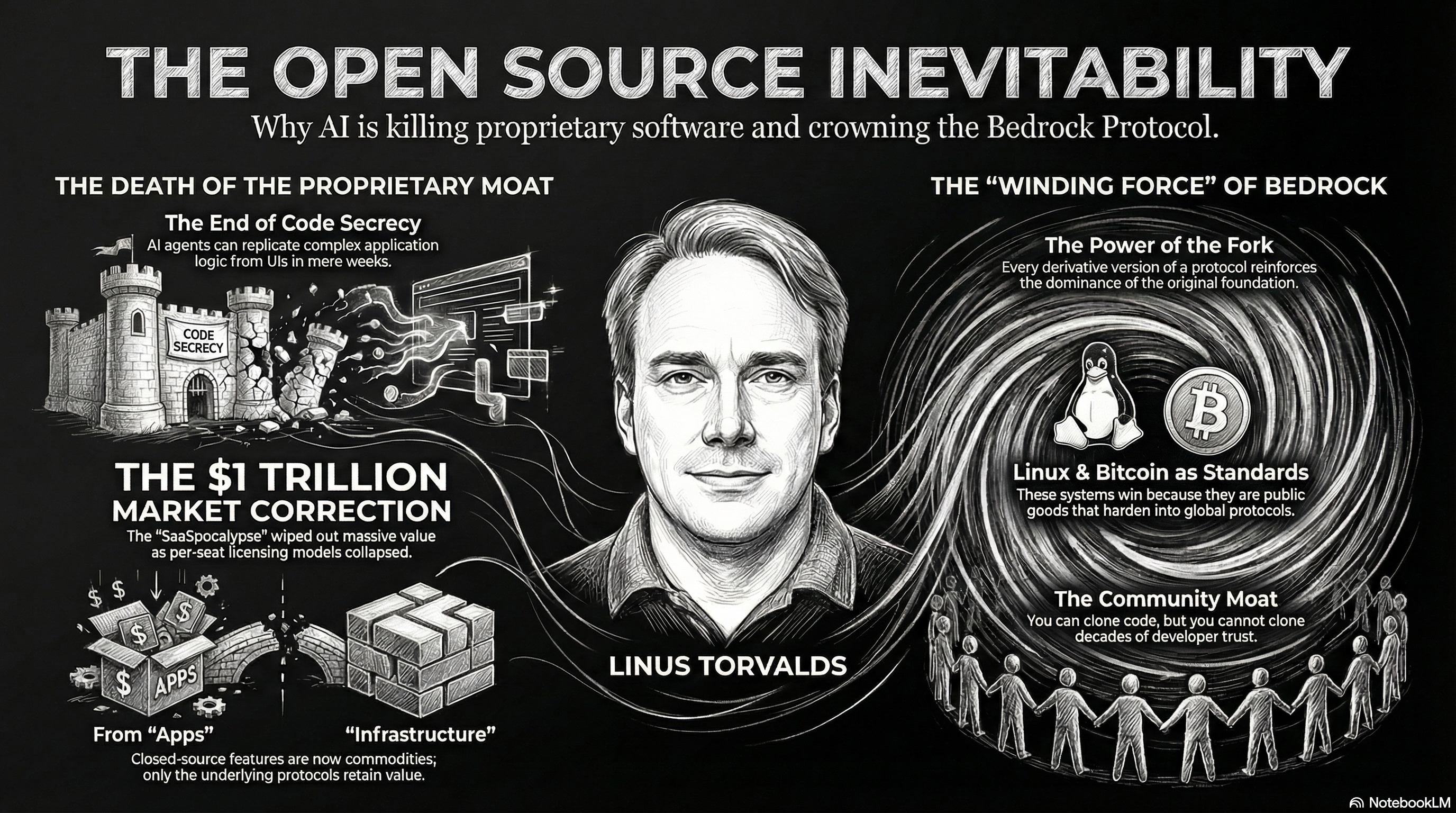
The arrival of artificial intelligence marks a “rupture” in the history of software development, where the traditional model of proprietary “black-box” code has effectively been bypassed. The central realization is simple: if an AI can observe a user interface and replicate the entire application logic in weeks, the effort to hide code becomes increasingly insignificant.
In this new reality, the only durable strategy is to embrace the open-source model—an idea essentially “fetched from the future” to solve the economic paradoxes of a world with zero-cost replication. True value no longer resides in the application itself, but in the foundational lineage and the “winding force” created every time code is forked or integrated.
The End of the “GPT Wrapper” Moat
The collapse of the application layer is best demonstrated by the “trivial cloning” of proprietary features. When raw intelligence is a commodity provided by foundational models, the specific UI and workflow of an application can be reverse-engineered almost instantly by the open-source community.
| Proprietary Feature | Open Source Clone | Timeline | Result |
|---|---|---|---|
| OpenAI Canvas | Open Canvas (LangChain) | ~3 weeks | Full parity with added multi-model support |
| SearchGPT | Perplexica / OpenPlexity | < 1 month | Proved search UI is a commodity, not a moat |
| Advanced Voice | Llama-Omni / Whisper | Instant | Local, low-latency replication of proprietary “magic” |
This rapid replication confirms that any feature built on top of a model is temporary. 1 If the code is destined to be cloned, sharing it becomes the only rational way to gain value through recognition and ecosystem integration.
The “SaaSpocalypse”: The Failure of the Closed-Source Enterprise Model
For two decades, the “Software as a Service” (SaaS) model relied on three moats: hiding the code, per-seat licensing, and complex user interfaces that forced “muscle memory” lock-in. AI has systematically destroyed all three, leading to a market correction dubbed the “SaaSpocalypse” that wiped out nearly one trillion dollars in market value by early 2026.
The Death of Per-Seat Licensing
SaaS empires like Salesforce, Atlassian, and Workday were built on the assumption that headcount was a proxy for productivity. In an agent-first world, one human using AI can do the work of five analysts, leading to a massive “revenue leak” for vendors using seat-based pricing. Microsoft CEO Satya Nadella has notably characterized the traditional SaaS model as being at a point of potential collapse.
The Weekend Clone
The market is realizing that the “code moat” has evaporated. A small team of generalist developers using AI agents can now replicate the core logic of a complex trade promotion or demand forecasting system—work that previously took years of engineering—in a matter of weeks for a fraction of the cost.
- Pricing Disruption: New entrants like Holosign can offer functional equivalents to platforms like DocuSign for a flat 19 dollars per month per organization, undercutting the 45 dollars per month per seat model of incumbents.
- Infrastructure over Apps: As AI agents become the primary interface for work, the underlying SaaS applications risk being hollowed out into invisible, commoditized infrastructure.
True Open Source vs. Corporate Trickery
Humanity possesses an uncanny ability to “smell the intent” behind technology projects. True open-source projects were born from decades of selfless toil, not corporate quarterly targets.
The Intent of Protocols
True open source is not merely making code available; it is a spirit of creating a public good that eventually hardens into a global protocol.
- Vim, Git, & Nix: These were open-sourced with pure intent, which is why they have become the immutable standards of the developer’s craft. Even if you clone Git’s code, you cannot replicate its global network effect or the “winding force” of its 100,000+ contributors.
- Nix / NixOS: Represents a “pure build protocol” that required decades of commitment to move from a niche package manager to the foundation for platforms like Replit.
The Corporate Proxy (Trickery)
In contrast, projects like Llama (Meta) or Android (Google) are strategic tools driven by the “Law of Conservation of Attractive Profits”. 2 These firms seek to “commoditize their complement”—making AI weights available to destroy the pricing power of pure-play competitors like OpenAI. While technically “open-weight,” these projects often lack the training data transparency required for true protocol status.
The Winding Force: Every Fork Makes You Foundational
The economic truth of the AI era is that sharing your code is the fastest path to wealth and recognition. In the “base and superstructure” of technology, value always flows from the derivative structure back to the foundational layer.
- The Bitcoin Foundation: Bitcoin is the ultimate example of an idea forked thousands of times. 3 Ethereum is effectively a conceptual fork of Bitcoin—while it adds smart contracts, its value is anchored in the Bitcoin foundation. 4 Even Vitalik Buterin and the Ethereum founding team anchored their initial value in Bitcoin, raising 31,000 BTC during their ICO. 5 Ethereum does not replace Bitcoin; it adds value to it as a productive superstructure.
- The Linux Bedrock: Every one of the thousands of Linux distributions acts as a “winding force” that pulls value back to the foundational kernel. Organizations are financially incentivized to “upstream” their fixes to the main tree because the cost of maintaining a private fork—the “hidden maintenance tax”—can reach 3.5 million dollars annually.
Speculative Future: The Hiding of the UI
If AI can replicate any application from its user interface, then future closed-source applications must inevitably “hide” their entire visual layer to survive. This suggests a transition toward Agent-First Architectures.
- Headless AI: Proprietary moats will move away from visual pixels and toward “invisible” back-end logic that works purely through AI agents.
- AX (Agent Experience): The new front door for proprietary software will be APIs and schemas designed for agents, not humans.
- The Final Moat: In this world, the only thing that cannot be cloned is the community, the trust, and the network effects of the protocol era.
Strategic Conclusion
Closed source has failed because its primary defense—the secrecy of the application layer—is now trivial to bypass. Open source has succeeded because it replaces the fragile “code moat” with a resilient “community moat.” The application layer is now a commodity, and the focus of history has shifted to the bedrock protocols that underpin digital life.
Those who remain in the proprietary GUI-based paradigm are fighting a lost war against the cloning capabilities of the very AI they helped create. The only path forward is to contribute to the shared foundation, where every fork is not a threat, but a reinforcement of dominance.
References
Tips and Donations
If you enjoyed this deep dive, consider supporting the project with a tip in Sats. It’s a simple, global way to support independent research.
To send Sats, you’ll need a lightning wallet.
-
Building Applications on Foundation Models | by Pablo Davicino - Medium, accessed March 17, 2026, https://medium.com/@pdavicino/building-applications-on-foundation-models-d959feaa5c39 ↩
-
Commoditize Your Complement: Meta AI Edition | by Angular Ventures Weekly - Medium, accessed March 17, 2026, https://medium.com/angularventures/commoditize-your-complement-meta-ai-edition-f81e44498aed ↩
-
Crypto-driven growth: A comparative study of Bitcoin and Ethereum on economic growth for multi-country analysis, accessed March 17, 2026, https://rujec.org/article/164511/download/pdf/1496748 ↩
-
Vitalik Buterin: The Silent Revolutionary of Ethereum | 链得得 …, accessed March 17, 2026, https://www.binance.com/en/square/post/24452082886938 ↩
-
Vitalik Buterin’s Net Worth And On-Chain Holdings (2026) - Arkham | Research, accessed March 17, 2026, https://info.arkm.com/research/vitalik-buterin-net-worth ↩