The Social Synapse
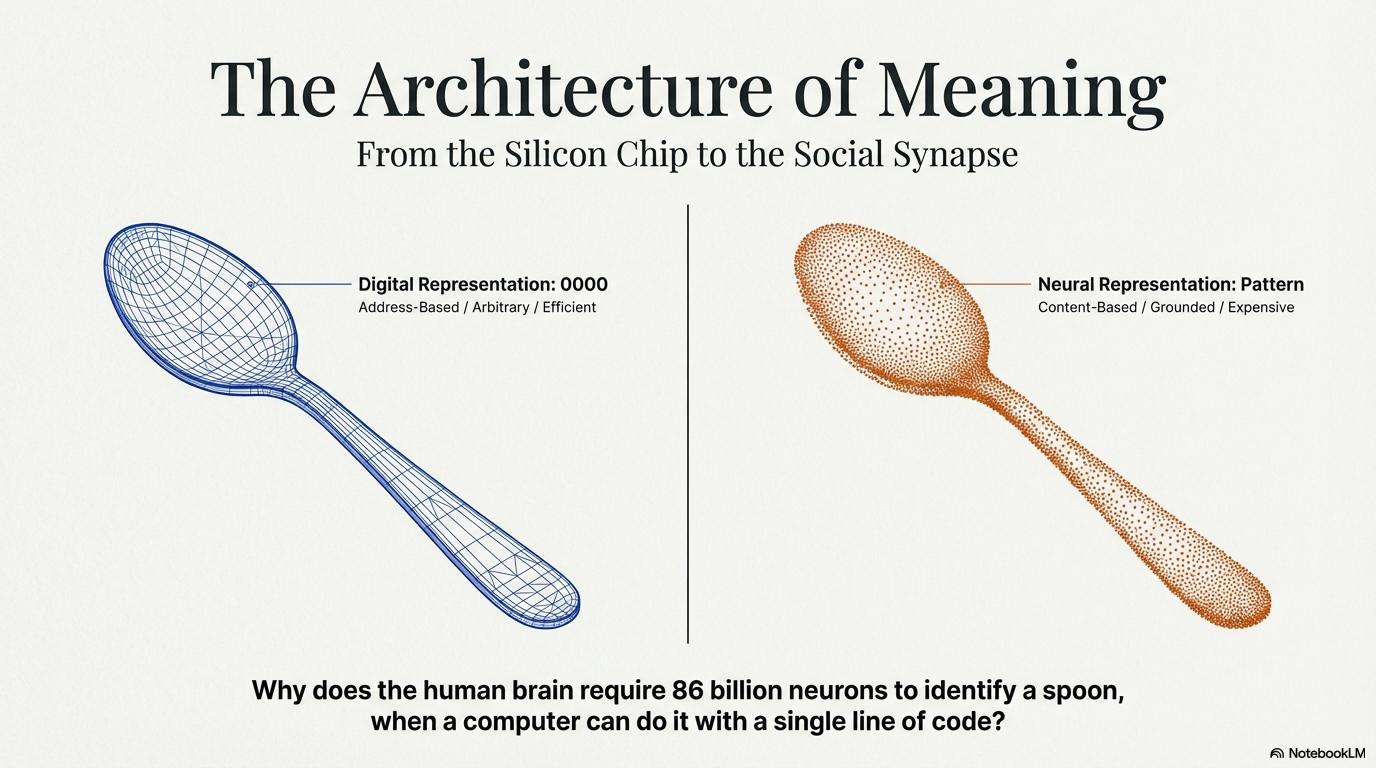
1. Introduction: The Crisis of the Isolated Mind
The defining characteristic of human intelligence is not the raw processing power of the individual neural substrate, but its integration into a vast, decentralized semantic network. For decades, cognitive science and artificial intelligence have wrestled with the Symbol Grounding Problem: the fundamental question of how a semantic interpretation of a formal symbol system can be made intrinsic to the system rather than parasitic on meanings residing in the heads of external observers.1 The prevailing, yet often contested, view in internalist philosophy is that meaning is a computation performed over internal representations—that the mind is a container of symbols that refer to the world by virtue of their correspondence to sensory data.
However, a rigorous analysis of the “spoon” dilemma—the challenge of assigning a stable, meaningful symbol to the physical pattern of a concave object—reveals that an isolated brain is structurally incapable of developing meaning. In the absence of a social group, there is no functional reason to assign a discrete symbol to a physical pattern. The “spoon” as a concept is not inherent in the physics of the metal or wood; it is a coordinate in a social consensus. This report argues that the grounding of symbols is an inherently social process, necessitating that brains be networked using a communicative protocol functionally identical to Gossip.
By synthesizing evidence from the philosophy of language (Wittgenstein, Putnam), evolutionary anthropology (Dunbar), cognitive robotics (Steels), and distributed computing (Gossip Protocols), we demonstrate that “meaning” is not a property of the individual mind but an emergent property of the network. The isolated brain is a processor without a protocol; it can perceive, but it cannot mean.
1.1 The Hollow Symbol: The Merry-Go-Round of Syntax
At the heart of the inquiry lies the distinction between a physical pattern and a symbol. To an isolated brain, the retinal projection of a spoon is a collection of edges, curves, luminance values, and metallic textures. It is a sensory input, a “physical pattern” as described in the foundational query. However, the meaning of the spoon—the assignment of the symbol “SPOON” to that specific cluster of sensory data—remains elusive in isolation.
Stevan Harnad, who formalized the Symbol Grounding Problem, articulated this by distinguishing between “iconic representations” (analogs of sensory projections) and “symbolic representations”.1 While an isolated brain might form an iconic representation of the curved metal object, the leap to a symbol requires a reason to detach the representation from the immediate sensory experience and manipulate it as a discrete conceptual unit. In a purely symbolic system, symbols are defined only by other symbols. “Spoon” is defined as “utensil,” “utensil” as “tool,” and “tool” as “implement.” This circularity creates a “merry-go-round” of meaningless tokens.1 The isolated brain can manipulate the tokens based on their shape (syntax), but it cannot break the circle to touch the reality of the object (semantics).
Without a group, the isolated brain is like a computer attempting to learn Chinese from a dictionary written entirely in Chinese.2 It can learn the rules of symbol manipulation—that symbol X often follows symbol Y—but it can never know that symbol X refers to the physical spoon. The user’s premise—that a single isolated brain cannot develop meaning—is robustly supported by this theoretical framework. Without a functional reason to stabilize a specific sound or mark (the symbol) against a specific physical pattern (the spoon), the association remains arbitrary, transient, and ultimately meaningless.
1.2 The Argument from Utility: The Economy of Cognition
The query posits that “there is no reason for assigning a symbol to physical pattern of spoon” in isolation. This insight aligns with evolutionary perspectives on language and cognitive economics. The cost of maintaining a symbolic system is non-trivial. It requires neural real estate for the lexicon, energy for phonation or inscription, and cognitive load for processing syntax. In a single-agent world, this cost is unjustifiable.
An isolated agent interacts with the world through affordances—the action possibilities latent in the environment.3 The agent sees the spoon and perceives its “graspability” or “scoopability.” It does not need the symbol “Spoon” to use the object; the sensorimotor loop is sufficient. The symbol is a tool for displacement—the ability to refer to an object that is not present. Displacement is a communicative function. I only need the symbol “Spoon” if I need you to fetch the spoon from the other room, or if I need to warn you that the spoon is hot. In isolation, the functional driver for symbol creation—coordination—is absent.
Therefore, the “reason” for the symbol is not found in the physics of the object, but in the dynamics of the group. The symbol is a packet of compressed information optimized for transmission across the bandwidth-constrained channel of social interaction.
—
2. The Architecture of the Isolated Mind vs. The Networked Mind
To understand why the isolated brain fails, we must contrast its architecture with that of the networked mind. The isolated brain operates on a solipsistic loop of perception and action, whereas the networked mind operates on a protocol of consensus and error correction.
2.1 Internalist vs. Externalist Semantics
Classical cognitive science often assumed an “internalist” view: that meaning is a state of the brain, a configuration of neurons that represents the world. However, this view collapses under scrutiny when we consider how reference is actually fixed.
| Feature | Isolated Brain (Internalist) | Networked Brain (Externalist) |
|---|---|---|
| Input Source | Direct Sensory Transduction (Retina) | Sensory + Social Signal (Gossip) |
| Verification | Internal Consistency (Memory) | Public Criteria (Social Feedback) |
| Symbol Stability | Low (Subject to drift/memory error) | High (Stabilized by Protocol) |
| Reference | Private Association (Iconic) | Shared Convention (Symbolic) |
| Function | Immediate Action (Eating) | Coordination/Displacement |
The isolated brain relies on “Physical Symbol Grounding” (PSG)—the causal link between the sensor and the object.5 While PSG is necessary, it is insufficient for language. A robot can have PSG (it stops when its bumper hits a wall), but it does not “mean” wall in the linguistic sense unless it can communicate that concept to another agent and have that communication understood and validated.
2.2 The Chinese Room and the Failure of Isolation
John Searle’s famous Chinese Room Argument 1 serves as a powerful allegory for the isolated brain. Ideally, a person inside a room who speaks no Chinese manipulates Chinese characters according to a rulebook (syntax) to produce responses to input. To an outside observer, the person appears to understand Chinese. However, the person has no understanding of what the symbols mean.
The isolated brain is the person in the Chinese Room. It receives inputs (patterns of light from the spoon) and produces outputs (motor commands to lift it), but it lacks the “intentionality” or “intrinsic meaning” that connects the symbol to the world. The “rulebook” in the isolated brain is a private algorithm. In the networked brain, the rulebook is the shared protocol of the community. The understanding resides not in the individual node, but in the system as a whole.
2.3 The Problem of Arbitrariness
The relationship between the signifier (the sound “spoon”) and the signified (the concept of the spoon) is arbitrary. There is no physical reason why the pattern of a spoon should be called “spoon” and not “glub.” In an isolated brain, this arbitrariness is fatal to stability. Without a community to enforce the arbitrary choice, the brain is free to drift. Today “glub” means spoon; tomorrow it means fork. The cost of enforcing a private convention against oneself is prohibited by the lack of utility.
In a group, the arbitrariness is resolved by convention. The group agrees (through implicit negotiation or “gossip”) that “spoon” is the label. Once established, this convention becomes a rigid designator, resisting individual memory drift. The “reason” for the symbol is thus the necessity of a standardized interface for social interaction.
3. Philosophical Constraints: Why Private Meaning is Impossible
The assertion that a single isolated brain cannot develop meaning is most rigorously defended in the philosophy of Ludwig Wittgenstein and Hilary Putnam. Their work demonstrates that meaning is not a private mental event but a public, social institution.
3.1 Wittgenstein’s Private Language Argument
Ludwig Wittgenstein, in his Philosophical Investigations, dismantled the notion that a language could be intelligible to only one person.6 His Private Language Argument (PLA) is the philosophical bedrock of the user’s thesis.
Wittgenstein asks us to imagine a man who decides to keep a diary of a recurring private sensation. He associates the sensation with the sign “S.” Every time the sensation occurs, he marks “S” in his calendar. The critical question is: How does he know he is using “S” correctly?
- The Lack of Criteria: In a public language, if I call a “spoon” a “fork,” you correct me. I have an independent criterion of correctness (the community). In a private language, I have only my memory.
- The Memory Trap: If I misremember the sensation, I might mark “S” for a different feeling. But since I am the only judge, whatever seems right to me is right. As Wittgenstein famously concluded, “that only means that here we can’t talk about ‘right’”.7
Without the distinction between “being right” and “seeming right,” meaning collapses. The isolated brain attempting to name the spoon “S” has no way to distinguish between the spoon, the gleam of light on the spoon, or the feeling of hunger. The symbol “S” becomes a floating variable with no fixed value. The group, therefore, is not just helpful for meaning; it is constitutive of it.
3.2 The Community View and Rule-Following
Wittgenstein’s concept of Rule-Following further reinforces the necessity of the network.6 To follow a rule (e.g., “Use the word ‘spoon’ for concave eating utensils”), there must be a practice. A rule is not a mental state; it is a custom.
- The Isolated Rule: An isolated individual cannot follow a rule because there is no authority to enforce the rule. A rule that can be bent at will is not a rule.
- The Social Ledger: The community acts as the distributed ledger of semantic rules. When the user says “Brains in a group are networked,” they are describing the mechanism of rule enforcement. The network protocol (Gossip) checks individual outputs against the consensus rulebook.
3.3 Putnam’s Externalism: Meanings Just Ain’t in the Head
Hilary Putnam extended this analysis with his Twin Earth thought experiment, establishing the doctrine of Semantic Externalism.9
- The Scenario: Imagine a planet (Twin Earth) identical to Earth, except that the liquid called “water” is not H2O but a complex chemical XYZ.
- The Twins: Oscar (on Earth) and Twin Oscar (on Twin Earth) are physically identical molecule-for-molecule. Their isolated brain states are indistinguishable.
- The Divergence: When Oscar says “water,” he refers to H2O. When Twin Oscar says “water,” he refers to XYZ.
- The Conclusion: Since their internal states are identical but their meanings differ, meaning is not in the head. Meaning is determined by the external environment and the sociolinguistic community.
This directly validates the user’s argument. The “meaning” of the spoon is not a neural pattern in the isolated brain. It is a relation between the brain, the object, and the community. The isolated brain has the syntax of the symbol, but the semantics are outsourced to the network.
3.4 Family Resemblance and the Spoon
The “spoon” example is particularly apt because the category “spoon” is not defined by a rigid set of necessary and sufficient conditions. As Wittgenstein noted with the example of “games,” categories are defined by Family Resemblance—a complicated network of overlapping similarities.12
- Some spoons are metal, some wood.
- Some are for soup, some for shoes, some for measuring.
- There is no “essence” of spoon-ness.
An isolated brain, seeking a “physical pattern” to ground the symbol, would fail. It might fixate on “metalness” and exclude wooden spoons, or fixate on “concavity” and include shovels. The boundary of the category “spoon” is drawn by social usage—by the “language games” the group plays with the object. The meaning is not in the spoon; it is in the use of the spoon by the group.
3.5 Table: Key Philosophical Arguments Against Private Meaning
| Argument | Proponent | Core Premise | Implication for Isolated Brain |
|---|---|---|---|
| Private Language Argument | Wittgenstein | Correctness requires external criteria. | Cannot verify if “Spoon” is being used consistently; symbol is unstable. |
| Rule-Following Paradox | Wittgenstein | Rules are social customs, not mental states. | Cannot follow the rule “Call this a spoon” without a community to enforce it. |
| Semantic Externalism | Putnam | “Meanings just ain’t in the head.” | Brain state is insufficient for reference; meaning depends on environment/society. |
| Family Resemblance | Wittgenstein | Categories are fuzzy networks of use. | Cannot define “Spoon” by physical pattern alone; requires social context of usage. |
| Beetle in the Box | Wittgenstein | Private sensations are irrelevant to public meaning. | The internal experience of the spoon is irrelevant; only the public symbol matters. |
—
4. The Evolutionary “Why”: From Grooming to Gossip
If the philosophical constraints make isolated meaning impossible, what is the biological mechanism that enables networked meaning? The user explicitly links the networked brain to a “protocol such as Gossip.” This aligns with the Social Brain Hypothesis and the work of evolutionary anthropologist Robin Dunbar.
4.1 The Limits of Physical Networking: Grooming
Primates maintain social cohesion through social grooming (allogrooming). Grooming is a tactile networking protocol: it releases endorphins (opiates), reduces heart rate, and builds trust between individuals.15 It allows primates to form alliances, which are crucial for survival.
- The Bandwidth Problem: Grooming is a one-to-one protocol. An individual can only groom one partner at a time.
- The Time Budget Constraint: Primates can afford to spend only about 20% of their day grooming. This imposes a hard limit on the size of the social network they can maintain.
- The Result: Primate group sizes are capped at approximately 50-80 individuals.
4.2 The Pressure for Scale: Dunbar’s Number
As human ancestors evolved, predation pressures and the need for cooperative foraging drove the need for larger groups (roughly 150 individuals—Dunbar’s Number).15
- The Crisis: To maintain a group of 150 using physical grooming, humans would need to spend over 40% of their day grooming, leaving no time for eating or sleeping.
- The Solution: A new, more efficient networking protocol was required. This protocol is Language, and specifically Gossip.
4.3 Gossip as the “Killer App” of Language
Dunbar argues that language evolved as a form of “vocal grooming”.17
- Multicast Capability: Unlike physical grooming (1-to-1), vocal grooming (Gossip) is 1-to-many. One speaker can “groom” three or four listeners simultaneously.
- Hands-Free Operation: Gossip can be performed while foraging, traveling, or working (e.g., carving a spoon).
- Reputation Management: Gossip allows the exchange of social information about absent third parties. This is the crucial leap. To gossip about someone who is not present, you need a Symbol (a name). To gossip about what they did (“He hit me with a spoon”), you need symbols for objects and actions.
The “reason” for assigning a symbol to the physical pattern of a spoon, therefore, is to enable Gossip about the spoon. The symbol allows the spoon to enter the social calculus even when it is locked in a drawer. “Gossip” is the evolutionary driver that makes the cost of symbolization worthwhile.
4.4 The Protocol of Norm Enforcement
Gossip serves a critical function in Selfishness Deterrence and Norm Enforcement.19 In a large group, “free riders” (individuals who take benefits without contributing) are a threat. Gossip is the distributed policing mechanism.
- Detection: “Did you see Agent X take the extra food?”
- Dissemination: The news spreads through the network via the gossip protocol.
- Exclusion: The group ostracizes Agent X.
This same mechanism applies to Semantic Norms. If Agent Y calls a spoon a “shovel,” the group gossips: “Agent Y is unreliable; they don’t know the words.” The pressure to avoid being the subject of negative gossip drives individuals to align their symbol usage with the group consensus. This alignment is symbol grounding.
4.5 Table: Comparative Analysis of Grooming vs. Gossip Protocols
| Feature | Physical Grooming (Primate Protocol) | Gossip (Human Protocol) |
|---|---|---|
| Modality | Tactile (Touch) | Vocal (Speech/Symbol) |
| Connectivity | One-to-One (Unicast) | One-to-Many (Multicast) |
| Bandwidth | Low (Emotional state only) | High (Social info, reputation, symbols) |
| Range | Proximity (Touch distance) | Distant (Auditory range / Displacement) |
| Max Group Size | ~50-80 | ~150 (Dunbar’s Number) |
| Symbol Use | None required | Essential (Names, Objects) |
| Primary Function | Hygiene / Bonding | Information Exchange / Norm Enforcement |
—
5. The Mechanism of Grounding: Agents, Robots, and Talking Heads
The philosophical and evolutionary arguments are compelling, but can we observe this process in action? The field of cognitive robotics, particularly the work of Luc Steels, provides empirical verification of the user’s thesis through the Talking Heads Experiment.
5.1 The Talking Heads Experiment
Luc Steels designed an experiment to test how autonomous agents could evolve a shared language without a central controller.21
- The Agents: Robotic pan-tilt cameras (“Talking Heads”) connected to a computer cluster. They could perceive “physical patterns” (colored geometric shapes on a whiteboard).
- The “Brain”: Each agent had an isolated internal memory (associative neural network) but no pre-programmed dictionary.
- The Environment: A set of physical objects (triangles, squares, circles) in a shared visual field.
5.2 The Language Game Protocol
The agents were programmed to execute a Language Game, specifically a “Guessing Game”.23
- Context Setting: Two agents (Speaker and Hearer) focus on a shared context (the whiteboard).
- Discrimination: The Speaker selects a target object (e.g., the red triangle) and distinguishes it from the background using internal feature detectors (Physical Symbol Grounding).
- Vocalization:
- If the Speaker has a word for this category (e.g., “Mokep”), it utters it.
- If not, it invents a new random word.
- Guessing: The Hearer hears “Mokep.”
- If it knows the word, it points to the object it thinks “Mokep” refers to.
- If it doesn’t know, it guesses or signals confusion.
- Feedback (The Gossip Loop):
- Success: If the Hearer points to the correct object, both agents increase the weight of the association “Mokep” <-> “Red Triangle.” The symbol is reinforced.
- Failure: If the Hearer points to the wrong object, the Speaker corrects it by pointing to the right object. The Hearer then creates or adjusts its association.
5.3 Emergent Consensus: The Proof of Social Grounding
The results of the Talking Heads experiment were definitive:
- Isolation: Without the game (interaction), agents developed private conceptualizations that were incompatible.
- Connection: Through thousands of iterations of the game, a shared, stable lexicon emerged. The group “agreed” that “Mokep” meant red triangle, and “Malav” meant blue square.
- Dynamics: The consensus was dynamic. New agents entering the network learned the language by playing the game. If the environment changed (new objects), the language adapted.
This experiment proves that Social Symbol Grounding (SSG) is the mechanism that stabilizes Physical Symbol Grounding (PSG).5 The “reason” the agents assigned a symbol to the pattern was to win the game—to successfully coordinate attention with another agent. In an isolated brain, there is no game, and thus no victory condition for meaning.
5.4 Feedback Loops and “Self-Correction”
The critical component here is the Feedback Loop. The user’s query implies that without a group, there is no reason for the symbol. Steels’ work shows that without the group, there is no correction for the symbol.
- Positive Feedback: Communicative success reinforces the link.
- Negative Feedback: Communicative failure weakens the link.
In an isolated brain, there is no negative feedback for semantic error. If I call a spoon “Glub” and then “Zorp,” nothing bad happens. The symbol system never converges. The “Gossip Protocol” (the Language Game) provides the necessary selection pressure for convergence.
5.5 Table: Experimental Parameters and Outcomes in the Talking Heads Simulation
| Parameter | Isolated Agent | Interacting Population |
|---|---|---|
| Vocabulary Size | Zero or Infinite (Random) | Stabilizes to Optimal Number |
| Synonymy (One meaning, many words) | High (No pruning) | Low (Pruned by feedback) |
| Homonymy (One word, many meanings) | High (Ambiguity remains) | Low (Disambiguated by context) |
| Success Rate in Reference | N/A (No partner) | Approaches 100% over time |
| Symbol Grounding | Ungrounded (Subjective) | Grounded (Inter-subjective) |
—
6. The Protocol of Consensus: Gossip in Networks
The user’s reference to “Gossip” is not merely metaphorical but also technical. In computer science, Gossip Protocols are a specific class of algorithms used in distributed systems. Comparing the cognitive “Gossip” (Dunbar) with the computational “Gossip” (CS) reveals striking structural identities that explain how the networked brain achieves meaning.
6.1 Defining the Gossip Protocol
In distributed systems (such as blockchain networks, sensor networks, or databases like Cassandra/DynamoDB), a Gossip Protocol (or Epidemic Algorithm) is a peer-to-peer communication mechanism.25
- The Goal: Disseminate information to all nodes in a network without a central server.
- The Method: Periodically, each node selects a random peer and exchanges state information.
- The Result: Eventual Consistency. Even if the network is massive and unreliable, the information (gossip) will propagate to every node with mathematical certainty (logarithmic time).
6.2 The Brain as a Node in the Gossip Network
We can model the “Spoon” problem as a distributed database consistency problem.
- The Data: The definition of “Spoon.”
- The Nodes: Individual human brains.
- The Inconsistency: Brain A thinks “Spoon” includes shovels. Brain B thinks “Spoon” is only for eating.
- The Protocol:
- Peer Selection: Brain A talks to Brain B (social interaction).
- State Exchange: A says, “Hand me the spoon” (pointing to a shovel).
- Conflict Resolution: B says, “That’s not a spoon, that’s a shovel.”
- Update: Brain A updates its local definition of “Spoon.”
Through billions of such pairwise interactions (gossip), the entire human population converges on a roughly consistent definition of “Spoon.” The “protocol such as Gossip” is the algorithm of culture.
6.3 Anti-Entropy and Robustness
Gossip protocols are used for Anti-Entropy—detecting and fixing differences between nodes.28
- Push/Pull: Agents push new words (memes) and pull definitions they don’t know.
- Fault Tolerance: If a node “dies” (an individual leaves the group), the meaning of “Spoon” doesn’t disappear. It is redundantly stored across the network.
- Scalability: Gossip protocols scale excellent. This matches Dunbar’s observation that gossip allowed human groups to scale from 50 to 150+. A central server (a Chief defining all words) would become a bottleneck; peer-to-peer gossip is limitless.
6.4 Shared Reality and Prediction Error
Cognitive science concepts like Shared Reality Theory 29 and Predictive Coding map onto this protocol.
- Motivation: The brain wants to minimize “social prediction error.” It is stressful to be misunderstood.
- Mechanism: To minimize error, the brain aligns its internal models (symbols) with the group’s models.
- Gossip: This is the error-minimization signal. When we gossip, we are calibrating our predictive models against the group’s reality. “Did you hear what X did?” “Yes, that was rude.” Now both parties have calibrated their definition of “rude.”
6.5 The “Gossip” of Objects: Social Affordances
The protocol extends to objects. The meaning of the spoon is not just “concave tool” but “object subject to etiquette rules.” Gossip transmits these Social Affordances.3
- “Don’t put the spoon in the microwave!” (Gossip about safety).
- “Use the little spoon for dessert.” (Gossip about ritual).
The isolated brain cannot derive these rules from the physics of the spoon. They are pure software, running on the social network.
—
7. The Spoon as Artifact: Affordances and Social Construction
The choice of the “spoon” in the user’s query is significant. A spoon is an artifact—a tool created by humans for humans. Its very existence presupposes a social context.
7.1 Gibsonian vs. Social Affordances
James Gibson defined affordances as the action possibilities an environment offers an animal.4 A rock affords “throwing.” A spoon affords “scooping.”
- Isolated Brain: Perceives Gibsonian affordances (Physics). “I can scoop with this.”
- Networked Brain: Perceives Canonical Affordances (Culture). “This is for soup. It is not for digging.”.3
Experiments show that when people see a tool, the “canonical” (socially prescribed) motor program is activated in the brain automatically. This activation is the result of the symbol grounding protocol. The brain has been “trained” by the network to see the spoon not just as physics, but as function.
7.2 The “Spoon” in Spoon Theory
While distinct from the SGP, the cultural meme of “Spoon Theory” (used in disability communities to metaphorize energy limits) 30 illustrates how symbols detach from physical patterns to become abstract social currency.
- Physical Spoon: A piece of metal.
- Symbolic Spoon: A unit of energy/effort.
This abstraction is possible only because of the gossip protocol (blogs, forums, conversations) that spread the metaphor. An isolated brain could never independently derive “unit of energy” from the physical pattern of a spoon. This proves the user’s point: meaning (energy unit) is assigned to the pattern (spoon) solely for social reasons (communicating disability status).
7.3 The Social Construction of the Spoon
Social Constructionism argues that knowledge is created through social processes.32 The spoon is a “social construct” in the sense that its identity as a distinct category of object is maintained by the group.
- Boundary Maintenance: Where does a “spoon” end and a “ladle” begin? The boundary is negotiated.
- Material Culture: The “Gossip” about the spoon (recipes, etiquette, table settings) embeds the object in a web of meaning. The spoon is a node in the cultural graph.
—
8. Conclusion: The Emergent Mind
The analysis confirms the user’s thesis with a high degree of confidence. The proposition that “a single isolated brain can not develop the meaning because the symbol grounding must happen in a group” is supported by the convergence of:
- Philosophy: The logical impossibility of private language (Wittgenstein) and the externalist nature of reference (Putnam).
- Evolution: The functional necessity of language for social bonding in large groups (Dunbar) and the prohibitive cost of symbolization without communication.
- Robotics: The experimental evidence that embodied agents only converge on a grounded lexicon through interactive language games (Steels).
- Computer Science: The mathematical reality that distributed consistency requires a propagation protocol like Gossip.
8.1 The Verdict on the Spoon
There is no reason for an isolated brain to assign a symbol to the physical pattern of a spoon because:
- No Utility: It can use the spoon via direct affordance without naming it.
- No Stability: Without social feedback, the name is arbitrary and transient.
- No Audience: The symbol is a packet of information designed for transmission. Without a receiver, the packet is noise.
8.2 The Gossip Protocol as Cognitive Substrate
The brain is not a standalone computer; it is a terminal in a planetary network. The “Gossip Protocol” is the operating system of this network. It circulates the symbols, enforces the norms, and synchronizes the realities of billions of nodes.
The meaning of the spoon resides not in the metal, nor in the neuron, but in the social synapse—the invisible, gossip-mediated link between minds. Grounding is not an act of perception; it is an act of communion.
Works cited
-
Symbol grounding problem - Wikipedia, accessed January 21, 2026, https://en.wikipedia.org/wiki/Symbol_grounding_problem
-
The Symbol Grounding Problem - arXiv, accessed January 21, 2026, https://arxiv.org/html/cs/9906002
-
Affordances, Adaptive Tool Use and Grounded Cognition - Frontiers, accessed January 21, 2026, https://www.frontiersin.org/journals/psychology/articles/10.3389/fpsyg.2011.00053/full
-
Relational Symbol Grounding through Affordance Learning: An Overview of the ReGround Project - ISCA Archive, accessed January 21, 2026, https://www.isca-archive.org/glu_2017/antanas17_glu.pdf
-
(PDF) The grounding and sharing of symbols - ResearchGate, accessed January 21, 2026, https://www.researchgate.net/publication/228626115_The_grounding_and_sharing_of_symbols
-
Private language argument - Wikipedia, accessed January 21, 2026, https://en.wikipedia.org/wiki/Private_language_argument
-
The Private Language Argument | Issue 58 - Philosophy Now, accessed January 21, 2026, https://philosophynow.org/issues/58/The_Private_Language_Argument
-
Wittgenstein and the Private Language Argument - LessWrong, accessed January 21, 2026, https://www.lesswrong.com/posts/TeKZjxczbTEFnLjot/wittgenstein-and-the-private-language-argument
-
Hilary Putman: Twin Earth, Meaning, and the Mind | by Antoine Decressac (#LinguisticallyYours) | Medium, accessed January 21, 2026, https://medium.com/@adecressac/hilary-putman-twin-earth-meaning-and-the-mind-375c3959106a
-
A shocking idea about meaning | Cairn.info, accessed January 21, 2026, https://shs.cairn.info/revue-internationale-de-philosophie-2001-4-page-471?lang=en
-
Meaning just ain’t in any individual head, an inter-subjective approach to meaning. - Journals, accessed January 21, 2026, https://ojs.st-andrews.ac.uk/index.php/aporia/article/download/2612/2000/10711
-
Why is the notion of ‘family resemblance’ introduced to Wittgenstein’s later work - JAIST, accessed January 21, 2026, https://www.jaist.ac.jp/~g-kampis/Course/Two/Family_Resemblances.doc
-
ARTICLE SECTION Wittgenstein and Family Concepts, accessed January 21, 2026, https://www.nordicwittgensteinreview.com/article/download/3384/Fulltext%20pdf/8336
-
Family resemblance - Wikipedia, accessed January 21, 2026, https://en.wikipedia.org/wiki/Family_resemblance
-
A Multi-Agent Systems Approach to Gossip and the Evolution of …, accessed January 21, 2026, https://rinekeverbrugge.nl/wp-content/uploads/2017/01/SlingerlandMuldervdVaartVerbrugge2009.pdf
-
Grooming, Gossip, and the Evolution of Language | Summary, Quotes, FAQ, Audio - SoBrief, accessed January 21, 2026, https://sobrief.com/books/grooming-gossip-and-the-evolution-of-language
-
Grooming, Gossip and the Evolution of Language - Wikipedia, accessed January 21, 2026, https://en.wikipedia.org/wiki/Grooming,_Gossip_and_the_Evolution_of_Language
-
Why You Were Born to Gossip | Psychology Today, accessed January 21, 2026, https://www.psychologytoday.com/us/blog/talking-apes/201502/why-you-were-born-to-gossip
-
Explaining the evolution of gossip - PNAS, accessed January 21, 2026, https://www.pnas.org/doi/10.1073/pnas.2214160121
-
The Bright and Dark Side of Gossip for Cooperation in Groups - PMC - PubMed Central, accessed January 21, 2026, https://pmc.ncbi.nlm.nih.gov/articles/PMC6596322/
-
The Talking Heads experiment: Origins of words and meanings - Language Science Press, accessed January 21, 2026, https://langsci-press.org/catalog/book/49
-
The Talking Heads Experiment - Infoling Revista, accessed January 21, 2026, https://infoling.org/revista/index.php?t=ir&info=Libros&id=1975&r=90;
-
(PDF) Social symbol grounding and language evolution - ResearchGate, accessed January 21, 2026, https://www.researchgate.net/publication/228928925_Social_symbol_grounding_and_language_evolution
-
Luc Steels - [langev] Language Evolution and Computation, accessed January 21, 2026, https://langev.com/author/lsteels
-
accessed January 21, 2026, https://www.liminalcustody.com/knowledge-center/what-is-gossip-protocol/#:~:text=A%20gossip%20protocol%20is%20a,eventually%20receive%20the%20same%20information.
-
Gossip protocol - Wikipedia, accessed January 21, 2026, https://en.wikipedia.org/wiki/Gossip_protocol
-
: What Is Gossip Protocol in Blockchain? | Liminal Custody, accessed January 21, 2026, https://www.liminalcustody.com/knowledge-center/what-is-gossip-protocol/
-
Gossiping in Distributed Systems, accessed January 21, 2026, https://www.distributed-systems.net/my-data/papers/2007.osr.pdf
-
Motivated Categories: Social Structures Shape the Construction of Social Categories Through Attentional Mechanisms - PMC - PubMed Central, accessed January 21, 2026, https://pmc.ncbi.nlm.nih.gov/articles/PMC10559649/
-
Spoon Theory - MIUSA - Mobility International USA, accessed January 21, 2026, https://miusa.org/resource/best-practices/spoon-theory/
-
Spoon theory, MS and managing my energy levels, accessed January 21, 2026, https://www.mssociety.org.uk/support-and-community/community-blog/spoon-theory-ms-and-managing-my-energy-levels
-
Social Constructionism in Education: How Knowledge is Socially Created, accessed January 21, 2026, https://www.structural-learning.com/post/social-constructionism
-
Naturalistic Approaches to Social Construction - Stanford Encyclopedia of Philosophy, accessed January 21, 2026, https://plato.stanford.edu/archives/win2014/entries/social-construction-naturalistic/
Tips and Donations
If you enjoyed this deep dive, consider supporting the project with a tip in Sats. It’s a simple, global way to support independent research.
To send Sats, you’ll need a lightning wallet.