The Standard Model of Decay
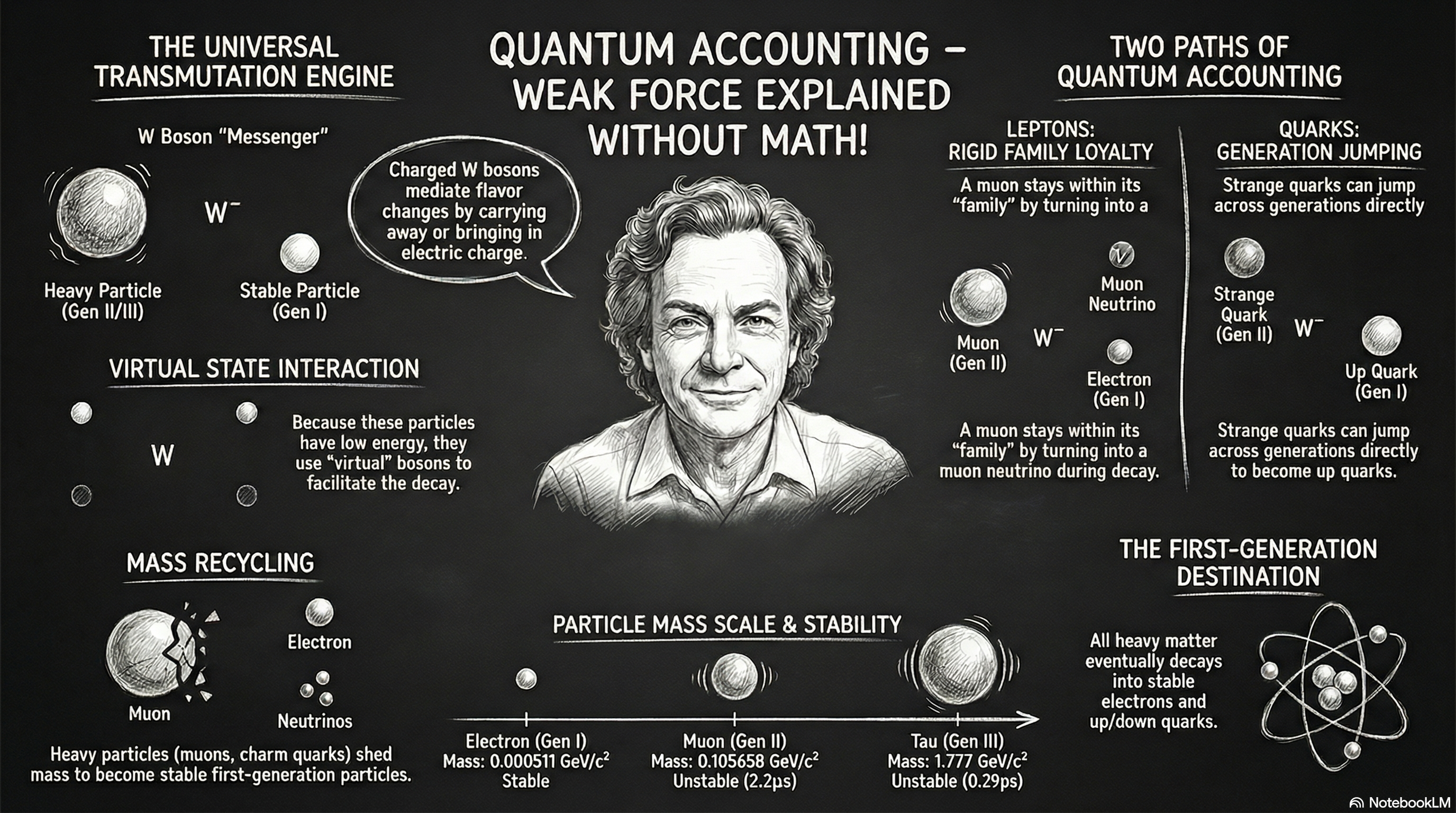
The Standard Model of particle physics represents the most robust theoretical architecture for describing the fundamental constituents of matter and the forces that govern their interactions, excluding only the gravitational force.1 Central to this framework is the organization of matter into three distinct generations of fermions, which include both quarks and leptons.1 The query regarding the decay patterns of the muon ( This report provides an exhaustive investigation into these processes, confirming they are indeed mediated by the weak force while elucidating the nuanced differences in their underlying quantum mechanical structures, particularly the role of the
The Architectural Foundation of Fermion Generations
The Standard Model classifies the twelve fundamental matter particles into two broad categories: quarks and leptons.1 These are further subdivided into three generations, where each generation acts as a heavier replica of the preceding one.7 The first generation, comprising the up and down quarks along with the electron and electron neutrino, is stable and constitutes the bulk of ordinary baryonic matter.1 The second and third generations are characterized by significantly higher masses and shorter lifetimes, as they eventually decay into first-generation particles through weak interactions.1
Classification and Mass Hierarchy of Fundamental Fermions
| Particle Category | Generation I | Generation II | Generation III | Primary Interaction Charge |
|---|---|---|---|---|
| Up-type Quarks | Up (![image6]) | Charm (![image4]) | Top (![image9]) | Color, Electric, Weak |
| Down-type Quarks | Down (![image7]) | Strange (![image5]) | Bottom (![image10]) | Color, Electric, Weak |
| Charged Leptons | Electron (![image11]) | Muon (![image12]) | Tau (![image13]) | Electric, Weak |
| Neutral Leptons | Electron Neutrino (![image14]) | Muon Neutrino (![image15]) | Tau Neutrino (![image16]) | Weak |
The mass hierarchy within these generations is provided by their varying interaction strengths with the Higgs field.1 Without the Higgs mechanism, these particles would remain massless and the generational distinctions would effectively disappear.9 The observed masses span several orders of magnitude, a phenomenon referred to as the “flavor puzzle”.9
Comparative Mass Scales in GeV
| Particle | Mass (GeV/c2) | Generation | Stability Context |
|---|---|---|---|
| Electron (![image11]) | ![image17] | 1 | Stable |
| Muon (![image12]) | ![image18] | 2 | Unstable (![image19]) |
| Tau (![image13]) | ![image20] | 3 | Unstable (![image21]) |
| Up Quark (![image6]) | ![image22] | 1 | Stable in Hadrons |
| Charm Quark (![image4]) | ![image23] | 2 | Unstable |
| Strange Quark (![image5]) | ![image22] | 2 | Unstable |
The transitions between these states—specifically the decay of heavy generations into lighter ones—are the primary evidence for the weak interaction’s role in changing particle flavor.3 While the electromagnetic and strong forces conserve flavor, the weak force is the only interaction capable of transforming a charm quark into a strange or down quark, or a muon into an electron.4
The Mechanics of Weak Force Mediation
The weak force is mediated by three heavy vector bosons: the
The Role of the ![image27] Boson and the Virtual State
In many low-energy decays, such as that of the muon or the strange quark, the energy available is far below the mass of a real Consequently, the interaction proceeds through a “virtual” According to the Heisenberg uncertainty principle, these massive force carriers can exist for an extremely short period, facilitating the flavor change before decaying into lighter particles to satisfy energy conservation.11
For example, in the beta-minus decay of a neutron, a down quark transitions into an up quark by emitting a virtual
Conservation Laws in Weak Transitions
Despite the flavor-changing nature of the weak force, several rigorous conservation laws must be obeyed.13
- Electric Charge: The total charge before and after the vertex must be conserved. A muon (charge
- Baryon Number: Quarks carry a baryon number of
- Lepton Number: Each generation has its own lepton number (
- **Weak Isospin (
Leptonic Decay Dynamics: Muon and Tau
Leptons are elementary particles that do not feel the strong force.1 Their decays are the most direct way to study the weak interaction because they are free from the complexities of color charge and gluon exchanges.14
Muon Decay: The Standard Candle
The muon ( The process is:
![image39]
This decay is a three-body process.14 The presence of three particles in the final state is a direct consequence of the conservation of energy and momentum, and more importantly, the conservation of individual lepton family numbers.16 The muon disappears and is replaced by its neutrino counterpart to preserve the “muon-ness” of the system, while the
Tau Decay: A Multi-Channel Landscape
The tau (
| Tau Decay Mode | Branching Fraction | Key Final State Particles |
|---|---|---|
| Electronic | ![image40] | ![image41] |
| Muonic | ![image42] | ![image43] |
| Hadronic | ![image44] | ![image45] |
The “electronic” mode of the tau is fundamentally identical in “way” to the muon decay.22 A tau transitions to a tau neutrino via a Thus, yes, the tau can decay into an electron in the exact same manner as the muon, though it has other options due to its greater mass.21
Quark Transitions: Charm and Strange Dynamics
Quark decays follow a similar Quarks cannot exist in isolation; they must be part of hadrons.1 Therefore, when we speak of a “strange quark decay,” we are actually observing the decay of a hadron like a Kaon (
The CKM Matrix and Flavor Mixing
Unlike leptons, where the transitions are primarily within the same generation (in the absence of neutrino oscillations), quarks readily mix across generations.6 The strength and probability of these transitions are quantified by the Cabibbo-Kobayashi-Maskawa (CKM) matrix.6
CKM Magnitude Values (Approximate)
| Down (d) | Strange (s) | Bottom (b) | |
|---|---|---|---|
| Up (![image6]) | ![image48] | ![image49] | ![image50] |
| Charm (![image4]) | ![image49] | ![image51] | ![image52] |
| Top (![image9]) | ![image53] | ![image54] | ![image55] |
Charm to Strange: The Favored Path
The charm quark ( This is known as a “Cabibbo-favored” transition.12 The process:
![image58]
This transition is conceptually parallel to the muon decaying into its neutrino, as it stays within its generation’s weak doublet.12
Strange to Up: The Suppressed Necessity
The strange quark (
Comparative Analysis: “Is it the Same Way?”
The user’s intuition that these decays are “the same way” is profoundly accurate in some respects and nuanced in others.
Shared Mechanisms (The “Yes” Factors)
- Weak Interaction: All four particles (muon, tau, charm, strange) are unstable only because of the weak force.2
- Charge-Changing Current: Each decay involves a change in electric charge mediated by a
- Generational Descent: In all cases, a heavier particle from the second or third generation decays into a lighter particle from a lower generation to minimize energy.8
- Vertex Structure: The Feynman diagrams for these processes look nearly identical at the fundamental level: a fermion line emits a
Structural Differences (The “Nuance” Factors)
While the force is the same, the “identity” of the transition differs:
- Leptons stay in the Family: A muon becomes a muon neutrino. It does not become an electron directly.14 The electron you see comes from the
- Quarks jump Generations: A strange quark becomes an up quark directly. It does not become a strange neutrino (which doesn’t exist).6
- Color vs. No Color: Quarks must always produce a final state that is color-neutral, meaning the strange-to-up transition always involves other quarks forming a meson or baryon.1 Leptons are solitary and do not have this constraint.1
Detailed Theoretical Implications
The existence of these three generations and their specific decay patterns provides critical insights into the Standard Model’s Lagrangian.1 The weak interaction is “chiral,” meaning it only couples to left-handed fermions.9 This parity violation was first observed in the beta decay of nuclei and is a hallmark of the
The Universality of the Weak Charge
One of the most powerful discoveries in particle physics is that the “weak charge” (the coupling constant This is known as “Weak Universality”.6 Whether it is a muon decaying or a charm quark transitioning, the fundamental strength of the The only reason some decays seem slower or less likely is due to the “mismatch” in the mixing matrices (CKM for quarks) or the phase space available due to mass differences.6
Hierarchy of Decay Likelihoods
| Decay Process | Classification | Governing Parameter | Observation |
|---|---|---|---|
| **Muon | |||
| **Charm | |||
| **Strange | |||
| **Tau |
The
Experimental Verification and Modern Challenges
The decay of these particles has been tested to incredible precision. The muon lifetime, for example, is used to determine the Fermi constant (
The Muon G-2 and Lepton Universality
In recent years, experiments at Fermilab and the LHC have looked at whether muons and electrons really are “identical” in their weak interactions as predicted.31 This principle, called Lepton Flavor Universality, suggests that the Experimental anomalies in the decay of This suggests that there might be unknown “new physics” particles that interact differently with the various generations.31
The Role of Neutrinos
A critical part of the user’s diagram is the neutrino. Every charged-current decay involving a charged lepton must involve a neutrino to conserve lepton number.16 For quarks, the neutrino usually appears when the emitted This implies that “lepton flavor” is not perfectly conserved over long distances, adding another layer of complexity to the generational structure.18
Conclusion
The analysis of the generational structure of the Standard Model confirms that the decays of the muon and tau into electrons, and the transitions of charm and strange quarks into up and down quarks, are indeed analogous processes governed by the weak force.4 They are “the same way” in that they all rely on the exchange of a virtual However, the “way” is distinguished by the specific quantum rules of each sector. Leptons follow a rigid path within their family doublets, where the flavor change is masked by the production of neutrinos.12 Quarks, conversely, exhibit explicit flavor mixing through the CKM matrix, allowing them to transition directly across generations—though often with a “penalty” in probability for jumping family lines.6
Ultimately, these decays are the universe’s mechanism for recycling heavy, high-energy matter into the stable, low-energy particles that form our world.1 The weak force acts as the universal “transmutation engine,” ensuring that regardless of whether a particle is a quark or a lepton, it will eventually find its way back to the first generation, provided there is a lighter state available to occupy.2 This shared reliance on the
Tips and Donations
If you enjoyed this deep dive, consider supporting the project with a tip in Sats. It’s a simple, global way to support independent research.
To send Sats, you’ll need a lightning wallet.