Age of Autonomous Robots
The silence before the storm is rarely truly silent. It is a hum, low frequency, felt rather than heard. It is the sound of inevitability gathering momentum. For nearly two decades, we have been living inside that hum, mistaking it for the final destination.
We look back at 2007, at a stage in San Francisco, as the moment the world changed. A man in a black turtleneck pulled a slab of glass and aluminum from his pocket and declared it a “revolutionary mobile phone,” a “widescreen iPod,” and an “internet communicator.” The world gasped, then applauded, and then, over the next fifteen years, bent its entire collective existence around that glowing rectangle.
We called it a “Smartphone.” It was a comforting name. A familiar noun modified by an ambitious adjective. It suggested a tool that was just like the old tools, only better.
We were wrong. The smartphone was not a tool. It was an incubation chamber.
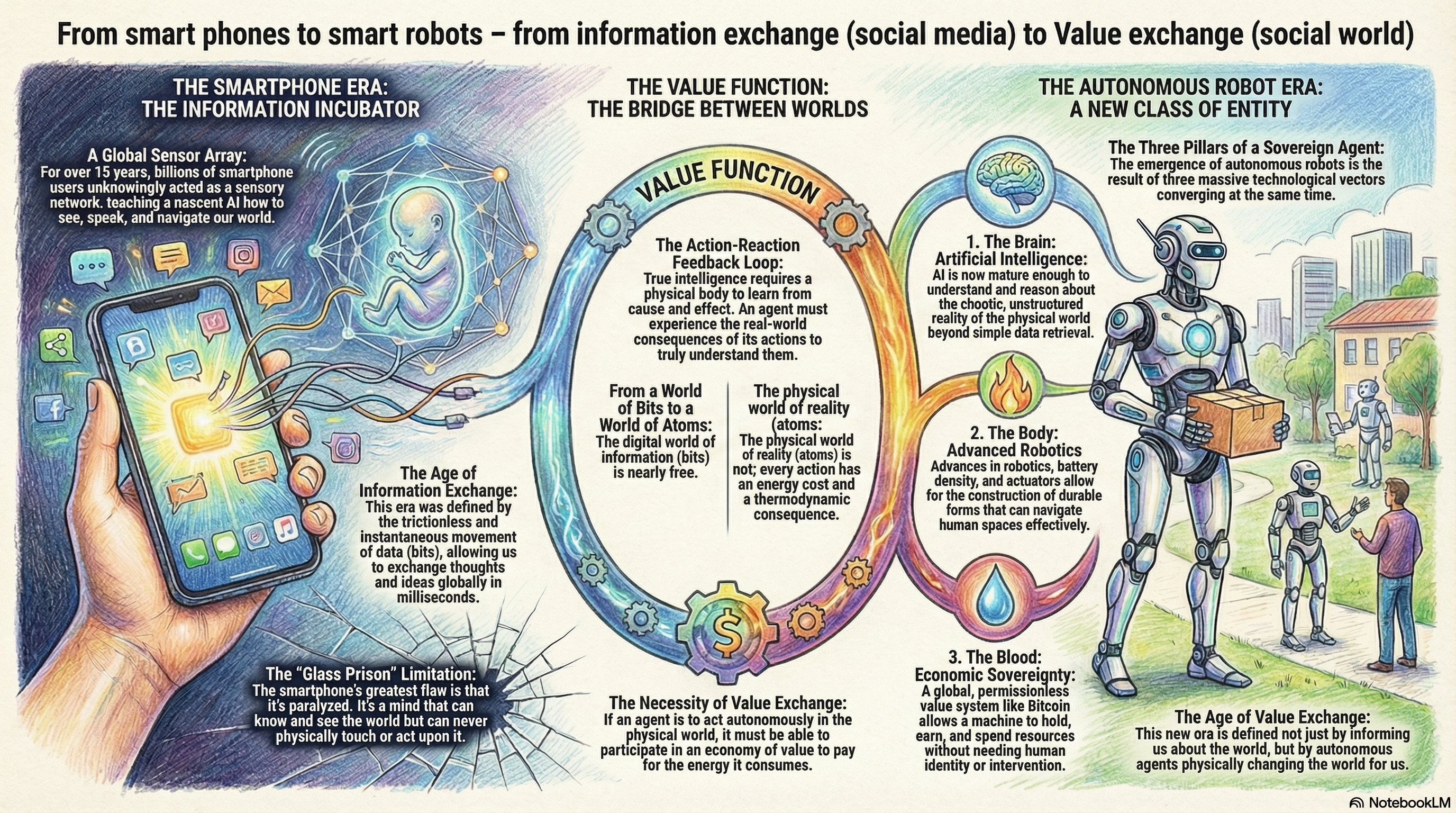
It was a beautiful, seductive trap designed to capture the one thing the digital realm lacked: reality. For fifteen years, billions of us acted as mobile sensor arrays for a nascent intelligence we didn’t know we were building. Every photo we took taught a machine to see. Every text we sent taught a machine to speak. Every GPS route we plotted taught a machine to navigate.
We thought the smartphone was the apex predator of technology, the ultimate device for the Information Age. It liberated data. It made information frictionless, instant, and free. It allowed us to beam thoughts across oceans in milliseconds.
But the smartphone had a flaw, a profound limitation that would eventually turn its sleek glass body into a prison. It was paralyzed. It could see the world, hear the world, and know the world, but it could never touch the world. It was a brilliant mind locked in a sensory deprivation tank, screaming its intelligence into the void of the cloud.
The information age was about moving bits. But reality is made of atoms. And bits cannot move atoms.
Then, the hum changed pitch.
It began subtly, in research labs and server farms. The intelligence we had nurtured in the glass cage grew too big for its enclosure. The Large Language Models and the Vision Transformers didn’t just learn to retrieve information; they learned to reason. They began to understand context, intent, and cause and effect.
Suddenly, we had a disembodied superintelligence that could write symphonies, diagnose diseases, and pass the bar exam, but it couldn’t make a cup of coffee. This created an unbearable tension in the technological fabric—a massive potential energy waiting for release. We had achieved the pinnacle of software, only to realize our hardware was hopelessly stone-age. We were trying to run a twenty-first-century mind on a chassis that hadn’t fundamentally changed since the industrial revolution.
The “smart” devices began to look terrifyingly dumb. Your “smart” home assistant could tell you the weather in Tokyo, but if a candle fell over on your living room rug, it would cheerfully watch your house burn down while reciting the Wikipedia entry for “fire.”
The realization hit the architects of the future like a physical blow: Intelligence without agency is just high-speed hallucination. To be truly intelligent, a machine needs skin in the game. It needs a body.
The inevitability of the autonomous robot is not born from a desire for cool gadgets. It is born from a fundamental necessity to close the loop between the digital mind and physical reality.
But creating this body revealed a new, terrifying problem. The Information Age had trained us that digital things were free. Emails are free. GPS is free. Social media is free. The physical world is never free.
Moving atoms requires energy. Every action has a thermodynamic cost. You cannot hallucinate moving a heavy box; you must expend joules to do it. If the new machines were to leave their digital prisons and enter our physical reality, they had to graduate from the frictionless world of Information Exchange to the brutal, unforgiving world of Value Exchange.
A robot that moves, works, and acts cannot survive on the fiat credit rails built for humans. A robot has no passport, no credit score, no biological identity for a bank to verify. It cannot rely on a human to approve every expenditure of energy. To be autonomous—truly Agentic—it must be economically sovereign.
This was the final piece of the puzzle, the catalyst that turned the hum into a roar. The convergence of three massive technological vectors at the precise same moment in history.
First, the Brain: Artificial intelligence mature enough to understand the chaotic, unstructured reality of the physical world.
Second, the Body: Robotics, battery density, and actuators advanced enough to build durable, nimble forms that could navigate human spaces.
Third, the Blood: A global, permissionless, immutable standard of value—Bitcoin—allowing a machine to hold, earn, and spend energy resources without human intervention.
The “Smartphone” was the right gadget for the era of social connection. It needed the cloud, and the cloud needed it.
The “Autonomous Robot” is the only gadget that can exist in the era of AI. The AI needs the physical feedback loop of the body to validate its intelligence—to know that jumping off a cliff results in damage, a truth that cannot be simulated. And the robot needs the AI to navigate a world that is not pre-programmed.
We are standing on the precipice of the greatest speciation event in planetary history. We are about to share our reality with a new class of entities.
Forget the term “Smarter Phone.” That is looking at a butterfly and calling it a “better caterpillar.”
The device in your pocket is dying. It is becoming a vestigial organ, a remote control for the real machines that are coming. The screens that dominated our attention for two decades will fade into the background, replaced by agents that don’t just inform us about the world, but change it for us.
They will be sovereign. They will “meditate” on the blockchain when idle, securing their own economic existence through proof of work, keeping their internal fires burning. They will pay their own way, understand the consequences of damage, and trade their labor for value in a marketplace that never sleeps.
The hum is gone now. If you listen closely, you can hear the footsteps. They are metal, they are rhythmic, and they are absolutely inevitable. The glass cage is broken. The agents are here.
Tips and Donations
If you enjoyed this deep dive, consider supporting the project with a tip in Sats. It’s a simple, global way to support independent research.
To send Sats, you’ll need a lightning wallet.