AI and the Jevons Paradox
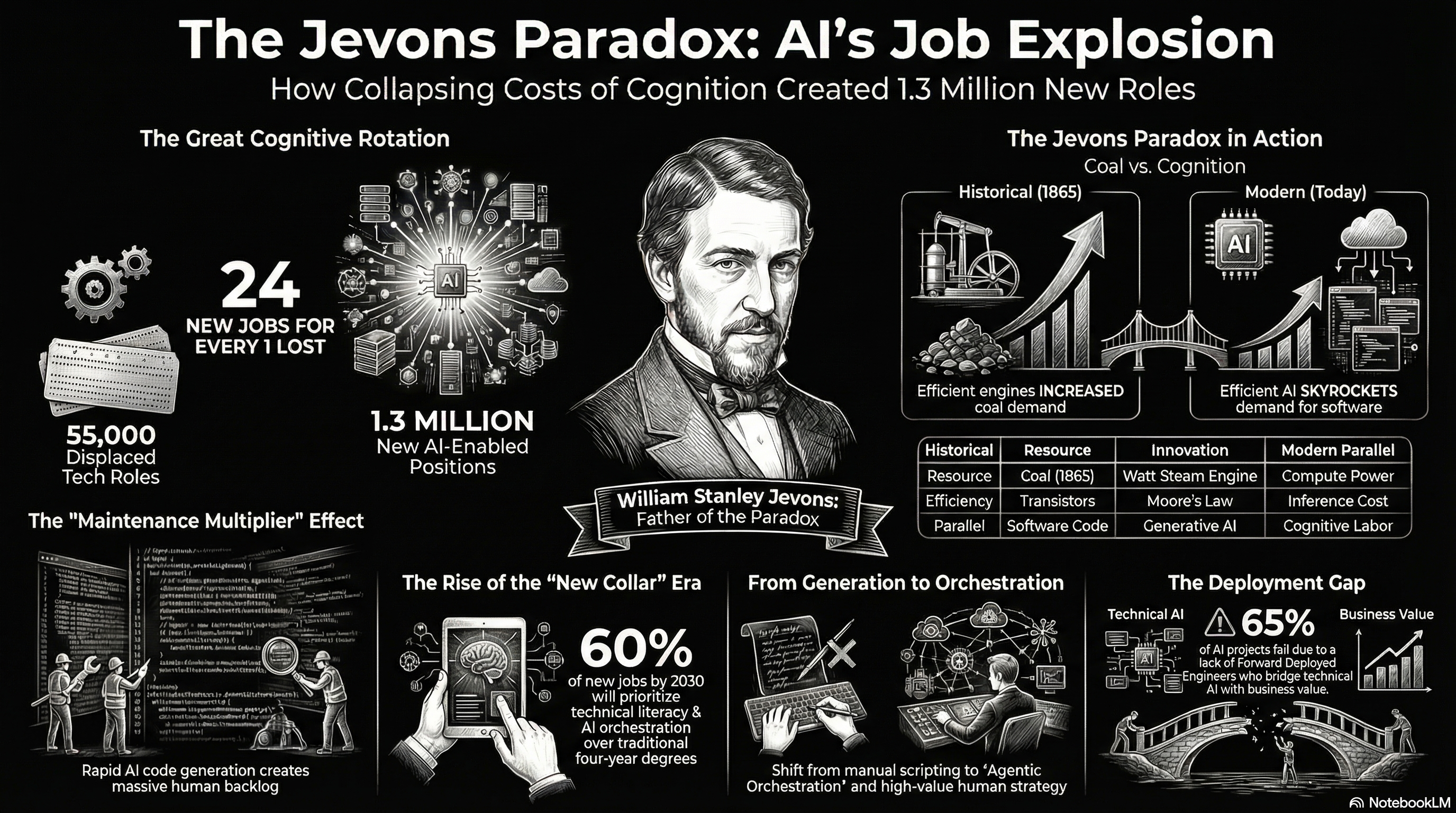
The contemporary labor market is currently navigating a period of structural volatility that defies traditional economic intuition. By the first quarter of 2026, the technology sector and the broader knowledge economy have witnessed a phenomenon that can be termed the “Great Cognitive Rotation.” This transition is characterized by a stark numerical divergence: the displacement of approximately 55,000 workers in established technology roles contrasted against the emergence of 1.3 million new positions fundamentally enabled or defined by artificial intelligence1 This ratio, representing nearly 24 new roles for every one lost, finds its theoretical underpinning in the Jevons Paradox. As the “cost of cognition”—the marginal expense associated with human-like reasoning, data synthesis, and software code creation—approaches a state of collapse, the systemic demand for these outputs has not diminished but has instead exploded2
The Theoretical Framework of the Jevons Paradox
The Jevons Paradox, also known as the Jevons effect, originated in the nineteenth-century observations of economist William Stanley Jevons. In his 1865 work, The Coal Question3, Jevons challenged the prevailing assumption that technological improvements leading to more efficient resource use would inevitably result in a decrease in total resource consumption4 Jevons focused on the coal-fired steam engine, observing that as James Watt’s innovations made the engine significantly more fuel-efficient than Thomas Newcomen’s earlier design, the total consumption of coal in Britain soared rather than declined4 The efficiency gain reduced the marginal cost of power, making the steam engine economically viable for a vast array of new industrial applications that were previously impossible to power4
In the context of the twenty-first century5, “cognition” and “code” have become the primary resources of production, mirroring the role of coal during the Industrial Revolution2 The Jevons Paradox occurs when the demand for a resource is highly price-elastic; when the cost of a unit of cognition falls due to AI-driven efficiency, the “rebound effect” induces a surge in demand that more than offsets the initial savings6 7
The Microeconomics of Rebound and Induced Demand
The mechanics of the Jevons Paradox in the cognitive era can be analyzed through the lens of price elasticity of demand. If the efficiency of code creation doubles, the effective price of software development is halved. If the demand for software is elastic, meaning the percentage increase in quantity demanded is greater than the percentage decrease in price, total labor and capital allocated to software will increase4
The transition is further driven by two distinct economic effects:
- The Substitution Effect: As cognitive labor becomes cheaper relative to other inputs, firms substitute human-only workflows with AI-augmented or AI-led processes8
- The Income Effect: The cost savings from cheaper cognition increase the “disposable” operational budget of a firm, allowing it to reinvest in higher-order complexity and new projects8
| Historical Resource | Efficiency Innovation | Impact on Unit Cost | Long-term Consumption Trend | Modern Parallel |
|---|---|---|---|---|
| Coal | Watt Steam Engine | Significant Reduction | Massive Increase (Industrialization) | Compute Power |
| Transistors | Moore’s Law | Near-Zero Marginal Cost | Exponential Vertical Growth | Inference Cost |
| Lighting | LED Technology | 75% Reduction | Diversification (Ubiquitous Lighting) | Content Creation |
| Software Code | Generative AI | Collapsing | Proliferation of Micro-services | Cognitive Labor |
Table 1: Historical applications of the Jevons Paradox and their modern cognitive equivalents9
The Collapse of Cognitive Costs and Code Creation
The “cost of cognition” refers to the expenses—human time, computational power, and energy—required to perform tasks that involve reasoning, pattern recognition, and the generation of structured information2 In early 2026, this cost is experiencing a “collapse” driven by several technological waves: predictive AI, generative AI, and the emerging era of agentive AI9
From Generation to Agentic Orchestration
While generative AI revolutionized the speed at which text and code could be drafted, agentive AI systems are capable of reasoning, planning, and executing multi-step workflows autonomously9 This shift allows for “Vibe Coding,” where individuals can describe desired software functionality in natural language and receive production-grade applications6 The implications for software engineering are profound; tasks that once required weeks of deterministic scripting now take minutes of “agentic orchestration”10
However, the Jevons Paradox suggests that this efficiency will lead to an even more software-dense world. When the “cost of entry” for complex tasks like data analysis or application development drops, the number of participants in the digital economy explodes2 11 This democratization leads to a surge in total economic activity, requiring more human intervention to manage the resulting scale and complexity2
Quantitative Efficiency Gains in the Enterprise
Early data from the 2025-2026 period indicates that firms are already seeing the impact of these efficiency gains. At Meta, for instance, engineer output rose 30% throughout 2025, while “power users” of AI-native coding tools experienced an 80% increase in productivity1 At Block, leadership has targeted a “gross profit per person” exceeding \2 million USD, representing a 4x increase in organizational economic density achieved through flattening teams and leveraging AI force-multipliers1
Dissecting the 55,000: Displacement and Restructuring
By mid-March 2026, approximately 55,911 tech workers were impacted by 171 global layoff events1 12 While headlines often present these as “AI layoffs,” the reality is a nuanced mixture of proactive restructuring, macroeconomic cooling, and strategic shifts toward AI-native infrastructure.
The Myth of the Jobpocalypse
The term “Jobpocalypse” has gained traction to describe the feared mass displacement of white-collar workers13 However, research indicates that AI is often used as a convenient “scapegoat” for layoffs that are actually driven by interest rate hikes, the end of pandemic-era over-hiring, and traditional cost-cutting13 Only about 20% of the recorded 55,00 layoffs were explicitly attributed to AI by the companies themselves1
Instead of simple replacement, many firms are engaging in “strategic density” plays. Companies like Cisco, Microsoft, and SAP have announced headcount reductions while simultaneously increasing investment in AI R&D and data center infrastructure5 This suggests a “handoff” of productivity leadership from maturing information and communication technologies (ICTs) to a new generation of AI-driven systems14
The Impact of “Density” and Flattened Organizations
Executive strategies in 2026, particularly those championed by Mark Zuckerberg and Jack Dorsey, emphasize the “talented individual” as a force-multiplier1 By using AI to handle the “baseline technical work,” companies are moving toward smaller, higher-skilled teams where the individual contributor has the same output capacity as a mid-sized department of the previous decade1
| Company | Workforce Action (2025-26) | Strategic Driver | Reported Efficiency Result |
|---|---|---|---|
| Meta | Targeted Team Flattening | Elevating “Power Users” | 80% increase in output for top tier |
| Block | Proactive Reductions | Gross Profit per Person focus | Targeted \2 USDM+ per employee |
| Cisco | Workforce Restructuring | Pivot to AI Networking | Re-allocation of CapEx |
| Federal Gov (DOGE) | 308,167 cuts (announced) | Efficiency/Reduction Mandate | 703% increase in cuts vs 2024 |
Table 2: Comparative analysis of workforce restructuring and efficiency drivers in 20261[^1]
The 12 Million: Unpacking the New Roles
The LinkedIn 2026 Davos report, “Building a Future of Work That Works,” provides a counter-narrative to the displacement story. It identifies over 1.3 million new AI-enabled jobs created globally over a two-year period, along with 600,000 new positions in data center operations1
Methodology and the “AI-Enabled” Label
It is critical to understand how these figures are derived. LinkedIn tracks “AI-related jobs” by monitoring changes in job descriptions, titles, and skills listed on user profiles1 When an existing role, such as a marketing analyst, adds “generative AI workflow” to their skillset, it is often counted in the growth of AI roles. Therefore, a portion of the 1.3 million jobs are not entirely “new” positions but represent the “upskilling” of the existing workforce1
Despite this, certain roles are genuinely new or have seen exponential growth. The title of “AI Engineer” has remained the top job in the U.S. for two consecutive years, while “Forward Deployed Engineer”—a role that bridges technical AI capability with customer-facing business value—has grown 42-fold1
The Rise of the “New Collar” Era
The emergence of these roles signals the “New Collar” era, where skills and certifications are prioritized over traditional four-year degrees15 By 2030, it is projected that 60% of new jobs will come from occupations that do not typically require a degree, provided the workers have the technical literacy to operate alongside AI systems15 This democratization of specialized tasks is a direct result of “expertise-leveling” technologies that enable a broader set of workers to perform tasks that previously demanded elite domains of expertise16
Induced Demand and the Proliferation of Software
The Jevons Paradox in the software domain manifests through several mechanisms that expand the total demand for human labor, despite individual tasks becoming more efficient. This is known as the “Scale Effect”—where automation-related price decreases expand the product market so much that more workers are needed to meet the new demand14
The Maintenance Multiplier
One of the most persistent drivers of labor demand is the “maintenance multiplier.” More software inevitably leads to more software that must be updated, secured, integrated, and monitored6 The “lifecycle costs” of an application do not vanish because it was generated by an AI; in many cases, the ease of creation leads to a “sprawl” of software in various states of disrepair, creating a massive backlog for professional developers who must “untangle” these systems6
The “Someday Pile” and Latent Opportunities
As the cost of “thinking” drops, organizations begin to apply intelligence to problems that were previously ruled out as too time-consuming or expensive2 This includes the development of hyper-niche software—such as custom CRMs for independent funeral homes or apps for tracking Rubik’s cube solving times—that would never have justified a traditional development budget6 The explosion of these niche markets creates a vast “tail” of demand for engineers who can maintain and integrate these specialized tools6
AI Workload Creep
A psychological and organizational phenomenon known as “AI workload creep” further drives demand. When an employee uses AI to finish a task 40% faster, the time savings rarely result in “leisure.” Instead, the “cost” of the task drops, making it reasonable for managers to request more frequent analyses, faster content pipelines, or the initiation of projects that previously lived in the “someday” pile17 This “induced demand” for output ensures that the total work time remains constant or even increases17
The “Forward Deployed Engineer” (FDE) and the Deployment Gap
The growth of the Forward Deployed Engineer (FDE) role highlights the primary constraint on the Intelligence Age: the “deployment problem”10 While foundational models like GPT-4 and Claude 36 offer extraordinary capabilities, approximately 65% of organizations abandoned AI projects in 2025 due to a lack of deployment skills10
The FDE Toolkit and Function
The FDE role is a hybrid of a software engineer, solutions architect18, and technical account manager19 20 They are responsible for “jumping into complex customer environments” to translate real-world challenges into working AI solutions20 This role is essential because many corporate workflows are “black boxes”—messy, poorly documented processes that are not yet ready for digital automation21
| Skill Tier | Component | Importance in 2026 | Role in Jevons Paradox |
|---|---|---|---|
| Tier 1: Foundations | Python, RPA Platforms, LLM APIs | Non-Negotiable | Enabling basic efficiency |
| Tier 2: Differentiators | LangChain, RAG Pipelines | High-Value | Managing complexity/context |
| Tier 3: Human-Centric | Discovery, Stakeholder Management | Critical | Bridging the “Black Box” gap |
| Tier 4: Emerging | Multi-modal AI, Fine-tuning | Strategic | Customizing the commodity |
Table 3: The technical and human skill hierarchy for AI automation and Forward Deployed Engineers10
FDEs are effectively the “civil engineers” of the digital age. Just as a civil engineer does not spend their time hauling concrete but instead solves complex structural problems, the FDE uses AI as a tool to solve “governance, privacy, and integration” challenges20 The demand for these professionals is growing at roughly 20% annually, while the supply remains severely constrained, leading to mean salaries exceeding \135,000 USD10
Theoretical Constraints: Amdahl, Brooks, and the Limits of Speedup
To understand why the creation of 1.3 million jobs is necessary to manage the efficiency gained from AI, we must look at the traditional “laws” of computation and project management.
Amdahl’s Law and the “Human Bottleneck”
Amdahl’s Law states that the speedup of a task is limited by its “serial” components—the parts that cannot be parallelized or automated22 In the context of AI, even if the “coding” part of a job is accelerated by 90%, the “human” parts—such as gathering requirements, ethical review, and strategic alignment—remain serial bottlenecks1 As the automated portions of work become faster and cheaper, the relative value and time-cost of the human components increase, requiring more “orchestrators” to keep the system moving17
Brooks’ Law and Communication Overhead
Brooks’ Law—the principle that adding human resources to a late software project makes it later—remains relevant22 While AI allows a “single talented person” to do more, the proliferation of AI agents and automated workflows increases the “communication overhead” between human and machine17 This complexity can lead to “diseconomies of scale” unless a new class of managers and engineers is hired to oversee the “agentic hive”9
Pro-Worker AI vs. Automation: The Acemoglu-Autor Framework
Daron Acemoglu and David Autor of MIT have articulated a critical distinction between “automating” technologies and “new task-creating” technologies16
The Risk of the “Automation Ideology”
The MIT research identifies a market failure: firm leadership often perceives a greater economic return from “automating expertise” than from “creating new tasks”16 If AI is used solely to substitute machinery for tasks previously performed by humans, it may raise average productivity while reducing “marginal productivity”—the additional contribution a human worker brings to the table23 This can lead to a decline in the labor share of national income, even as corporate profits soar16
The “New Task” Pathway
Conversely, “New Task-Creating” technologies are unambiguously pro-worker24 25 These innovations open up uses for human labor that did not exist before. Examples include:
- MRI Radiologists (who did not exist 80 years ago)23
- AI Forensic Analysts (who investigate the origins of machine errors)15
- Prompt Engineers and AI Integrators15
The 1.3 million jobs identified in the LinkedIn Davos report represent the “New Task” pathway, where AI serves as a “collaborator” that extends human judgment and enables individuals to tackle more sophisticated problems16
The Energy and Infrastructure Nexus
The Jevons Paradox in cognitive labor is inextricably linked to the physical reality of data centers and energy consumption26. While the “cost of thinking” may be collapsing for the end-user, the “cost of powering” those thoughts is skyrocketing9
The Data Center Boom
The “explosive growth in attention to AI” has fueled a global construction boom in data centers, which play a central role in the modern economy27 Last year alone, 600,000 “AI-enabled data center jobs” were created to maintain the high-voltage transmission lines28, substations, and cooling systems required by these facilities1 In the U.S., AI is projected to drive 20% of total electricity demand by 2030[^8]
The Efficiency Paradox in Hardware
The paradox repeats in energy: as AI models become more efficient, we do not use less energy; we build more models9 For example, the Chinese model “DeepSeek” reportedly runs on 10 to 40 times less energy than comparable U.S. models29 Rather than reducing global energy demand, such efficiency breakthroughs act as a “catalyst” for even more widespread adoption, turning AI into a “commodity we just can’t get enough of”30
Stranded Assets and the Energy Transition
A significant risk in the 2026-2029 period is the “Investment Trap”29 Tech giants have invested hundreds of billions into natural gas-powered data centers with 30-year lifespans29 If more efficient systems or different energy sources (like Small Modular Reactors or SMRs) become the standard, these gas plants could become “economically unviable” stranded assets29 This pressure could drive the fastest energy transition in history, but it will be driven by “economic pain” and competitive pressure rather than central planning29
| Energy Metric | Pre-AI (2020) | AI-Boom (2025-26) | 2030 Projection |
|---|---|---|---|
| Data Center Electricity Use | ~1-2% Global | ~4-6% Global | Up to 10% Global |
| U.S. Grid Demand from AI | Negligible | Rising | 20% of total |
| Data Center Construction CapEx | Millions | \750 USD Billion (Annual) | \3 USD Trillion (Cumulative) |
| Fossil Fuel Dependency (Gas) | Baseline | 40% of DC power | Volatile/Transitioning |
Table 4: Macro-trends in energy consumption and infrastructure investment driven by the Jevons Paradox30
Psychological Factors: Loss Aversion and the Skill Preparedness Gap
The transition from a labor market defined by “coding” to one defined by “orchestration” is complicated by human psychology. The Jevons Paradox explains why the jobs are there, but “loss aversion” explains why the 55,000 lost jobs hurt more than the 1.3 million new ones inspire31
The Hurt of Selling the “Skill House”
Economic psychologists observe that “loss aversion” makes the psychological pain of losing a job (or the value of a hard-won skill) outweigh the potential gain of a new one31 Many tech workers are effectively living in a “Manchester-to-Edinburgh” commute situation—commuting between an old skill set that is losing value and a new role that requires total dislocation of their professional identity31
The Preparedness Crisis
While the LinkedIn data shows that “job seekers outpace job openings at the highest level since the pandemic32,” it also reveals that nearly 80% of workers feel “unprepared” to make a career move in the age of AI15 Only 3% of LinkedIn members have listed AI skills on their profiles, yet 75% of companies agree that “people skills” (adaptability, critical thinking, collaboration) are now the primary differentiator1
Mathematical Modeling of the Cognitive Rebound
To quantify the Jevons Paradox in this context, we can define the “Rebound Effect” (\$R\$) as the ratio of the “taken back” efficiency gains to the initial gain.
If \$\Delta \eta\$ is the initial efficiency improvement (e.g., AI makes coding 50% faster) and \$\Delta U\$ is the subsequent increase in usage (e.g., the company builds 100% more software features), then:
\$\$R = \frac{\Delta U}{\Delta \eta}\$\$
When \$R > 100%, USD we observe the Jevons Paradox6 In the 2026 software market, with output per power user up 80% and the 1.3M/55K job ratio, the estimated rebound effect for cognitive labor is well over 200%, suggesting that for every unit of work “automated,” more than two units of new work are “induced” by the lower cost and higher complexity of the ecosystem1
The Geopolitical Architecture of the Intelligence Age
The national ability to dominate the AI technology stack is now viewed as the primary dictate of geopolitical, economic, and moral architecture in the twenty-first century5
The U.S. vs. China Wildcard
While the U.S. is spending hundreds of billions on energy-hungry infrastructure, China’s focus on efficiency (evidenced by DeepSeek) presents a “Wildcard”29 If the U.S. is locked into fossil-fuel-dependent, expensive infrastructure while competitors develop systems that run on 4[^0] times less energy, a massive “market correction” could occur29 This highlights that the Jevons Paradox is not just an internal labor market dynamic but a global competitive race where “lagging economies risk falling into a state of insurmountable stagnation5”5
The “Systemic Macroeconomic Effect”
The White House Council of Economic Advisers (CEA) has adopted the Jevons Paradox as its theoretical framework for workforce policy5 Their data suggests that while AI substitutes for specific “codifiable” tasks, its systemic effect is “profoundly augmentative5”5 By driving down the marginal cost of cognitive labor, AI enables “service vectors” in medicine33, scientific discovery, and environmental management5 that were previously “economically unviable” due to high human capital costs5
Conclusion: The Great Rotation and the Human Premium
The analysis of the 55,000 lost jobs versus the 1.3 million created roles indicates that the framework of the Jevons Paradox is an accurate predictor of the current cognitive labor market. The “collapse of cognitive costs” has not led to a world with less work, but a world with more work that is fundamentally different in nature2
The primary findings of this investigation are:
- Efficiency creates Demand: The collapse in the cost of creating code has induced a massive surge in the demand for software, leading to a proliferation of micro-services and internal tools that require human oversight2
- The Deployment Gap is the new Bottleneck: The creation of 1.3 million roles is largely concentrated in “bridging” positions like the Forward Deployed Engineer, who handles the complexity that AI cannot yet navigate10
- Physical Infrastructure is the Ceiling: The Jevons Paradox in software is driving a 600,000-job boom in the physical construction and maintenance of data centers, with energy demand becoming the ultimate constraint on cognitive abundance15
- Human Capital must Pivot: The “Jobpocalypse” is a myth of displacement that ignores the “Great Rotation.” However, the transition is hampered by a significant skill gap34, with 80% of the workforce feeling unprepared for the “New Collar” era1
Ultimately, the Intelligence Age is not defined by the replacement of the human mind, but by its reallocation to higher-order tasks of strategy, empathy, and complex orchestration2 As basic cognition becomes a commodity, the “Human Premium”—the value of judgment, ethics, and “listening hard” to uncover root causes—will become the most sought-after resource in the global economy2 The Jevons Paradox ensures that as thinking becomes cheaper, we will only find more things worth thinking about2
Tips and Donations
If you enjoyed this deep dive, consider supporting the project with a tip in Sats. It’s a simple, global way to support independent research.
To send Sats, you’ll need a lightning wallet.
References
-
AI Productivity Scam? 2026 Labor Data is Wild | by Amelia Lee - Medium, accessed March 25, 2026, https://medium.com/@weare1010/the-ai-layoff-paradox-55-000-jobs-cut-1-3-million-created-and-the-workers-left-behind-e4a41fea5d2b ↩ ↩2 ↩3 ↩4 ↩5 ↩6 ↩7 ↩8 ↩9 ↩10 ↩11 ↩12 ↩13 ↩14 ↩15 ↩16 ↩17
-
AI Entrepreneurs Hub, accessed March 25, 2026, https://tac.whitebeardstrategies.com/communities/groups/ai-entrepreneurs/home/posts/6902183cf78330aeaa6325af ↩ ↩2 ↩3 ↩4 ↩5 ↩6 ↩7 ↩8 ↩9 ↩10 ↩11 ↩12
-
The Jevons Paradox and the Myth of Resource Efficiency Improvements - Uberty, accessed March 25, 2026, https://uberty.org/wp-content/uploads/2015/08/John_M._Polimeni_Kozo_Mayumi_Mario_Giampietro.pdf ↩
-
Jevons paradox - Wikipedia, accessed March 25, 2026, https://en.wikipedia.org/wiki/Jevons_paradox ↩ ↩2 ↩3 ↩4
-
The United States’ Strategic Wager on Artificial Intelligence and the Future of Work, accessed March 25, 2026, https://www.timetrex.com/blog/us-strategic-wager-on-ai ↩ ↩2 ↩3 ↩4 ↩5 ↩6 ↩7 ↩8 ↩9 ↩10
-
Jevons’ Paradox and AI: Why It Means More Developers, Not Fewer - Mr. Phil Games, accessed March 25, 2026, https://www.mrphilgames.com/blog/jevons-paradox-software-development-ai-more-developers ↩ ↩2 ↩3 ↩4 ↩5 ↩6 ↩7 ↩8
-
Rebound Effects of AI on Sustainability: Economic and Policy Perspectives, accessed March 25, 2026, https://sciintl.scione.com/cms/fulltext.php?id=341 ↩
-
The European Union Green Deal: Clean Energy Wellbeing Opportunities and the Risk of the Jevons Paradox - MDPI, accessed March 25, 2026, https://www.mdpi.com/1996-1073/14/14/4148 ↩ ↩2
-
DeepSeek: Are US tech giants in danger? - CPR Asset Management, accessed March 25, 2026, https://cpram.com/fra/en/individual/publications/megatrends/deepseek-are-us-tech-giants-in-danger ↩ ↩2 ↩3 ↩4 ↩5 ↩6
-
The AI Automation Engineer in 2026: A Comprehensive Technical and Career Guide - Sundeep Teki, accessed March 25, 2026, https://www.sundeepteki.org/advice ↩ ↩2 ↩3 ↩4 ↩5 ↩6
-
Future Market Blueprints: Harnessing Artificial Intelligence in a World Wired for Wonder - Scholarly Commons, accessed March 25, 2026, https://scholarlycommons.law.northwestern.edu/cgi/viewcontent.cgi?article=1909&context=njilb ↩
-
Sean Malady, Author at J & J Staffing Resources - Page 4 of 10, accessed March 25, 2026, https://www.jjstaff.com/author/admin/page/4/ ↩
-
The Jobpocalypse Is Real, but AI Isn’t To Blame - mastergradschools, accessed March 25, 2026, https://mastergradschools.com/master-industry-trends/jobpocalypse-ai-master-graduate-advice ↩ ↩2
-
Growth trends for selected occupations considered at risk from automation, accessed March 25, 2026, https://www.bls.gov/opub/mlr/2022/article/growth-trends-for-selected-occupations-considered-at-risk-from-automation.htm ↩ ↩2
-
A New World of Work: Global Labor Market Rotates, Not Retreats - LinkedIn Pressroom, accessed March 25, 2026, https://news.linkedin.com/2026/2026-Davos-Press-Release ↩ ↩2 ↩3 ↩4 ↩5 ↩6
-
NBER WORKING PAPER SERIES BUILDING PRO-WORKER ARTIFICIAL INTELLIGENCE Daron Acemoglu David Autor Simon Johnson Working Paper 348, accessed March 25, 2026, https://www.nber.org/system/files/working_papers/w34854/w34854.pdf ↩ ↩2 ↩3 ↩4 ↩5
-
What Is AI Workload Creep? How AI Tools Expand Your Task List Instead of Shrinking It, accessed March 25, 2026, https://www.mindstudio.ai/blog/what-is-ai-workload-creep/ ↩ ↩2 ↩3 ↩4
-
Forward Deployed Engineer, Deepgram - Remote Rocketship, accessed March 25, 2026, https://www.remoterocketship.com/us/company/deepgram/jobs/forward-deployed-engineer-deepgram-united-states-remote/ ↩
-
Forward Deployed Engineer at DOMO DOMO - Remote Rocketship, accessed March 25, 2026, https://www.remoterocketship.com/company/domo-domo/jobs/forward-deployed-engineer-united-states-remote ↩
-
Job Application for Forward Deployed Engineer (West) at Relyance AI - Greenhouse, accessed March 25, 2026, https://job-boards.greenhouse.io/relyance/jobs/5819515004 ↩ ↩2 ↩3
-
Predictions for an AI Future, Now - Syllepsis, accessed March 25, 2026, https://syllepsis.live/2026/02/22/predictions-for-an-ai-future-now/ ↩
-
dwmkerr/hacker-laws: Laws, Theories, Principles and Patterns for developers and technologists. - GitHub, accessed March 25, 2026, https://github.com/dwmkerr/hacker-laws ↩ ↩2
-
Rebalancing AI-Daron Acemoglu Simon Johnson - International Monetary Fund, accessed March 25, 2026, https://www.imf.org/en/publications/fandd/issues/2023/12/rebalancing-ai-acemoglu-johnson ↩ ↩2
-
Building pro-worker AI - Brookings Institution, accessed March 25, 2026, https://www.brookings.edu/articles/building-pro-worker-ai/ ↩
-
Building pro-worker AI - The Hamilton Project, accessed March 25, 2026, https://www.hamiltonproject.org/publication/paper/building-pro-worker-ai/ ↩
-
Sustainable and Low Carbon Development in the Energy Sector - MDPI, accessed March 25, 2026, https://mdpi-res.com/bookfiles/book/12432/Sustainable_and_Low_Carbon_Development_in_the_Energy_Sector.pdf?v=1773168382 ↩
-
SUSTAINABLE DATA CENTERS ROADMAP - Innovation for Cool Earth Forum (ICEF), accessed March 25, 2026, https://icef.go.jp/wp-content/themes/icef_new/pdf/roadmap/icef2025_roadmap%20Oct%209.pdf ↩
-
Combined Vehicle to Building (V2B) and Vehicle to Home (V2H) strategy to increase electric vehicle market share | Request PDF - ResearchGate, accessed March 25, 2026, https://www.researchgate.net/publication/353595134_Combined_Vehicle_to_Building_V2B_and_Vehicle_to_Home_V2H_strategy_to_increase_electric_vehicle_market_share ↩
-
Theory: The AI bubble35 might accidentally force the fastest energy transition in history (just not how anyone planned) - Reddit, accessed March 25, 2026, https://www.reddit.com/r/collapse/comments/1otgsor/theory_the_ai_bubble_might_accidentally_force_the/ ↩ ↩2 ↩3 ↩4 ↩5 ↩6 ↩7
-
What is Jevons Paradox? And why it may — or may not — predict AI’s future, accessed March 25, 2026, https://news.northeastern.edu/2025/02/07/jevons-paradox-ai-future/ ↩ ↩2
-
The Cambridge Handbook of Psychology and Economic Behaviour [2 ed.] 1107161398, 9781107161399 - DOKUMEN.PUB, accessed March 25, 2026, https://dokumen.pub/the-cambridge-handbook-of-psychology-and-economic-behaviour-2nbsped-1107161398-9781107161399.html ↩ ↩2 ↩3
-
Honest question to those who think AI won’t take our jobs : r/cscareers - Reddit, accessed March 25, 2026, https://www.reddit.com/r/cscareers/comments/1qm9y3q/honest_question_to_those_who_think_ai_wont_take/ ↩
-
Jevons Paradox: Rise of the Machines May Create More Work for Physicians - PMC, accessed March 25, 2026, https://pmc.ncbi.nlm.nih.gov/articles/PMC12959442/ ↩
-
Minding the gap: the LBS Data Science and AI initiative | London Business School, accessed March 25, 2026, https://www.london.edu/think/minding-the-gap-the-lbs-institute-for-data-science-and-ai ↩
-
Is it a bubble? - Hacker News, accessed March 25, 2026, https://news.ycombinator.com/item?id=46220640 ↩