AI and the Cantillon Effect
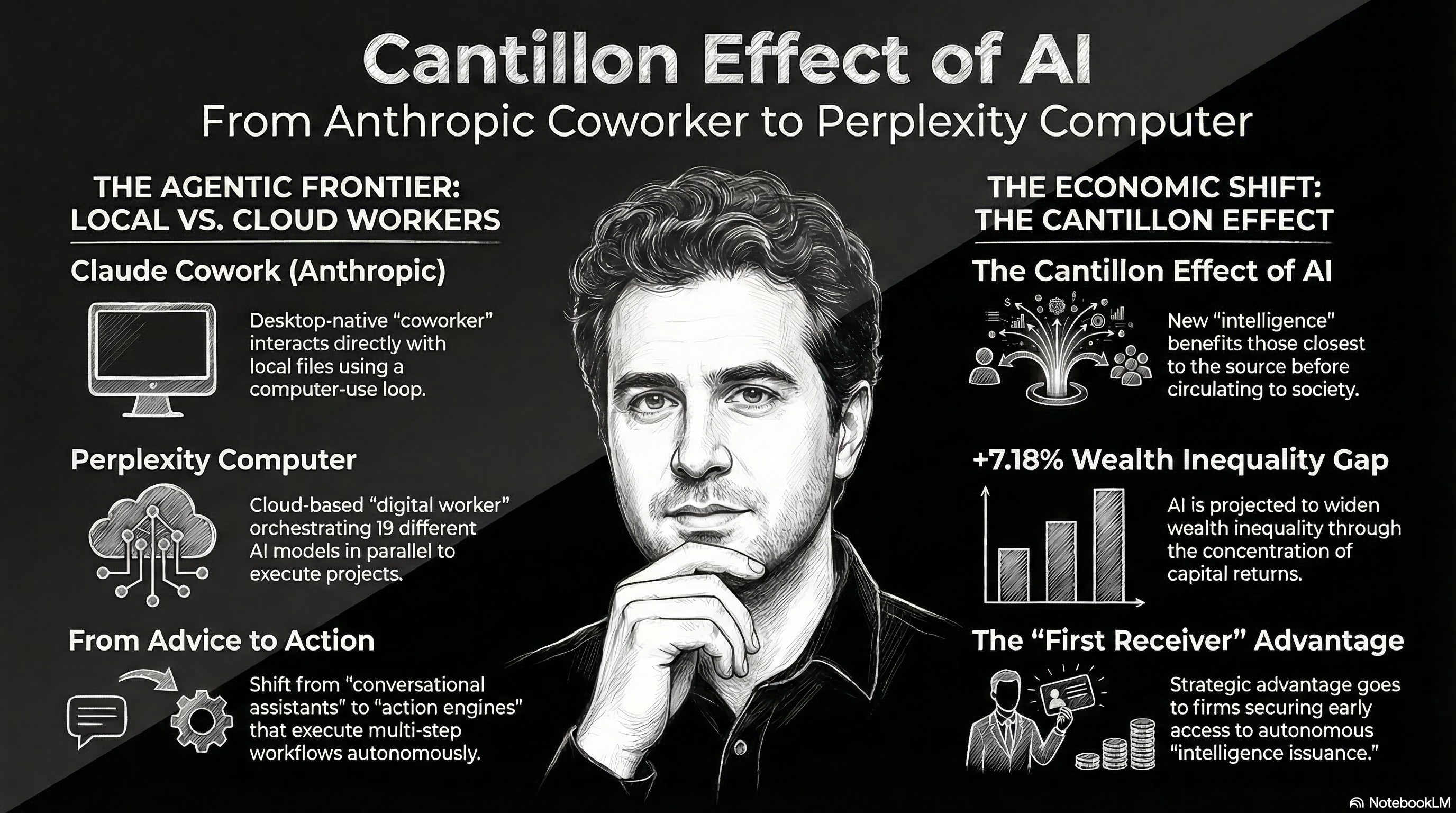
The transition from generative artificial intelligence as a conversational interface to an autonomous agentic framework represents a fundamental shift in the architecture of digital work. In early 2026, the technology landscape is no longer dominated by chatbots that merely provide information; the focus has shifted toward “action engines” capable of interacting directly with computer environments, managing files, and executing multi-step workflows. This paradigm shift, often referred to as the “Agent War,” is being led by a cohort of frontier labs—Anthropic, Perplexity, OpenAI, and Google—each vying to become the primary interface for digital labor. The emergence of tools like Anthropic’s Claude Cowork and Perplexity’s Computer reflects a burgeoning realization that the ultimate value of large language models (LLMs) lies in their ability to act as digital employees rather than simple advisors.1
The Emergence of the Digital Coworker: Claude Cowork and the Desktop-Native Agent
Anthropic has cultivated significant hype around Claude Cowork, a research preview that expands the Claude assistant from a conversational partner into a task-executing digital coworker. Integrated into the Claude Desktop experience, Cowork allows the model to interact directly with the user’s local files, folders, and applications. This desktop-native approach is a strategic move to embed intelligence within the existing workflows of professionals, rather than requiring them to port data into a web-based chat box.1
The design philosophy behind Claude has always emphasized a “thoughtful mentor” persona, characterized by sepia tones and serif fonts that encourage deeper reading and careful thought structure. This psychological conditioning is now being applied to autonomous tasks. Unlike standard chat interactions, Cowork operates through a continuous loop: it captures a screenshot of the environment, plans the next action required to reach a goal, and executes that action via a virtual mouse and keyboard.2 This “computer use” capability allows Claude to perform desktop operations such as organizing large document directories, extracting data into spreadsheets, and synthesizing multiple document sources into structured reports.1
The excitement surrounding Claude Cowork is partly driven by the expansion of Anthropic Labs, a specialized team focused on incubating experimental products at the frontier of Claude’s capabilities. Led by product veterans like Mike Krieger, the co-founder of Instagram, and Ben Mann, the Labs team aims to discover experimental products and scale them for enterprise use.3 This has already yielded “Claude Code,” a billion-dollar product that allows for autonomous software development, and the Model Context Protocol (MCP), which has become an industry standard for connecting AI to tools and data.3
Architectural Components of Claude Cowork
| Feature | Description | Strategic Utility |
|---|---|---|
| Model Context Protocol (MCP) | Industry-standard bridge for connecting AI to diverse data sources. | Prevents “walled gardens” by allowing secure, universal tool integration. |
| Skills | Reusable instruction sets for repeatable workflows. | Allows users to “teach” Claude specific, complex tasks once. |
| Connectors | Secure bridges to services like Google Drive and Gmail. | Enables data retrieval and action across the existing software stack. |
| Artifacts | Interactive content creation and real-time iteration. | Delivers completed work rather than just text-based advice. |
| Computer Use Loop | Screenshot-Analyze-Plan-Act cycle. | Facilitates navigation of any software interface, including legacy apps. |
Despite its potential, Cowork remains in a research preview phase, restricted to Claude Max subscribers on specific platforms. It faces practical limitations, such as requiring the computer to remain awake and the application to be open to execute scheduled tasks. If the computer is asleep, the agent skips the task and resumes only upon wake-up.6 Furthermore, while it handles complex file operations, it consumes a significant amount of the user’s message quota—sometimes equivalent to dozens of regular chat messages for a single session.4 These frictions highlight that while the vision for a digital coworker is clear, the infrastructure for seamless, always-on autonomy is still being refined.
Perplexity Computer: The Multi-Model Orchestration Paradigm
While Anthropic focuses on deep integration within a single-model ecosystem, Perplexity has introduced “Perplexity Computer,” a cloud-based “digital worker” that represents a fundamentally different approach to agentic AI. Perplexity Computer is positioned as a chief of staff or virtual analyst that can execute entire projects—from research and design to coding and deployment—autonomously.5
The defining characteristic of Perplexity Computer is its orchestration of 19 different AI models in parallel. Perplexity recognizes that as AI matures, models are specializing rather than commoditizing; some excel at reasoning, others at deep research, and others at rapid factual lookups. By using an “orchestration harness,” Perplexity Computer identifies the best model for each specific subtask of a project and routes work accordingly.6 For example, Claude Opus 4.6 may serve as the central reasoning engine, while Google’s Gemini handles deep research and OpenAI’s GPT-5 manages long-context recall.7
| Orchestrated Model | Primary Role in Workflow | Key Advantage |
|---|---|---|
| Claude Opus 4.6 | Central Reasoning Engine | Decomposes goals, identifies dependencies, and handles logic. |
| Google Gemini 2.5/3.0 | Deep Research and Synthesis | Processes massive token windows for exhaustive information gathering. |
| OpenAI GPT-5.2 | Long-Context Recall and Web Search | Retrieves information across vast datasets and legacy web interfaces. |
| xAI Grok 4.20 | Lightweight, Fast Tasks | Handles quick factual lookups and simple processing jobs. |
| Google Nano Banana | Image Generation | Produces visual assets within the project workflow. |
| Google Veo 3.1 | Video Creation | Generates video content as part of the project deliverables. |
Perplexity’s tool is available exclusively to “Max” subscribers at a premium price point of 200 USD per month, reflecting its positioning as a tool for “GDP-moving decisions” rather than casual productivity.8 The system utilizes a credit-based pricing model, providing 10,000 credits monthly, with tasks consuming varying amounts based on complexity.5 This shift from ad-revenue models to high-ticket subscription and enterprise monetization marks a significant evolution in Perplexity’s business strategy.9
Security and Sandbox Environments
One of the most critical aspects of Perplexity Computer is its use of isolated compute environments. Every task runs in a secure sandbox with access to a real filesystem and browser, but is entirely walled off from the user’s personal computer and network.6 This cloud-based approach allows for “always-on” persistence; a project can run for hours or even months without the user being present. Perplexity has even introduced a “Personal Computer” that runs on a dedicated Mac mini, staying connected to the user’s files 24/7 to act as a persistent digital proxy.10 This contrast between Anthropic’s local file interaction and Perplexity’s cloud-native sandbox represents a divergence in how “computer use” is envisioned: one as an extension of the local machine, and the other as a remote digital employee.1
The Game-Changer Debate: Agents versus Traditional API Connectors
The question of whether agentic AI is a “game changer” often centers on its relationship with traditional automation tools like Zapier and Make. These legacy platforms pioneered no-code automation by connecting thousands of apps through deterministic, API-to-API logic. If a specific event occurs in one app, the system triggers a predefined action in another.11 This model is highly efficient for high-volume, predictable tasks where data mapping is straightforward. However, it is inherently rigid; the automation breaks if a software UI changes, if an API is unavailable, or if the task requires human-like judgment.12
Agentic AI systems represent a move from rule-based to reasoning-based automation. Agents do not follow a fixed script; they understand a high-level goal and autonomously chart a course to achieve it, using tools and APIs as needed.13 This allows them to handle unstructured data—such as text, images, and video—and to adapt their plans when obstacles arise.13 For example, whereas a Zapier workflow might struggle to “audit ad spend and draft a reallocation plan,” an agentic system can navigate different platforms, synthesize the data, and prepare a presentation independently.14
Comparison of Automation Philosophies
| Feature | Traditional Automation (Zapier/Make) | Agentic AI (Claude Cowork/Perplexity Computer) |
|---|---|---|
| Intelligence Model | Rules-based, explicit logic. | Reasoning-based, LLM-powered. |
| Adaptability | Low—breaks when processes change. | High—adjusts strategies dynamically. |
| Data Handling | Structured data and API calls. | Unstructured data (natural language, images). |
| Interface | Predominantly APIs. | APIs, GUIs (clicks, keystrokes, screenshots). |
| Primary Goal | Execute individual predefined steps. | Achieve outcomes and complete broad goals. |
| Learning | None—repeats the same process. | Continuous improvement from outcomes. |
The emergence of “vision-action loops,” where agents observe the screen and interpret raw pixels, is the true catalyst for change. This enables the automation of tasks inside “messy,” no-API environments, such as legacy internal tools or dashboards that lack modern integrations.15 However, experts suggest that rather than replacing connectors, agents will sit atop them. A “hybrid stack” approach is gaining favor, where Zapier-style API flows handle the reliable data transfer, and AI agents manage the decision-making and project coordination.16 Zapier itself is adapting to this reality by introducing “Zapier Central,” which allows users to build “mini-agents” with their own logic to perform tasks that standard Zaps cannot.17
Specialized Autonomy: Mosaic AI vs. Generalist Computer Agents
A critical evolution in the agentic race is the move from “general computer use” to “specialized outcome engines.” While Claude Cowork and Perplexity Computer attempt to master the general interface of a PC, startups like Mosaic.so are building omnipresent API infrastructures for specific vertical labor. Mosaic’s recent launch of its AI video editing API demonstrates a fundamental shift: the elimination of traditional UI steps like timelines or exports in favor of autonomous agents.
Mosaic’s flagship demo features “Larry,” a Slack-based bot that autonomously clips and posts edited footage, such as historical Steve Jobs tapes, directly into team channels. Founded by ex-Tesla engineer Adish Jain, Mosaic represents an evolution from prompt-based video tools to a “No-UI” paradigm. This contrast highlights three distinct approaches to digital labor in 2026:
- Claude Cowork (Local Execution): Focuses on interacting with the user’s existing local software. It excels at summarizing meeting notes from local audio files or organizing folders, but its “mimic a human” interface (mouse/keyboard) is inherently slower for intensive tasks like video rendering.
- Perplexity Computer (Cloud Orchestration): Leverages specialized models like Google’s Veo 3.1 within a cloud sandbox to generate high-fidelity video. It includes tools like ffmpeg in its isolated Linux environment, allowing it to “build” video projects, but it still operates within a generalist container that requires high credit consumption.
- Mosaic AI (Infrastructure-First): Operates as a background API that removes the need for a screen entirely. By providing a direct “editing intelligence” layer, it allows agents to bypass the browser and desktop interfaces that slow down Claude and Perplexity. In one case study, this infrastructure-first approach allowed a single podcaster to replace a 5-person production team with Mosaic-integrated agents.
This suggests that while “computer use” is the current media hype, the long-term winners may be tools that make the computer (and its UI) redundant for specific high-value workflows.
The Titan’s War: Google, OpenAI, and the Race for the Action Engine
Google and OpenAI are currently engaged in a high-stakes “Agent War,” racing to move beyond the conversational chatbot and toward the “Action Engine”.18 This race is not just about intelligence, but about control over the primary discovery interfaces of the digital world. Google’s strategy is heavily defensive, viewing agents as a way to maintain its search and browser dominance in an AI-first environment. OpenAI, conversely, needs agents to justify its massive valuation and transition from a research lab into a comprehensive digital service provider.19
OpenAI’s “Operator” agent is built on a “Universal Executor” model, designed to navigate any web-based interface exactly as a human would. It captures high-frequency screenshots to identify interactive elements and execute multi-step tasks autonomously, such as booking international travel across multiple websites or managing procurement workflows.14 Operator has gained significant traction in the consumer market through partnerships with major companies like Uber and Disney, positioning itself as a universal interface for real-world transactions.18
Google’s primary response is “Project Jarvis,” now officially integrated into the Chrome ecosystem as “Project Mariner.” Powered by Gemini 2.0 and 3.0, Mariner leverages Google’s ownership of the Chrome browser—the world’s most popular gateway to the web—to provide a “zero-latency” experience.8 Mariner is an “action engine” that can take direct control of a browser to execute multi-step tasks. Its “Vision-Action Loop” uses spatial reasoning to interpret pixels, allowing it to navigate even websites that are “broken” or lack APIs.18
Strategic Positioning: Google AI vs. OpenAI Operator
| Strategy | Google (Project Mariner/Jarvis) | OpenAI (Operator) |
|---|---|---|
| Ecosystem | “The Castle”—Integrated and secure within Workspace/Chrome. | “The Metropolis”—Sprawling, open, and platform-agnostic. |
| Primary Advantage | Native browser integration; zero-latency; enterprise governance. | universal executor model; high-profile consumer partnerships. |
| Enterprise Focus | Audit trails (Artifacts), Vertex AI security, and managed office browser (Comet). | Public-facing products; API access; massive consumer brand recognition. |
| Architecture | Vision-first spatial reasoning; 2-million-token context window. | Pixel-based browser navigation; multimodal memory; unified system router. |
Google is positioning its agents as “governance-first,” generating a log of “Artifacts”—screenshots and summaries—of every action taken. This allows corporate IT departments to monitor exactly how the AI interacts with sensitive data, making it a favorite for enterprises requiring strict audit trails.18 OpenAI, meanwhile, is experimenting with ads that feel like helpful answers within the agent interface, competing for user trust as the primary discovery platform.20
The question of whether these titans are “behind” is nuanced. Anthropic and Perplexity were earlier to release functional “computer use” features to the public, but Google and OpenAI possess the massive infrastructure and distribution networks (Chrome, Android, ChatGPT) to potentially dominate the market once their agents are fully refined.18 Anthropic’s Claude remains the “technical leader” in benchmarks like SWE-bench, but Google’s Gemini 2.5/3.0 Pro and OpenAI’s GPT-5 are rapidly closing the gap in expert-level knowledge and agentic benchmarks.21
Macroeconomic Trajectories: Productivity, Business Growth, and GDP
The integration of agentic AI is expected to catalyze a fundamental shift in the potential growth rate of the global economy, with the United States positioned as the primary beneficiary of this transition. For professionals, the impact on productivity is profound; AI doesn’t just suggest a schedule—it negotiates meeting times across time zones and prepares briefing notes.14 Middle-management administrative tasks, which involve high levels of coordination and information synthesis, are particularly exposed to automation, with McKinsey projecting that up to 45% of these tasks could be automated by 2030.14
Business investment in AI is currently the clearest signal of this shift. In the first half of 2025, tech-related categories contributed significantly to investment growth, with hardware investment in computers and servers up 41% annually.22 Hyperscalers like Meta, Alphabet, and Microsoft are projected to allocate 342 USD billion to capex in 2025, a 62% increase from the previous year, to support the infrastructure needed for autonomous intelligence.22
Projections for U.S. GDP and Productivity (2025–2035)
| Period | Potential GDP Growth (Forecast) | Productivity Growth (Forecast) |
|---|---|---|
| 2025–2029 | 2.1% (Goldman Sachs) | 1.7% (Goldman Sachs) |
| Early 2030s | 2.3% (Goldman Sachs) | 1.9% (Goldman Sachs) |
| By 2035 | +1.5% Cumulative (Penn Wharton) | Peak boost in 2032 (+0.2 p.p.) |
| By 2055 | ~3.0% Cumulative (Penn Wharton) | Persistent effect of 0.04 p.p. annually. |
While the “investment boom” is real, its immediate impact on U.S. GDP is complicated. Much of the capital spending on chips and servers flows toward imports from Taiwan and Korea, which subtracts from domestic GDP.22 Furthermore, there is a “productivity paradox” currently at play: while 70% of firms report using AI, 80% have seen no significant impact on employment or productivity yet.24 This is characteristic of early-stage technology cycles, where adoption rises sharply in the first decade, but organizational adjustment takes longer to translate into measurable output.23
The most exposed occupations to AI automation are office and administrative support (75%), business and financial operations (68%), and computer-related roles (63%).23 However, “exposure” does not necessarily equate to displacement. In many high-wage occupations, AI acts as a complement, increasing the value per worker and potentially raising wages for those who can adapt to the new technology.23 For the U.S., being the earliest adopter provides a strategic “cushion” of innovation that adds resilience to the economy, even as labor force growth slows.22
The Cantillon Effect of Agentic AI: A New Theory of Intelligence and Wealth
The most significant long-term consequence of agentic AI adoption may not be the aggregate increase in productivity, but the structural redistribution of wealth, a phenomenon best understood through the “Cantillon Effect.” Coined by 18th-century economist Richard Cantillon, the effect describes how the creation of new money benefits those who receive it first—governments, banks, and asset holders—before it circulates to the wider population as inflation.25 Those “closest to the source” gain purchasing power and acquire assets at prevailing prices, while latecomers find themselves dealing with inflated costs and diminished prospects.25
Artificial intelligence represents a new issuance mechanism, not of currency, but of “intelligence”.26 Like money, intelligence creation does not diffuse evenly across society. It enters through specific institutions, platforms, and economic roles—primarily the trillion-dollar capital concentrations of frontier AI labs and their early enterprise partners.26 The “first receivers” of this intelligence injection are sectors closest to monetization and behavioral leverage: financial trading, advertising, surveillance, and optimization-heavy platforms.26
Structural Redistribution through AI Adoption
Wealth inequality is projected to widen significantly in the AI era. A task-based model calibrated by the IMF predicts that while AI could actually reduce wage inequality by displacing high-income white-collar tasks, it will substantially increase overall wealth inequality.27 This is because high-income workers are better positioned to benefit from the higher capital returns generated by AI adoption. They hold the largest share of their wealth in risky, high-return assets like firm equity and defined-contribution pensions, which directly benefit from the productivity gains captured by AI-integrating corporations.28
| Metric | AI-Driven Shift (Projection) | Previous Automation Waves |
|---|---|---|
| Wealth Gini Coefficient | +7.18 p.p. (Widening) | +6.89 p.p. |
| Wage Gini Coefficient | -1.73 p.p. (Shrinking) | +2.05 p.p. |
| Mechanism | Capital returns concentration. | Skill-biased labor displacement. |
| Primary Beneficiary | Asset owners and capital holders. | High-skilled labor. |
The “Cantillon Effect of Agentic AI” suggests that by the time the “average person” feels the impact of AI, the structural redistribution of wealth will have already occurred.26 The bottleneck is not intelligence itself, which may eventually become a commodity, but control over the deployment, interfaces, and incentive design of these systems.26 Those who control the “Action Engines” will shape the attention, legislation, and norms of the digital economy before a broad social consensus can form.26
This creates a self-reinforcing cycle of wealth concentration. Early beneficiaries leverage their financial and intelligence advantages to secure even more resources, further widening the gap between “Cantillionaires”—those amassing wealth by capitalizing on the intelligence creation process—and the latecomers.25 For nations like the United States, early adoption creates a “first-mover” advantage that could increase global income inequality by disproportionately benefiting advanced economies over those with less-developed digital infrastructure.29
Conclusion: Navigation of the Agentic Era
The transition toward agentic AI is not a minor update to the digital ecosystem; it is a fundamental shift in how human intelligence interacts with technology. Anthropic’s Claude Cowork and Perplexity’s Computer are the first examples of “always-on” digital employees that move beyond providing information to delivering completed work. While traditional automation tools like Zapier will continue to serve as the plumbing of the internet, the reasoning-first agents of 2026 are the new architects of workflow.
The competitive race between Google, OpenAI, and Anthropic will determine which “discovery interface” owns the future of digital labor. However, the economic reality of this race is defined by the Cantillon Effect. The disproportionate increase in wealth will likely accrue to those who adopt and control the intelligence engine early, leaving latecomers to absorb the social and economic costs of displacement. For businesses and nations, the strategic imperative is no longer just “using AI,” but securing a position as a “first receiver” in the issuance of intelligence. Those who navigate this frontier successfully will not only see productivity gains but will capture the structural wealth generated by the most significant technological paradigm shift of the century.
Strategic navigation of this era requires a dual focus: optimizing for the immediate productivity gains of autonomous agents while simultaneously addressing the profound distributional challenges they create. Policies such as reskilling initiatives, progressive taxation on capital gains, and inclusive innovation frameworks will be essential to ensure that the “intelligence injection” serves as a tool for broader social prosperity rather than a mechanism for dystopian mass immiseration.29 The Agentic Frontier is now open, and the redistribution of wealth and power has already begun.
Tips and Donations
If you enjoyed this deep dive, consider supporting the project with a tip in Sats. It’s a simple, global way to support independent research.
To send Sats, you’ll need a lightning wallet.
References
-
https://www.amplifilabs.com/post/claude-cowork-explained-how-anthropic-is-building-agentic-productivity ↩ ↩2 ↩3 ↩4 ↩5
-
https://medium.com/@nhungphnguyen/ai-models-as-products-why-chatgpt-claude-and-perplexity-feel-so-different-7b0857609293 ↩
-
https://www.anthropic.com/news/introducing-anthropic-labs ↩ ↩2
-
https://www.reddit.com/r/ClaudeAI/comments/1reyaij/what_exactly_is_claude_cowork/ ↩
-
https://www.perplexity.ai/hub/blog/introducing-perplexity-computer ↩ ↩2 ↩3
-
https://medium.com/@dxtoday/perplexity-computer-just-launched-and-it-changes-what-ai-tool-even-means-7b1836fca6de ↩
-
https://www.gend.co/sp/blog/perplexity-computer-ai-agent-orchestration ↩
-
https://intellectia.ai/news/stock/perplexity-ai-launches-nextgen-ai-platform-perplexity-computer ↩
-
https://yourstory.com/ai-story/perplexity-personal-computer-computer-for-enterprise-ai-systems ↩
-
https://www.mindstudio.ai/blog/best-zapier-alternatives-ai-multi-step-reasoning ↩ ↩2
-
https://medium.com/@aungsoehtet.we/the-2026-ai-agent-showdown-openais-operator-vs-google-s-jarvis-d2108bdf032b ↩ ↩2 ↩3 ↩4
-
https://zapier.com/blog/claude-computer-use-openai-operator/ ↩ ↩2
-
https://www.reddit.com/r/automation/comments/1rk2000/honest_review_which_automation_tool_is_actually/ ↩
-
https://www.reddit.com/r/ArtificialInteligence/comments/1pqf7ka/i_tested_dozens_of_agentic_ai_tools_so_you_dont/ ↩
-
https://markets.financialcontent.com/wral/article/tokenring-2026-1-6-googles-project-jarvis-and-the-rise-of-the-action-engine-how-gemini-20-is-redefining-the-web ↩ ↩2 ↩3 ↩4 ↩5
-
https://skill-maps.com/blog/html/jarvis-ai-agent-google’s-digital-assistant-that-actually-does-your-work ↩
-
https://martech.org/openai-and-google-reveal-competing-visions-for-ai-ads/ ↩
-
https://www.pluralsight.com/resources/blog/ai-and-data/best-ai-models-2026-list ↩
-
https://am.jpmorgan.com/us/en/asset-management/adv/insights/market-insights/market-updates/on-the-minds-of-investors/is-ai-already-driving-us-growth/ ↩ ↩2 ↩3 ↩4
-
https://knowledge.wharton.upenn.edu/article/how-ai-could-lift-productivity-and-gdp-growth/ ↩ ↩2 ↩3 ↩4
-
https://gizmodo.com/ai-added-basically-zero-to-us-economic-growth-last-year-goldman-sachs-says-2000725380 ↩
-
https://www.reddit.com/r/singularity/comments/1qdljuw/the_cantillon_effect_of_ai/ ↩ ↩2 ↩3 ↩4 ↩5 ↩6
-
https://www.imf.org/-/media/files/publications/wp/2025/english/wpiea2025068-print-pdf.pdf ↩ ↩2
-
https://www.imf.org/en/publications/wp/issues/2025/04/04/ai-adoption-and-inequality-565729 ↩
-
https://www.researchgate.net/publication/390497882_AI_Adoption_and_Inequality ↩ ↩2