Bitcoin: The Public Truth
The etymological root of the word “cryptography” stems from the Greek kryptos, meaning “hidden,” and graphein, meaning “to write”.1 For millennia, the teleological purpose of this mathematical discipline has been the creation and preservation of an information asymmetry, hiding data from unauthorized observation to establish a secure domain of confidentiality. From the leather scytale wrapped around a stick in 7th century B.C. Greece to the rotor-based Enigma machines of World War II, the objective was singular and unwavering: the creation of an immutable secret.1 Cryptography evolved as the rigorous science of the “private truth,” ensuring that only the sender and the designated recipient could decipher the contents of a communication while the rest of the world observed only chaotic noise.2
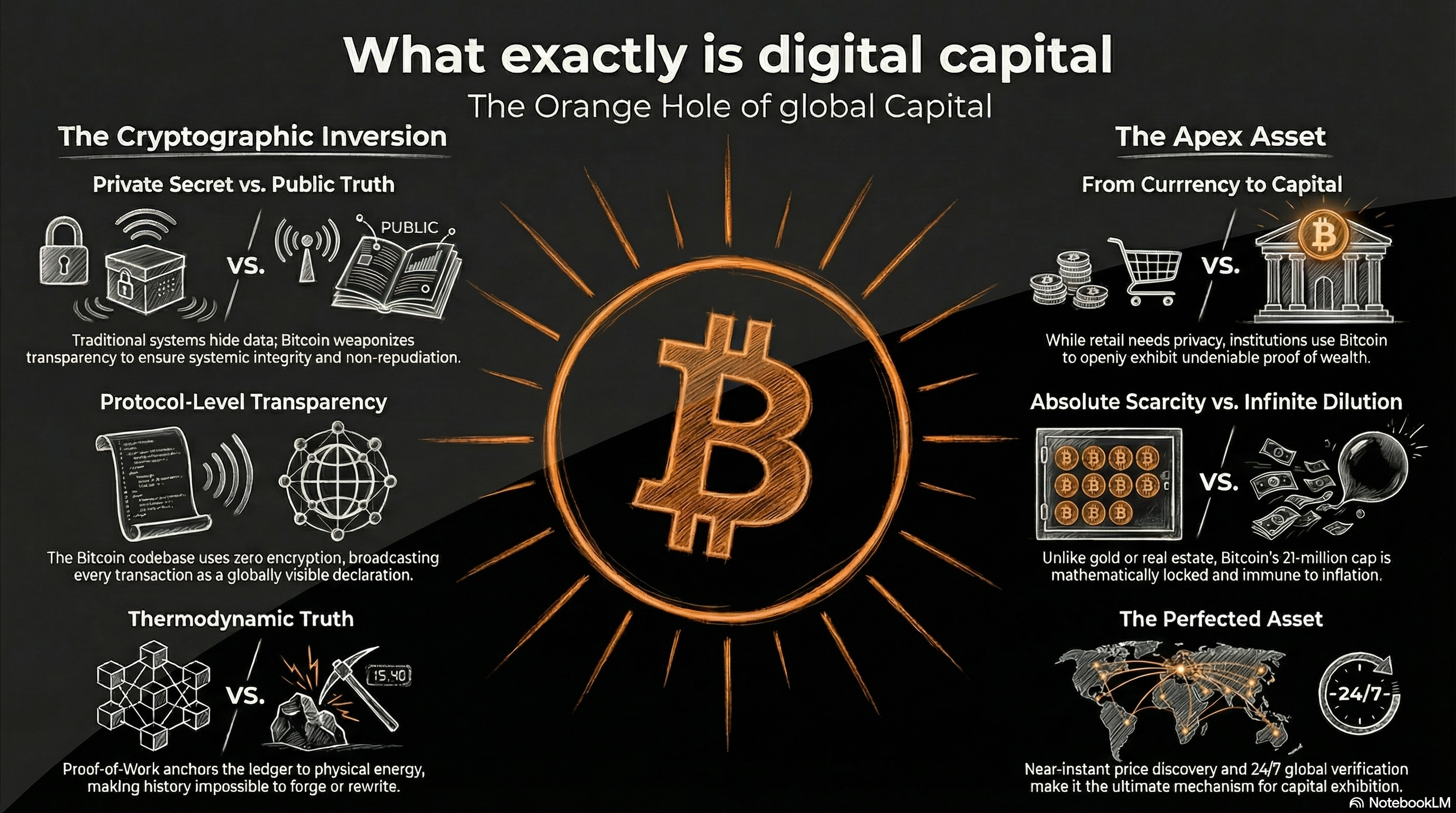
In late 2008, the pseudonymous entity Satoshi Nakamoto published a whitepaper that fundamentally subverted this ancient paradigm.3 While originally pitched as an electronic cash system, the architecture actually birthed something far more profound: a digital capital network. Bitcoin leverages the precise mathematical tools of cryptography—specifically cryptographic hash functions—not to conceal information, but to expose it to the absolute maximum degree.4 It utilizes cryptography to authenticate an open statement, deliberately discarding the pillar of confidentiality in favor of absolute transparency, structural integrity, and systemic non-repudiation.4 By weaponizing cryptographic primitives to secure an open, distributed ledger, Bitcoin flips the purpose of cryptography on its head. It transitions the discipline from a mechanism engineered for generating an “immutable secret” to a deterministic engine designed for generating an “immutable open statement”.5
The consequence of this architectural inversion is the creation of perfected digital capital. By making the secret definitively public and open, Bitcoin engineers an objective “public truth”.6 It establishes a thermodynamic and mathematical consensus reality that relies on cryptographic proof rather than institutional opacity.7 This exhaustive research report provides a deep technical and philosophical analysis of this paradigm shift. It dissects the Bitcoin codebase, evaluates the cryptographic primitives employed at the protocol layer, explores why public blockchains fail as everyday currencies but triumph as apex assets, and analyzes the profound societal utility of objectively exhibiting decentralized public capital.
The Historical Teleology of Cryptography: The Utility of Private Truth
To grasp the magnitude of Bitcoin’s architectural departure, one must first rigorously examine the historical trajectory and foundational assumptions of cryptography. Early cryptographic methods were almost entirely concerned with message confidentiality and the obfuscation of plaintext.8 Julius Caesar utilized a simple substitution cipher—shifting the alphabet by a fixed number of positions—to securely transmit battle plans to his generals without exposing strategic truths to intercepting adversaries.1 In the modern era, coinciding with the advent of digital computing in the 20th century, the dawn of the digital age heralded the birth of highly sophisticated encryption algorithms.2 Cryptanalysts and mathematicians developed complex cryptosystems to protect top-secret government communications, secure personal digital privacy, and safeguard the transmission of sensitive financial data over public networks.2
The conceptual foundation of all these systems is the paradigm of the “Private Truth.” An encrypted message contains a truth (the plaintext) that is intentionally obfuscated into a mathematically chaotic state (the ciphertext) using specific encryption schemes.2 The truth definitively exists, but it is cordoned off from the public sphere, rendered accessible only to those entities possessing the requisite decryption key.2 This paradigm inherently necessitates a closed, permissive system where access is synonymous with decryption.
Modern cryptography is broadly categorized into symmetric and asymmetric systems, both of which historically served the master of confidentiality. Symmetric cryptography requires both the sender and the recipient to share a single, identical secret key to encrypt and decrypt the payload.9 Asymmetric cryptography, widely known as Public Key Cryptography (PKC), introduced a revolutionary dual-key system: a public key that can be openly distributed, and a mathematically linked private key that is kept strictly secret.9
While asymmetric cryptography enabled digital signatures and key exchanges without the perilous logistical necessity of transmitting a shared secret over an insecure channel, its primary application remained stubbornly rooted in confidentiality.10 Secure Sockets Layer (SSL), Transport Layer Security (TLS), and modern end-to-end encrypted messaging systems all utilize these cryptographic primitives to establish secure, opaque tunnels through the inherently transparent infrastructure of the internet.9 The primary objective in these architectures is the obfuscation of the message content.11
The Nature of Human Organization: Converting Fiat to Capital
To understand why a system completely devoid of this traditional encryption is valuable, we must define the economic purpose of human organization. Whether looking at a sovereign nation-state or a global corporation, the fundamental lifecycle of an organization revolves around raising and deploying resources.
Organizations raise “fiat”—currency, operating liquidity, and immediate purchasing power—through mechanisms like debt issuance, equity sales, or taxation. However, holding fiat is not the ultimate goal. The primary objective is to strategically convert that raised fiat into Capital. Capital represents the assets accumulated on a balance sheet that are perceived to hold and generate greater value in the future. For example:
- A technology conglomerate like Google raises fiat to fund research and development, converting that money into a proprietary technology moat and intellectual property.
- A real estate investment trust (REIT) raises fiat from shareholders to acquire land and commercial properties.
- A mining corporation converts its operating fiat into heavy machinery and extracted physical gold.
In this economic cycle, the role of privacy (the Private Truth) is absolutely vital for operations. Corporations rightfully protect their operational data, supply chain logistics, and R&D pipelines as trade secrets to maintain a competitive advantage. Sovereign states protect their strategic transactions for national security. No rational entity wants its daily operational financial history broadcast on a public network.
However, while operations demand privacy, capital accumulation demands exhibition. Organizations have a distinct, driving need to openly showcase the Capital they have hoarded on their balance sheets. Displaying a robust, undeniable accumulation of Capital signals strength, dominance, and ultimate solvency to the market, which in turn allows the organization to raise more fiat money (through better debt terms or higher equity valuations) to continue the cycle.
Bitcoin’s open, immutable ledger purposefully strips away transactional privacy, making it a complete failure as an operational currency, but leaving behind the perfect mathematical mechanism for the undeniable exhibition of Capital.
The Architectural Inversion: From Immutable Secret to Open Statement
Bitcoin resolves the need for capital exhibition by entirely abandoning the concept of confidentiality at the protocol layer.4 To achieve this unprecedented feat, Bitcoin systematically separates the cryptographic concepts of authentication, integrity, and non-repudiation from the concept of confidentiality.4
In the core Bitcoin protocol and its underlying database structure, there is absolutely no encryption.4 The blockchain is a fully consensual, distributed, and completely unencrypted public ledger.4 Every transaction, every balance, every script, and every address is universally visible to any participant running a node anywhere on the network.12
Anatomy of an Open Statement: Codebase Analysis of CTransaction
An exhaustive examination of the Bitcoin Core source code reveals the stark transparency of the system’s fundamental data structures. The protocol utilizes a series of C++ classes to define the state of the network, none of which implement encryption for data-in-transit or data-at-rest.13
The primary structural object for network interaction is the CTransaction class.13 A transaction in Bitcoin is not a transfer of encrypted balances within an opaque database; rather, it is an open, globally broadcast statement declaring the destruction of previous cryptographic locks and the creation of new ones. The architecture of this statement is explicitly designed for public consumption and verification.
| Component | Codebase Description | Visibility and Function |
|---|---|---|
| COutPoint | A reference to a specific output from a previous transaction. It consists of a Txid (a 256-bit transaction hash) and an index number n referencing the previous transaction’s output array. | Plaintext. It allows any node to globally locate the exact origin of the funds being claimed.13 |
| CTxIn (Transaction Input) | Contains the prevout location data and the scriptSig (the cryptographic signature proving authorization to spend the referenced output). It also includes an nSequence number. | Plaintext binary string. It exposes the cryptographic proof of ownership to the entire network.13 |
| CTxOut (Transaction Output) | Contains the nValue (the precise amount of Satoshi being transferred) and the scriptPubKey (the mathematical conditions and opcodes required to spend those specific funds in the future). | Plaintext numeric values and scripting opcodes. It acts as a transparent, mathematically verifiable lock.13 |
| CTransaction | The immutable aggregate structure containing vectors of inputs (vin), outputs (vout), a version number, and a nLockTime variable. | Fully unencrypted and publicly broadcast. Represents the complete open statement.13 |
This structural architecture conclusively proves that Bitcoin’s application of cryptography is distinctly divorced from the traditional pursuit of secrecy.14 Users do not encrypt a private message asking for an account update. Instead, they digitally sign a globally visible statement and broadcast it to thousands of mutually suspicious nodes simultaneously.3
Hashing and UTXOs: The Engine of Structural Truth
To secure this exhibition of capital without encryption, the system requires an incredibly robust alternative mechanism to prevent tampering, forgery, and double-spending.14 Bitcoin achieves this through the exhaustive, systemic application of one-way cryptographic hash functions (specifically SHA-256) and the Unspent Transaction Output (UTXO) model.1
Unlike traditional bank accounts that track an ongoing total balance, Bitcoin operates strictly on UTXOs. Every unit of Bitcoin exists as a discrete, indivisible output locked by a script. When a transaction occurs, it completely consumes the existing UTXOs as inputs and creates entirely new UTXOs as outputs.
Resolving the Double-Spend Dilemma
Because the ledger is unencrypted, one must ask: what prevents an actor from broadcasting two validly signed transactions that attempt to spend the exact same UTXO at the same time?
- Mempool Validation: When an actor broadcasts two conflicting transactions to the network, individual nodes receive them at slightly different times. A node will accept the first valid transaction it sees into its memory pool (mempool) and will instantly reject the conflicting second transaction, refusing to relay it further.2. Block Constraints: A single miner cannot mathematically include both conflicting transactions within the same block; the protocol’s strict rules dictate that a UTXO can only be consumed once, rendering any block containing a double-spend structurally invalid to the rest of the network.15. Thermodynamic Consensus (Proof-of-Work): If the two conflicting transactions propagate to two different miners, and both miners successfully solve the intensely difficult SHA-2[^16] Proof-of-Work cryptographic puzzle at the exact same moment, a temporary network fork occurs.
Bitcoin resolves this temporary fork through the physical laws of thermodynamics via the “longest chain rule”.16 The network will naturally build upon whichever block is extended first by the next miner. The shorter chain is orphaned and discarded, and any transactions unique to that discarded block (including the losing half of the double-spend) are invalidated. The public ledger is thus firmly anchored to the physical world through the demonstrable expenditure of real energy, establishing an objective, chronological, and completely immutable history.17
The Epistemological Shift: Table Truth vs. Public Truth
Moving beyond its technical architecture, Bitcoin’s utilization of cryptography initiates a profound epistemological shift in how modern society archives and exhibits objective reality. It perfectly balances the sociological dichotomies between the private domain and the public sphere.
In sociological and philosophical analysis, there is a recognized distinction between “table truth” and “public truth”.18
- Table Truth (The Private Truth): This represents the unvarnished, internal reality of an entity. In a corporate context, “table truth” consists of operational privacy, proprietary algorithms, localized supply chain vulnerabilities, and unannounced strategic acquisitions. This privacy is functional, necessary, and fiercely protected.
- Public Truth: This represents the curated statement an entity presents to the outside world to build trust, satisfy shareholders, and project strength.
Historically, bridging the gap between an organization’s private table truth and its public truth requires friction-heavy, trusted third parties (like auditing firms and regulatory bodies) to verify that the public statement accurately reflects the private reality.
Bitcoin fundamentally alters this dynamic for capital exhibition. It utilizes advanced cryptography not to hide the private truth, but to provide a mechanism where the Capital aspect of an entity’s balance sheet can be independently and globally verified as an absolute Public Truth without requiring the entity to expose its operational Table Truth. When a transaction is locked into a block via SHA-2[^16] Proof-of-Work, it transforms instantly into an undeniable, globally accessible public truth.19 The ledger is the absolute reality, allowing the globe to instantly verify an entity’s accrued capital without needing to trust a single intermediary or auditor.20
The Ultimate Manifestation: The Apex Asset and Perfected Digital Capital
Because corporations and sovereign entities exist to raise fiat and convert it into Capital that preserves and grows value for the future, the ultimate test of any asset is how accurately and quickly its value can be ascertained and exhibited.
Historically, ascertaining the true value of traditional Capital assets is a slow, opaque, and highly subjective endeavor. Consider real estate: acquiring land and constructing a property requires massive upfront capital and years of time. Crucially, once the property is built, its true market value remains entirely theoretical until a definitive sale occurs, which could take decades. Similarly, the valuation of intellectual property, such as Apple’s proprietary technology, can only be accurately gauged during quarterly earnings reports. For nation-states, attempting to quantify the value of their social programs or political stability is nearly impossible.
This friction in traditional capital formation is precisely what makes Bitcoin the “Apex Asset.” Unlike real estate or corporate infrastructure, which take years to fructify, the acquisition of Bitcoin is near-instantaneous. Once acquired, its price discovery is near-perfect; it trades continuously on global exchanges without closing times, providing a minute-by-minute, cryptographically undeniable proof of exactly what that capital is worth translated across dozens of global fiat systems.
Finally, the ultimate driver of this digital capital is the absolute scarcity enshrined in its code. In the physical and corporate worlds, whenever an asset demonstrates immense value, competitors inevitably imitate and inflate the supply. Google’s technology moat is aggressively challenged by OpenAI; Apple’s market dominance is perpetually challenged by Microsoft. Even physical gold, the historical standard of scarce capital, suffers from pseudo-scarcity; as its price rises, it becomes economically viable to dig deeper into the earth, and the future promises massive supply expansions through deep-sea and asteroid mining.
Bitcoin is immune to this physical and corporate inflation. Its hard cap of21 million units is mathematically locked into the protocol. It cannot be diluted by competitors, it cannot be mined from asteroids, and it cannot be over-leveraged in secret. It is the perfect marriage of absolute, code-enshrined scarcity and immediate, public verifiability.
Therefore, by flipping the purpose of cryptography from creating an immutable secret to creating an immutable open statement, Bitcoin transcends the role of a mere currency. It becomes perfected digital capital: an apex asset allowing any entity to instantly acquire, perfectly price, and undeniably exhibit their accumulated wealth to the entire world.
Tips and Donations
If you enjoyed this deep dive, consider supporting the project with a tip in Sats. It’s a simple, global way to support independent research.
To send Sats, you’ll need a lightning wallet.
References
-
Cryptography systems and the Merkle tree - Banco Santander, accessed March 28, 2026, https://www.santander.com/en/stories/cryptography-blockchain ↩ ↩2 ↩3 ↩4
-
The History of Cryptography | IBM, accessed March 28, 2026, https://www.ibm.com/think/topics/cryptography-history ↩ ↩2 ↩3 ↩4 ↩5 ↩6
-
The History of the Blockchain and Bitcoin | Freeman Law, accessed March 28, 2026, https://freemanlaw.com/the-history-of-the-blockchain-and-bitcoin/ ↩ ↩2
-
How Bitcoin Uses Cryptography | River, accessed March 28, 2026, https://river.com/learn/how-bitcoin-uses-cryptography/ ↩ ↩2 ↩3 ↩4 ↩5 ↩6
-
What Is Blockchain? | IBM, accessed March 28, 2026, https://www.ibm.com/think/topics/blockchain ↩
-
accessed December 31, 1969, https://medium.com/the-bitcoin-times/bitcoin-and-the-philosophy-of-truth-3236e3c8868a ↩
-
The Quotable Satoshi - Cryptocurrency, accessed March 28, 2026, https://satoshi.nakamotoinstitute.org/quotes/cryptocurrency/ ↩
-
From Julius Caesar to the blockchain: a brief history of cryptography - Ensae Alumni, accessed March 28, 2026, https://www.ensae.org/fr/news/745 ↩
-
Cryptography 101: Demystifying Cryptography and Cryptocurrency & the Impacts on Cybersecurity | LMG Security, accessed March 28, 2026, https://www.lmgsecurity.com/cryptography-101-demystifying-cryptography-and-cryptocurrency-its-impact-on-cybersecurity/ ↩ ↩2 ↩3
-
Technical principles and protocols of encryption and their significance and effects on technology regulation - Taylor & Francis, accessed March 28, 2026, https://www.tandfonline.com/doi/full/10.1080/13600834.2024.2404280 ↩
-
Cryptography as the Means to Protect Fundamental Human Rights - MDPI, accessed March 28, 2026, https://www.mdpi.com/2410-387X/5/4/34 ↩
-
BITCOIN VERSUS TRADITIONAL PAYMENT SYSTEMS: IS ONE MORE EFFECTIVE THAN THE OTHER? - WisdomTree.eu, accessed March 28, 2026, https://www.wisdomtree.eu/-/media/eu-media-files/other-documents/research/market-insights/market-insight-bitcoin-vs-traditional-payment.pdf?sc_lang=en-gb ↩
-
bitcoin/src/primitives/transaction.h at master · bitcoin/bitcoin · GitHub, accessed March 28, 2026, https://github.com/bitcoin/bitcoin/blob/master/src/primitives/transaction.h ↩ ↩2 ↩3 ↩4 ↩5 ↩6
-
The Basics of Hash Functions and their Role in Bitcoin Security - D …, accessed March 28, 2026, https://d-central.tech/the-basics-of-hash-functions-and-their-role-in-bitcoin-security/ ↩ ↩2
-
How Do Cryptocurrencies Use Cryptography? - Kraken, accessed March 28, 2026, https://www.kraken.com/learn/how-do-cryptocurrencies-use-cryptography ↩
-
Bitcoin: A Peer-to-Peer Electronic Cash System - United States Sentencing Commission, accessed March 28, 2026, https://www.ussc.gov/sites/default/files/pdf/training/annual-national-training-seminar/2018/Emerging_Tech_Bitcoin_Crypto.pdf ↩
-
Cryptography in Blockchain. From Hashing to Merkle Trees and Why It… | by Rpsewminikavindya | Feb, 2026 | Medium, accessed March 28, 2026, https://medium.com/@rpsewminikavindya/cryptography-in-blockchain-382087261de4 ↩
-
From Violence to Blessing - exploring mimetic theory, biblical theology, & beloved community, accessed March 28, 2026, https://theologyandpeace.com/wp-content/uploads/2020/08/from-violence-to-blessing_vern-redekop.pdf ↩
-
How does Bitcoin work? - Bitcoin, accessed March 28, 2026, https://bitcoin.org/en/how-it-works ↩
-
Money, Blockchains, and Social Scalability | Satoshi Nakamoto …, accessed March 28, 2026, https://nakamotoinstitute.org/library/money-blockchains-and-social-scalability/ ↩
-
What data structure is used to store the bitcoin transactions in the blockchain?, accessed March 28, 2026, https://bitcoin.stackexchange.com/questions/114243/what-data-structure-is-used-to-store-the-bitcoin-transactions-in-the-blockchain ↩