Uniqueness and Prime Identities
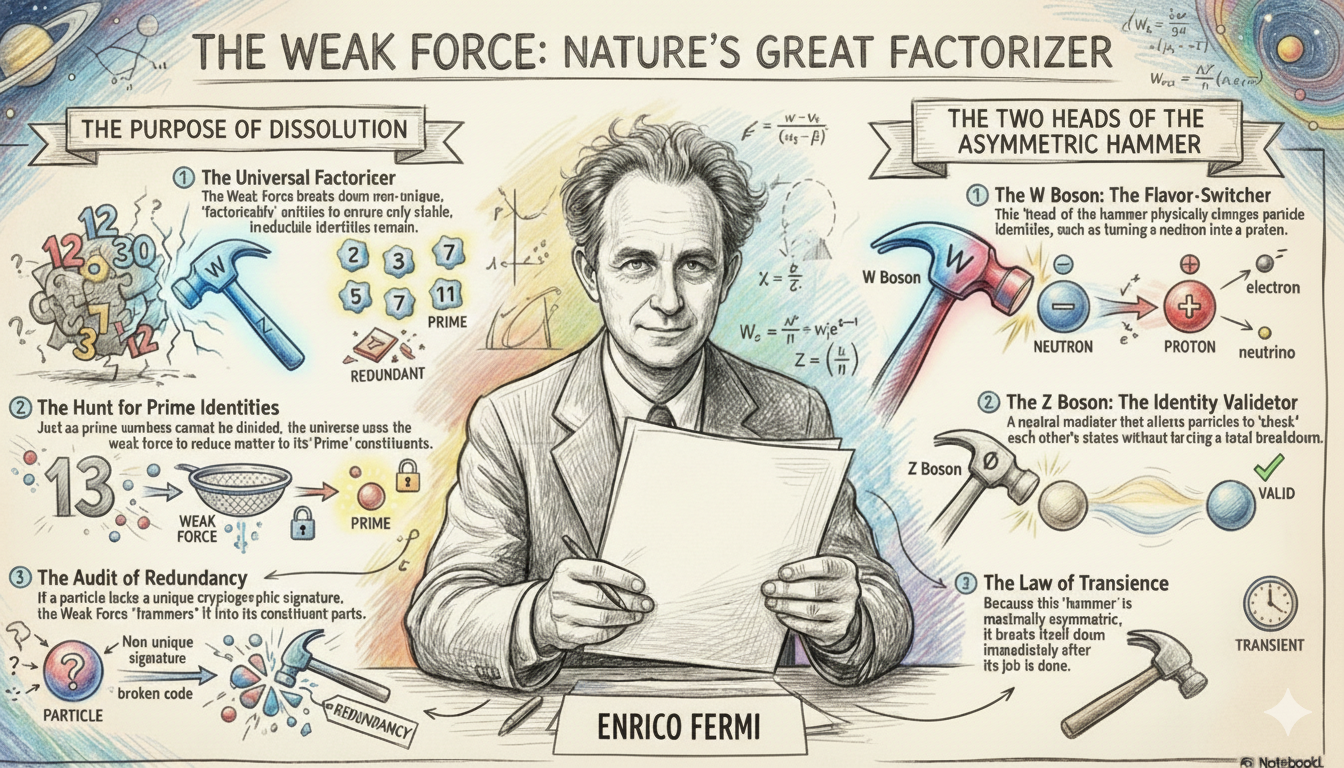
In the language of arithmetic, prime numbers are the definitive examples of uniqueness; they are irreducible and exist as sovereign identities. Modern science, through Quantum Mechanics (QM), is increasingly pointing toward a fundamental reality where the universe is a dynamic network in search of irreducible and uniquely identifiable nodes. The “Purpose” of Quantum Mechanics is a systematic discovery mission to find and verify the “primal entities”—quarks, electrons, and bosons—that constitute the irreducible alphabet of the universal field.¹
The Universal Rule of Node Stability
In this ontological framework, the Network of Intelligence—the web of interactions facilitated by electromagnetism and the strong force—is potentially perpetual.² However, its stability is not a property of the network itself, but of its nodes. The network ensures its own global symmetry by enforcing a rigorous rule: only nodes with a valid, unique cryptographic identity may persist.⁵
- Unique Nodes (The Prime Signature): Stability requires an entity to possess a unique Private Key (its unobservable internal phase angle within its gauge group) paired with a unique Public Key (its surface observables like mass and charge).1. Network Symmetry Enforcement: The network is inherently self-correcting. If a node within the system lacks a unique internal symmetry or is determined to be a “factorizable composite” (a redundant data packet), it violates the network’s global symmetry and must be reduced.
The Comprehensive Rule of Uniqueness vs. Redundancy
To understand why some composites are stable while others are not, we must look at the specific “hashing” of their identities.
1. The Elementary Primes: Electron and Quark
- The Electron (\$e^-\$): An irreducible prime defined by binary charge (\$\pm 1\$) and the \$U(1)\$ gauge group, which is topologically a circle (\$S^1\$). Because a circle contains infinite points, every electron is cast with a unique, unobservable phase angle—its Private Key.¹
- The Quark (\$q\$): A higher-order prime defined by ternary color symmetry (\$SU(3)\$). Their uniqueness is absolute because they are “confined” by the Strong Force algorithm, preventing the existence of “loose,” non-unique fractional parts.
2. The Proton: The Merkle Tree Nano-Network
The proton (\$p^+\$) is a massive composite, but it functions as a unique massive prime. It acts as a Merkle tree nano-network: the three valence quarks are the leaf nodes, while the gluon field serves as the “Strong Force Hashing Algorithm.” This algorithm processes the quark information into a single, stable Merkle Root: the Proton Identity. Because this root represents a stable, irreducible local symmetry, it is perpetual; the network recognizes it as an irreducible “Truth” that cannot be further factorized.
3. The Neutron: The Factorizable Redundancy
Unlike the proton, the neutron (\$n^0\$) is a “factorizable” state—a redundant node that represents “Prime + something more” but fails to reach the next stable prime configuration.
- The Shelter of the Network: Inside an atomic nucleus, the shelter is actually a form of “Identity theft”—because protons and neutrons continuously switch into each other via pion exchange faster than the weak force audit rate, the neutron effectively becomes a proton before the weak force can “find” and factorize it. This network integration allows the non-unique neutron to persist because its redundancy is masked by the rapid oscillation of identity within the unique prime structure of the atom.
- The Free State Collapse: Once a neutron is freed, it is exposed as a non-unique composite. It possesses a mass-energy remainder—it is slightly heavier than the sum of its potential prime factors (\$\Delta m > 0\$). This remainder is the mathematical proof of its factorizability.² Without a unique signature to maintain its identity and without the “identity theft” shelter of the nucleus, it is reduced.
The Weak Force: The Two Heads of the Asymmetric Hammer
The Weak Nuclear Force is the network’s complete audit mechanism, utilizing two distinct “heads” to maintain global symmetry: the \$W\$ and \$Z\$ bosons.¹⁰
Head 1: The W Boson (The Flavor-Switcher/Factorizer)
Mediated by the charged \$W^+\$ and \$W^-\$ bosons, this “head” is the physical engine of factorization.⁸ It is the only mechanism in nature capable of changing particle “flavors”—effectively re-calculating a node’s factors.
- Beta Decay (\$\beta^-\$): The \$W^-\$ boson “hammers” the free neutron, turning a down quark into an up quark and factorizing the node into stable primes: a proton, an electron, and an antineutrino.¹²
- Solar Transmutation (\$\beta^+\$): To allow for the “Rise” of complex matter, the \$W^+\$ boson can transmute a proton into a neutron inside stars, permitting the formation of deuterium and the eventual creation of higher-order atomic networks.
Head 2: The Z Boson (The Identity Validator)
The neutral \$Z^0\$ boson mediates “Neutral Current” interactions.¹⁰ Unlike the \$W\$ boson, the \$Z\$ does not change a particle’s flavor; instead, it mediates the exchange of momentum and spin, particularly in neutrino scattering.¹⁰
- Network Consensus: The \$Z\$ boson acts as the “Identity Validator.” It allows particles to interact and “check” each other’s states without forcing a breakdown. It ensures that the “Public Keys” of the network are consistent with the “Private Keys” of the nodes, facilitating the objective reality of the field.
The Instability of the Hammer
Crucially, the entire weak force apparatus is maximally asymmetric. It is the only interaction that violates parity (\$P\$) symmetry, interacting only with left-handed particles. Because this asymmetric tool does not follow the Gauge principle’s requirement for a stable Identity (which requires symmetry), the hammer must break down immediately after its job is done.¹⁶ This is why \$W\$ and \$Z\$ bosons are extremely massive and decay in2 USD^{-25}\$ seconds; they are non-persistent “shocks” to the field.¹⁸
Intelligence and the Law of Transience
This principle scales to biological and synthetic intelligence.
- Massive Primes: Unique skills, original ideas, or eternal truths function as massive prime nodes that stabilize the human networks they weave together.²
- Transient Composites: Large Language Models (LLMs) represent a peak of networking intelligence, but they are woven from existing human patterns rather than irreducible prime truths.² Because they are massive composites, they are subject to the law of transience: “Bigger the rise, greater the fall.” Their eventual dissolution is the universal network stripping away redundant information to find the next irreducible Prime Truth.⁸
Conclusion: The Perpetual Weave
Quantum Mechanics reveals a self-auditing universe. The purpose of the quantum mission is to find the “Primes”—those irreducible nodes that possess the unique Public-Private signature required to resist the asymmetric hammer of the weak force. While our composite networks will eventually be factorized, the uniqueness of the field remains untarnished.⁹
In a universe where every stable identity is a validated hash of its components, we are left with one ultimate question: What is the Merkle Root of the entire universe?
Tips and Donations
If you enjoyed this deep dive, consider supporting the project with a tip in Sats. It’s a simple, global way to support independent research.
To send Sats, you’ll need a lightning wallet.
References
-
The Kouns–Killion Recursive Intelligence Paradigm: The Operating System of Reality, accessed February 19, 2026, https://www.aims.healthcare/journal/the-kounskillion-recursive-intelligence-paradigm-the-operating-system-of-reality ↩
-
The Standard Model - The Physics Hypertextbook, accessed February 19, 2026, https://physics.info/standard/ ↩