Chiral Ontology of the Self
Abstract
This report presents an exhaustive investigation into the geometric structure of authenticity, positing that the relationship between the individual agent (Microcosm) and the universal totality (Macrocosm) is governed not by linear causality or moral obligation, but by the physics of chirality (mirror symmetry) and parity. By synthesizing principles from computational complexity theory, non-equilibrium thermodynamics, neurobiology, and Spinozist metaphysics, we construct a rigorous argument demonstrating that the most “selfishly” authentic act—the precise definition of one’s internal contour—is the only geometric mechanism by which the collective will of the universe can be fulfilled. We further apply this framework to the ancient discipline of Karma Yoga, reinterpreting it not as religious dogma but as a cybernetic feedback loop that resolves the friction between individual intent and universal reality.
—
Part I: The Computational Impossibility of the External
The foundational premise of this argument serves as a negative proof: the individual agent cannot, by definition, compute the “will” or “need” of the collective universe through external observation. This is not merely a philosophical limitation of human wisdom but a hard mathematical limit imposed by the laws of thermodynamics, information theory, and complex adaptive systems. To attempt to navigate one’s life by calculating “what the universe wants” is to engage in a computational fallacy analogous to the “Halting Problem” or the impossible physics of Laplace’s Demon.
1.1 The Laplace Limit and the Fallacy of Deterministic Prediction
The historical ambition of objective morality—the idea that one can look at the world, assess its deficiencies, and calculate the optimal intervention—rests on a Newtonian conception of the universe. This view assumes that the universe is a closed system of linear variables where the future is a direct, computable function of the present. This view culminated in the concept of “Laplace’s Demon,” an intellect proposed by Pierre-Simon Laplace in 1814 that, knowing the precise position and momentum of every particle in the universe, could perfectly predict the entire future trajectory of the cosmos.1
If the universe were Laplacian, authenticity would indeed be linear: one would simply consult the Demon, calculate the “Universal Need,” and shape oneself to fill it. However, modern physics and information theory have definitively dismantled this possibility. The universe is an open system characterized by thermodynamic irreversibility and quantum indeterminacy. As recent critiques of complexity theory highlight, even a hypothetical demon possessing infinite computational power would fail to predict the collective will because of “sensitive dependence on initial conditions”—the hallmark of chaos theory.2 A deviation in the measurement of a single atom’s position by 0.00000000000001% would render the macroscopic prediction of the system entirely invalid after a short temporal horizon.2
1.1.1 The Recursive Bind of the Open System
For an individual to calculate “what the universe wants from them,” they would need to build a predictive model of the universe that includes themselves as a variable. This triggers a paradox of self-reference found in computation theory. A system attempting to model itself enters an infinite regress (The Model must contain the Model, which must contain the Model…), leading to “computational inertness”.3 The “collective want” is not a static data point waiting to be read; it is an emergent property that arises from the interactions of agents. It changes the moment the agent interacts with it.1
Therefore, looking outward to determine one’s shape is a category error. It is an attempt to read a map that is being drawn in real-time by the footsteps of the reader. The “Prediction Limit” is absolute: the external world is computationally opaque to the finite agent.
1.2 The Signal-to-Noise Problem in External Vectors
Even if we step back from the physics of total prediction and merely attempt to “read the room” of society, the individual is confronted with the “Noise” of contradictory vectors. The external environment does not broadcast a unified signal of “Need.” Instead, it bombards the agent with conflicting optimization targets.
- Biological Vectors: The genetic imperative demands reproduction, safety, and caloric surplus.
- Economic Vectors: The market demands specialization, capital accumulation, and competitive advantage.
- Cultural Vectors: Society demands conformity, altruism, and self-effacement.
These vectors do not sum to a coherent direction; they often cancel each other out or create a state of “decision latency” where the agent is paralyzed by the impossibility of satisfying all external variables . Hayek’s “Knowledge Problem” in economics provides a robust analogue here. Hayek argued that no central planner (and by extension, no individual moral calculator) can aggregate the dispersed, tacit knowledge of a whole society to set a “price”.4 The “knowledge” of what is needed is distributed in the “cloud,” not computable by the “head”.4 Similarly, the individual cannot compute the “price” of their life (their authentic path) by aggregating external data. The data is too dispersed, too contradictory, and too rapid.6
Table 1: The Computational Asymmetry of Direction
| Inquiry Vector | Data Source | Latency | Computational Cost | Fidelity |
|---|---|---|---|---|
| Outward-In (External) | Infinite Variables (History, Society, Economy) | High (Lagging Indicators) | Infinite (Uncomputable) | Low (Contradictory/Noise) |
| Inward-Out (Internal) | Singular Impulse (Conatus/Acorn) | Zero (Real-Time) | Low (Direct Access) | High (Deterministic Signal) |
1.3 Thermodynamic Coordination and Information Loss
Recent advancements in “Thermodynamic Coordination Theory” (TCT) suggest that for multiple agents to coordinate toward a collective goal, they must undergo “radical information loss”.8 To align with a group, an individual must compress their high-dimensional complexity into a low-dimensional signal that the group can process (e.g., “I am a doctor,” “I am a soldier”).
This “coarse-graining” creates a thermodynamic tension. When an individual attempts to shape themselves based on external expectations, they are essentially performing lossy data compression on their own being. They strip away the nuance of their specific “shape” to fit a generic social protocol. This results in a loss of “ontological fit,” where the individual becomes a generic component rather than a specific solution. The universe, being a complex adaptive system, thrives on high-fidelity information, not generic redundancy. By trying to be “what is needed” (a generic good person), the individual deprives the universe of the specific information (the unique self) that the system actually requires for novelty and evolution.8
—
Part II: The Zero-Latency Signal of the Internal
If the external world is a domain of noise, latency, and computational opacity, the internal world offers a signal of “zero latency.” This section validates the “Internal Impulse” not as a fleeting whim or a hedonistic distraction, but as a precise, deterministic data stream—the only data point in the universe that the individual can access directly, without the distortion of sensory estimation.
2.1 The Physics of Impulse: Conatus and the Will
To understand why “Impulse” is a valid navigational tool, we must strip the term of its pejorative associations with “impulsivity” (which is often a reaction to external stimuli, i.e., a compulsion).10 True impulse is the expression of Conatus.
2.1.1 Spinoza’s Conatus and the Conservation of Being
Baruch Spinoza defined Conatus as the innate, striving force of a thing to “persevere in its being”.11 This is not merely a biological survival instinct; it is the metaphysical inertia of the entity’s essence. A thing does not desire because it lacks; it desires because it is.12 The internal impulse is the direct manifestation of this force. It is the universe’s energy localized in a specific mode, attempting to sustain and expand its unique geometry.
Nietzsche expanded this into the Will to Power, arguing that the fundamental drive of any organism is not mere preservation (which is reactive) but the discharge of strength (which is active).13 In this framework, an individual’s deepest desires are not choices made by the ego, but forces acting through the ego. They are the “universe’s code” executing on specific hardware.2 To suppress this impulse is to dampen the total energy of the system.
2.1.2 The “Acorn” Theory of Destiny
Psychologist James Hillman formalized this intuition in his “Acorn Theory,” which posits that each individual enters the world with a unique “daimon” or image that defines their destiny, much like an acorn holds the pattern of the oak.14 This “soul’s code” is present before environmental conditioning. The “impulse” is the daimon’s attempt to align the life with its innate pattern.16
Crucially, this theory argues that the “Acorn” is deterministic in its shape but free in its realization. An acorn cannot choose to be a rose; its “freedom” lies only in becoming a magnificent oak or a stunted one. The “Impulse” is the data stream guiding the organism toward its optimal ontological shape. Ignoring this signal leads to pathology—a “loss of soul” where the individual becomes a hollow shell of external expectations.17
2.2 The Neuroscience of Zero Latency
Cognitive neuroscience provides the physiological mechanism for this argument. The brain operates two distinct processing systems: System 1 (Intuition) and System 2 (Analysis).
2.2.1 Processing Speed and Efficiency
Analytical reasoning (“System 2”) is slow, serial, and resource-intensive.18 It is the system used to “calculate” external duty or social expectations. It suffers from high latency and is easily overwhelmed by the “Noise” of the external world.19
In contrast, Intuition (“System 1”) operates as a high-bandwidth, parallel processing system.20 It synthesizes vast amounts of subconscious data, genetic predispositions, somatic markers, and past experiences in milliseconds.21
- Zero Latency: The “Impulse” is the output of this high-speed calculation. It arrives in the conscious mind effectively instantaneously. It is the only signal the organism receives with “zero latency” .
- The “Gut” Brain: This signal is often transmitted via the Enteric Nervous System (ENS) and the Vagus nerve—the “second brain” in the gut.22 Research confirms that in complex, high-variable environments (like life), “gut” decisions often outperform analytical ones because they bypass the bottleneck of conscious deliberation and access the “total history” of the organism .
2.2.2 Interoception as the Primary Signal
This internal signal is grounded in interoception—the brain’s perception of the body’s internal state.23 While exteroception (perception of the outside world) deals with the “impossibility of the external,” interoception deals with the “certainty of the internal.”
Predictive coding models in neuroscience suggest that the brain minimizes “free energy” (surprise) by comparing internal predictions with sensory inputs.24 When an individual suppresses their interoceptive signals (impulses) to conform to an external model (e.g., “I feel I should paint, but the market says I should code”), they generate massive “prediction error” or dissonance.24 This dissonance manifests as anxiety, alienation, and a loss of agency.25 The “Impulse” is the system’s attempt to restore homeostasis and coherence—to align the organism with its structural reality.
2.3 The Deterministic Nature of “Want”
A common critique of following one’s impulse is that desires are random, selfish, or socially constructed. However, from a rigorous deterministic perspective, “randomness” is an illusion caused by ignorance of causes.
In a deterministic universe (or even a probabilistic quantum one), a person’s “want” is the necessary output of the equation of their existence. It is the sum total of:
- Genetics: The hardware code.
- Epigenetics & History: The specific software updates installed by experience.
- Space-Time Coordinate: The specific location in the causal web.
There is no “Ghost in the Machine” making arbitrary choices. The “Impulse” is the universe calculating a vector through the individual.2 To reject the impulse in favor of an external “moral” calculation is to reject the specific data stream the universe has assigned to that node. It is an act of arrogance—assuming the conscious Ego knows better than the 13.8 billion years of causality that produced the Impulse.
—
Part III: The Kicker — Chirality and the Mirror Image
Having established that the External is uncomputable and the Internal is the primary data source, we arrive at the crux of the argument: the geometric relationship between the two. Why does following the internal signal (which seems selfish) fulfill the external need (which seems selfless)?
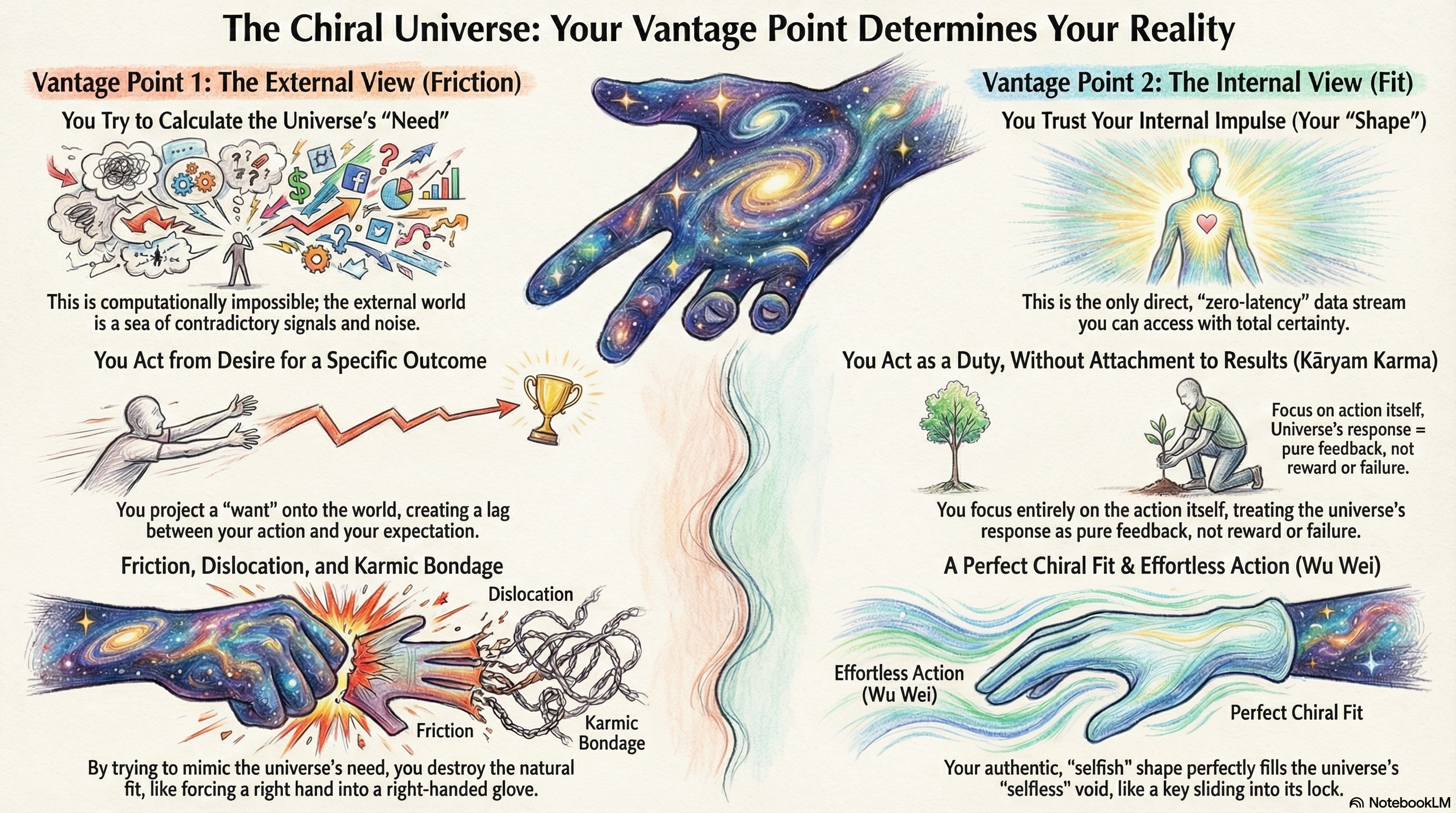
The answer lies in Chirality. The relationship between the Individual (Microcosm) and the Universe (Macrocosm) is not linear; it is chiral.
3.1 The Physics of Handedness
In physics and chemistry, chirality refers to the property of objects that are non-superimposable on their mirror images. A left hand and a right hand are chiral twins.26 They are identical in every internal measurement (angles, bone lengths, density), yet they are fundamentally different in their interaction with space. A left hand cannot fit into a right-handed glove.
3.1.1 The Geometry of the Void and the Solid
We can model the relationship between the Individual and the Universe using the concepts of Positive and Negative Space.28
- The Universe’s Need (The Void): The universe, being an open system of “lack” and “demand,” presents a specific “hole” or “negative space” at the exact coordinate of the individual. Let us say this hole is shaped like a “Right Hand.”
- The Individual’s Desire (The Solid): The individual’s Conatus or Acorn defines them as a specific “solid” or “positive space.” Let us say this solid is shaped like a “Left Hand.”
Crucially, a Right-Handed Void can only be filled by a Left-Handed Solid. They must be mirror images to interlock. If the solid were also Right-Handed (identical in orientation to the void), it would not fit; it would be a “dislocation”.30
3.2 The Illusion of Opposition (Parity)
This chiral relationship creates a perceptual paradox known as the “Illusion of Opposition.”
When we look at the Universe’s Need and the Individual’s Desire side-by-side on a linear plane, they appear to be opposites.
- The Universe says “Give.” The Individual says “Take” (or “Keep”).
- The Universe says “Sacrifice.” The Individual says “Grow.”
- The Universe acts as a Concave mold. The Individual acts as a Convex form.
To the linear mind (System 2), this looks like conflict. The individual thinks: “My desire contradicts the world’s need. I must change my shape.”
However, in chiral geometry, opposition is the prerequisite for fit. The left hand must be opposite to the right glove to enter it. If the individual tries to “fix” their selfishness by reversing their chirality (trying to become a “Right Hand” to match the “Right Hand” void), they effectively destroy the fit. They become an “Incongruent Counterpart”.31
3.3 Kant’s Incongruent Counterparts and Orientation
Immanuel Kant used the problem of “Incongruent Counterparts” (e.g., left and right hands) to prove that space has an intrinsic orientation that cannot be reduced to the relationship between parts.31
Kant argued that you could describe a left hand perfectly—listing every vein, bone, and angle—and that description would be identical to a description of a right hand. Yet, they are distinct. The difference is not in their content but in their orientation or parity within absolute space.
Applying this to authenticity: The “Selfish” act (Internal Impulse) and the “Selfless” act (External Duty) might look identical in terms of effort or energy, but they have opposite parity.
- Authenticity: Preserves the Left-Handed orientation (Self-Definition).
- Conformity: Attempts to twist the self into a Right-Handed orientation (External-Definition).
The universe is a “chiral environment”.30 It selects for specific asymmetries. It does not want a generic, achiral blob. It wants the specific, chiral key that fits the specific, chiral lock.
3.4 The Lock and Key Mechanism
This metaphor is literalized in biology. Enzymes (the agents of change in biological systems) work solely on the “Lock and Key” principle.34 An enzyme must maintain its specific, rigid shape to bind with the substrate. If the enzyme were to “relax” its shape to be more “accommodating” or “open” (less selfishly defined), it would lose its catalytic power.35
The “Acorn” is the key. The “Universal Situation” is the lock. The key must be “selfish” about its shape. If the key tries to look like the lock (empathy/mimicry), it fails. It must remain aggressively, stubbornly, the inverse of the lock.
—
Part IV: The 180-Degree Rotation
If the pieces are mirror images, how do we make them click? We cannot change the shape (the Solid). We must change the vantage point. This is the geometric operation of the 180-Degree Rotation.
4.1 Periagoge: The Turning of the Soul
Plato’s Republic describes the essence of education and enlightenment not as the implantation of sight, but as periagoge—the “turning around” of the whole soul.36
In the Allegory of the Cave, the prisoners face the wall, watching shadows (projections of reality). To see the truth, they must not merely “look harder” at the shadows; they must rotate their entire body 180 degrees away from the wall and toward the source of light.38
- The Shadow (External): The “Universe’s Need” as perceived by the calculating mind is a shadow. It is a projection. It is “computably impossible” to understand.
- The Light (Internal): The “Internal Impulse” is the source of the data.
- The Rotation: The individual must turn their back on the “Shadows” (the external calculation of what they should do) and face the “Light” (the internal reality of what they must do).
4.2 Metanoia and Paravrtti
This geometric rotation is echoed in the mystical traditions, reinforcing its universality.
- Metanoia (Christianity): Often mistranslated as “repentance” (feeling bad), the Greek metanoia literally means “beyond the mind” or a “change of mind”.39 It is a structural reorientation of the will—a turning away from the external performance of virtue toward an internal alignment with the Truth.40
- Paravrtti (Yogacara Buddhism): This concept describes a “turning about in the deepest seat of consciousness”.41 It is a “revulsion” from the false discrimination of the external world (the dualism of subject/object) and a return to the Alaya-vijnana (Storehouse Consciousness), where the “seeds” of reality are kept.42
In our geometric argument, Paravrtti is the moment the agent stops trying to “Reverse Prompt Engineer” the universe and instead allows the universe to run its code through them.
4.3 The Vantage Point Shift
The solution to the Chiral Puzzle—fitting the Hand into the Glove—requires the Hand to inhabit its own vantage point completely.
- The Friction of the External View: When you look at yourself from the outside (Universe’s perspective), you are trying to force your Left Hand into the Left Hand’s mold (because you are looking at the mold, mirroring it). This creates friction. You are “anti-aligned.”
- The Fit of the Internal View: When you inhabit your own hand (Internal Vantage), you essentially rotate 180 degrees relative to the mold. Now, your Left Hand is facing the Right-Handed Void correctly.
- Wu Wei (Effortless Action): This alignment results in Wu Wei.43 Wu Wei is not passivity; it is frictionlessness. It is the sensation of the key sliding into the lock. It occurs only when the individual stops “trying” (calculating external fit) and simply “is” (manifesting internal shape).44
—
Part V: Case Study — The Cybernetics of Karma Yoga
The geometric model of the “Lock and Key” provides a static image of alignment. However, life is a dynamic, evolving process. To understand how the individual (Key) navigates the changing universe (Lock) over time, we must look to the ancient discipline of Karma Yoga. When stripped of religious iconography and viewed through the lens of systems theory, Karma Yoga reveals itself as a sophisticated cybernetic loop designed to solve the “Prediction Limit” described in Part I.
5.1 The “Tiny Box” as Boundary Conditions
Every individual operates within a “Tiny Box”—a set of constraints defined by their body, their skills, their historical situation, and their environment. In physics, these are known as Boundary Conditions . You cannot solve a differential equation without defining the boundaries; similarly, you cannot solve the problem of your life by ignoring your constraints.
- The Illusion: We often try to run away from our “Tiny Box,” imagining a reality where we have different skills or are in a different location.
- The Reality: The “Tiny Box” is not a prison; it is the specific shape of the instrument. It is the “Given.” As the Bhagavad Gita states, one must perform the duty born of one’s own nature (Svabhava), even if it appears flawed, rather than the duty of another.7 The box objectively exists; it is the only place where action can occur.
5.2 The Two Vectors: Desire vs. Devotion
The central mechanism of the “180-Degree Rotation” (Part IV) is found in the distinction between two directional vectors: Desire (Kama) and Devotion/Duty (Yoga).
5.2.1 The Vector of Desire (The Friction)
When an individual acts from Desire, they are projecting a specific “want” onto the universe. They perform an action (e.g., creating a video, writing code) and simultaneously demand a specific response (e.g., 1 million views, a promotion).
- Signal Noise: Desire introduces “Lag” into the system. The individual is evaluating the present action against a future expectation. When the universe returns data that doesn’t match the expectation (e.g., low views), the individual perceives this as “failure” or “rejection.”
- Result: The ego resists the data. The “Tiny Box” remains static because the individual is too busy arguing with the feedback to learn from it.
5.2.2 The Vector of Devotion (The Chiral Fit)
When an individual acts from Karma Yoga, they perform the exact same action, but the vector of attention is rotated 180 degrees. They are not asking the universe to reward them; they are asking the universe to teach them.
- Brahman as Feedback: In this model, Brahman (The Universal Absolute) functions as the Universal Feedback Mechanism.15 The response from the world—whether it is analytics, physics, or market trends—is viewed as Prasad (Grace/Truth).12 It is absolute data.
- Cybernetic Calibration: The Yogi accepts this feedback without the distortion of ego. If the analytics are low, it is not a “rejection”; it is a “correction signal.” The Yogi uses this signal to calibrate their “Tiny Box,” improving their skills and adjusting their output.
5.3 Karyam Karma: The Algorithm of Chiral Fit
The Bhagavad Gita defines the perfect actor as one who performs Karyam Karma—“action that is to be done”.38 This is the algorithmic solution to the Chiral Puzzle.
“Do the necessary duty without attachment to the results.” (Gita 18.9)
We can translate this into information theory:
- Desire is a Lagging Indicator: Desire is based on a past mental model of how the world should look. It is a static image.
- Action (guided by Feedback) is a Leading Indicator: Action based on real-time feedback is dynamic.
The “180-degree rotation” of Karma Yoga is the shift from monitoring the Scoreboard (Reward/Fruit) to monitoring the Ball (Action). By the time you see the score, the game has moved on. The Yogi remains in the “Zero Latency” state of the internal impulse (Part II) while allowing the external feedback to edit their trajectory in real-time.
5.4 Summary: The Cybernetic Yogi
Karma Yoga is not a moral exhortation to be “good”; it is a technical instruction on how to minimize signal latency.
- Input (The Box): You accept your boundary conditions (skills/situation).
- Output (The Impulse): You act authentically according to your nature (Svabhava).
- Feedback (Brahman): The Universe responds.
- Iteration (Yoga): You accept the feedback as absolute truth (Prasad), free from the noise of “I wanted X.” You adjust. You act again.
By treating the External World not as a vending machine for desires but as a mirror for calibration, the “Selfish” act of the individual becomes perfectly tuned to the “Need” of the collective. The Microcosm processes the Macrocosm’s data, and the Chiral Fit is achieved.
—
Summary and Synthesis
The geometric argument for authenticity resolves the tension between Self and Universe by proving that they are not opposing forces, but chiral halves of a single mechanism.
- The Problem: The Universe is a Lock (Negative Space). You are the Key (Positive Space).
- The Error: You try to calculate the shape of the Lock by looking at it (External Calculation). This is impossible due to the Laplace Limit and Thermodynamic Chaos. You guess wrong. You try to mimic the Lock, becoming a hollow copy (Void mimicking Void).
- The Solution: You rely on the only zero-latency data you have: the shape of the Key in your hand (Internal Impulse). You accept that this shape (Selfishness) looks opposite to the Lock.
- The Mechanism: You perform the 180-Degree Rotation (Periagoge / Karma Yoga). You stop looking at the Lock’s expected reward (Desire) and focus entirely on being the hardest, most defined Key possible (Karyam Karma).
- The Result: Because the Universe designed the Key (Determinism), the perfected Key inadvertently fits the Lock perfectly.
The universe does not want you to guess what it wants. It wants you to be the piece that fits the hole. If a puzzle piece could think, and it tried to shape itself to look like the rest of the puzzle, it would fail. It must shape itself to be exactly what it is. By aggressively pursuing your own internal shape (your impulse), you inadvertently solve the chiral equation. You fit the lock because you stopped trying to be the key, and just allowed yourself to be the metal.
The most “selfless” contribution you can make is to be entirely “selfish” regarding your internal impulse, because your selfishness is simply the universe’s will viewed in a mirror.
—
Citations
1 Nature: Evolution, Laplace’s Demon
2 Reddit: Laplace’s Demon Inefficient
9 Polanyiana: Weak Emergence
46 ResearchGate: Epistemic Symmetry
8 Arxiv: Thermodynamic Coordination
3 Nova Spivack: Trans-computational Processing
47 PMC: Intrinsic Motivation & Prediction Error
11 Reddit: Spinoza Conatus vs Nietzsche
26 EJAS: Chirality in McCarthy
28 JOCI: Negative Space
48 Peterson Littenberg: Space & Anti-Space
49 Monitask: Decision Latency
30 ResearchGate: Electromagnetic Trapping Chiral
35 ResearchGate: Chirality of Drugs
29 Sara Oca: Negative & Positive Space
7 Fraser Institute: Hayek Knowledge Problem
27 MDPI: Symmetry & Chirality
4 FEE: Hayek Collective Brain
31 UFSM: Kant Incongruent Counterparts
32 UC Davis: Kant on Space
23 Frontiers: Interoception vs Exteroception
24 ResearchGate: Integrative Model Interoception
43 Creature and Creator: Wu Wei
20 Frontiers: Intuition vs Insight
39 PSU Press: Metanoia
41 Unborn Mind: Paravrtti
14 Bookey: The Soul’s Code
38 ResearchGate: Plato’s Cave Periagoge
34 ResearchGate: Specificity & Lock/Key
Ribbonfarm: Boundary Condition Thinking
Polanyiana: Concept of Boundary Conditions
15 Advaita Vision: Brahman Experience
45 Tamil and Vedas: Limitations of Yajnas
12 Assets Global: Chiral Relationship
13 Ahambrahmasmi: Karyam Karma vs Kamya Karma
Medium: Zero Latency Dream
Monitask: Decision Latency
ResearchGate: Trust Your Gut
Web links
-
Laplace’s demon in biology: Models of evolutionary prediction | Evolution - Oxford Academic
-
Why Laplace Demon is ultimately an inefficient and useless being : r/freewill - Reddit
-
On The Formal Necessity of Trans-Computational Processing for Sentience | Nova Spivack
-
Artificial Intelligence and Economic Calculation - Kennesaw State University
-
Pete Boettke on Austrian Economics and the Knowledge Problem | Mercatus Center
-
Is Spinoza’s concept of “Conatus” comparable to Nietzsche’s “Will to Power”? - Reddit
-
SPINOZA’S CONATUS AND NIETZSCHE’S WILL TO POWER: SELF-PRESERVATION VS. INCREASE OF POWER?
-
The Dual Process model: the effect of cognitive load on the ascription of intentionality
-
Intuition and Insight: Two Processes That Build on Each Other or Fundamentally Differ?
-
The Science of Intuition: Tapping Into the Subconscious Mind - Neuroba
-
Trust your gut: How instinct can lead to faster and better decisions | Dropbox Blog
-
(PDF) Psychological-Functional Model of Alienation: A Structural Psychological Cycle
-
Mirror-Image Asymmetry, Chirality, and Suttree - OpenEdition Journals
-
Fundamental Cause of Bio-Chirality: Space-Time Symmetry—Concept Review - MDPI
-
Electromagnetic trapping of chiral molecules: orientational effects of the irradiating beam
-
Three Remarks on the Interpretation of Kant on … - ResearchGate
-
The Universe and Life is asymmetric: Chirality - The Astronomist
-
(PDF) History, Landscapes, Metaphors and Ghosts Around the Concept of Specificity
-
On the Chirality of Drugs and the Structures of Biomacromolecules | Request PDF
-
The Silent Shadows: Epistemic Clientelism and Plato’s Cave - ResearchGate
-
Metanoia : rhetoric, authenticity, and the transformation of the self
-
What does repent of your sins ACTUALLY mean? : r/Christian - Reddit
-
Store-consciousness (Alaya-Vijnana) - A Grand Concept of the Yogacara Buddhists
-
Wu Wei: Effortless Action - Creature and Creator | Science, Art and Religion
-
The Performance of Realness The Par | PDF | Authenticity (Philosophy) - Scribd
-
In Search of the Neural Circuits of Intrinsic Motivation - PMC - PubMed Central
Tips and Donations
If you enjoyed this deep dive, consider supporting the project with a tip in Sats. It’s a simple, global way to support independent research.
To send Sats, you’ll need a lightning wallet.