The AI Adaptive Vanguard
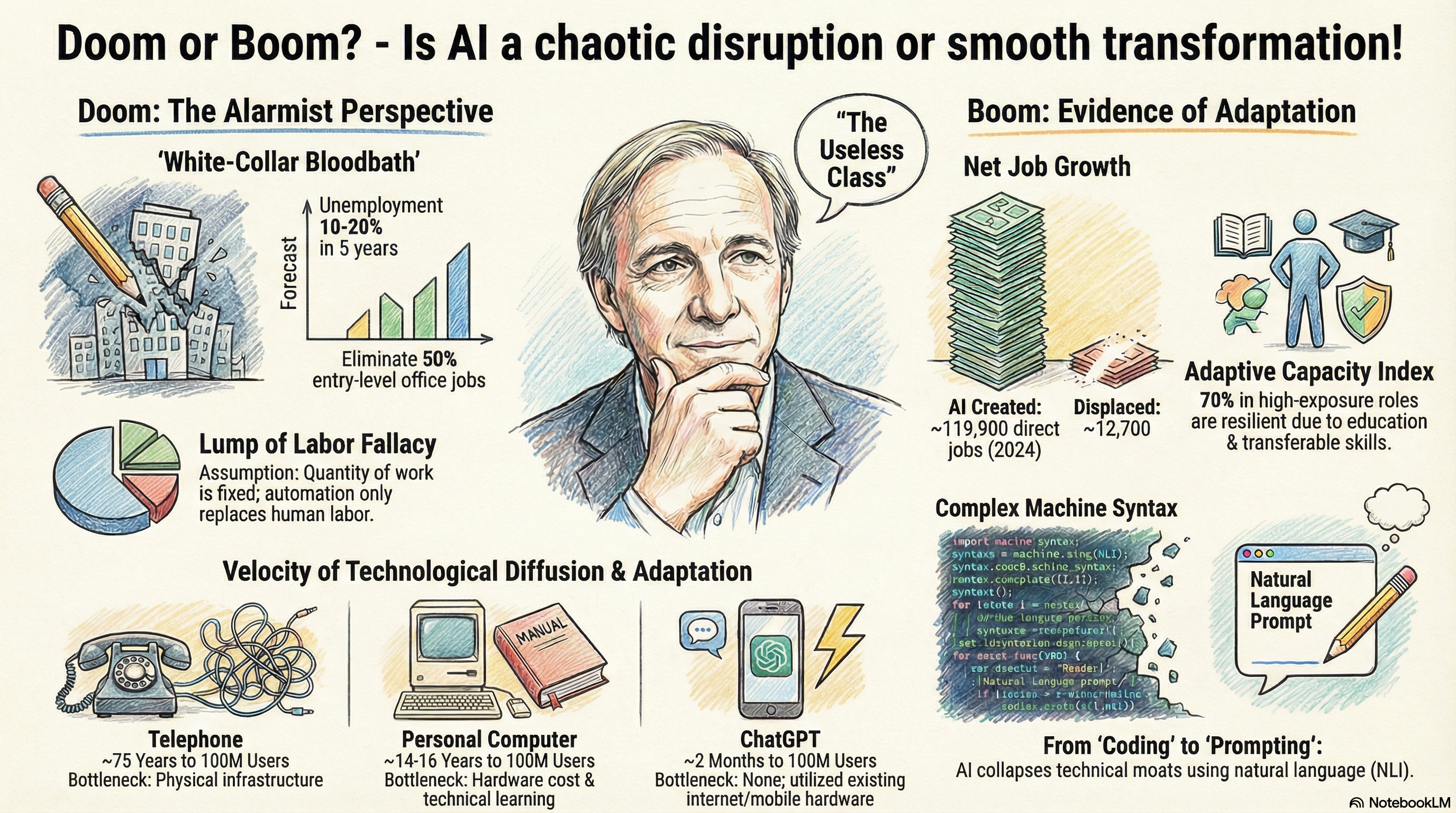
The contemporary discourse surrounding artificial intelligence is frequently dominated by a deterministic binary: either AI will usher in a post-labor utopia or it will precipitate a catastrophic collapse of the middle class. Figures such as Dario Amodei, CEO of Anthropic, and billionaire investor Ray Dalio have lent their voices to the latter, forecasting mass unemployment and a “white-collar bloodbath” as AI transitions from a tool of augmentation to one of full automation. However, a rigorous analysis of historical technological diffusion, the inherent accessibility of the natural language interface, and the emergent data on labor market resilience suggests that these alarmist perspectives fundamentally underestimate the human capacity for adaptation.
Unlike previous industrial revolutions, which were gatekept by the necessity of physical infrastructure or the mastery of arcane technical languages, the AI revolution is defined by its radical ease of use. The speed at which this technology has permeated the global consciousness—reaching 11 million users in a fraction of the time required by the internet or the personal computer—is not merely a statistical anomaly; it is proof of a new paradigm where the workforce adjusts faster than the disruption can displace it. By leveraging the “preexisting highways” of the smartphone and the cloud, and by utilizing “playful” gateways like poetry and generative art for mass literacy training, AI is democratizing high-level cognitive productivity, ultimately creating more opportunities than it eliminates.
The Great Compression: Quantifying the Unprecedented Velocity of Diffusion
To understand why the current workforce is uniquely positioned to handle AI-driven disruption, one must first examine the temporal compression of technological adoption over the last century. Historical precedents demonstrate that the primary barrier to job creation in new sectors has often been the lag between the invention of a technology and the mass acquisition of the skills needed to operate it.
Historical Timelines of Saturation
The diffusion of electricity, the telephone, and the automobile was a multi-decadal process constrained by the necessity of physical network effects. The telephone, for instance, required approximately 75 years to reach just 11 million users, as the rollout was tethered to the slow, capital-intensive process of laying copper wire. In contrast, the digital age initiated a period of acceleration. The internet reached the 100-million-user milestone in roughly seven years, benefiting from existing telephony, but still requiring the adoption of specialized hardware and the navigation of early, non-intuitive interfaces.
Artificial intelligence has shattered these benchmarks. ChatGPT reached 11 million users in just two months. This velocity is made possible because AI did not require a new hardware platform or a new physical grid; it was “driven on a highway that was already there,” utilizing the billions of smartphones and cloud-connected PCs already in the hands of the global workforce.
| Technology | Time to Reach 11 Million Users | Primary Bottleneck to Adoption |
|---|---|---|
| Telephone | ~72 Years (Global) | Physical landline infrastructure and wiring |
| Electricity | ~43 Years (US Household Saturation) | Grid construction and appliance costs |
| Personal Computer | ~14-13 Years | Cost of hardware and technical learning curve |
| World Wide Web | ~7 Years | Modem availability and ISP rollout |
| Mobile Phone | ~14 Years | Cellular tower coverage and device costs |
| ChatGPT | ~2 Months | None; utilized existing internet/mobile hardware |
This compression suggests that the “disruption lag”—the period where workers are displaced before new roles are created—is being shortened by the technology itself. Because AI is integrated into existing software stacks like Microsoft 365, Salesforce, and WhatsApp, the “learning” happens in situ, as part of the daily workflow.
Infrastructure as a Catalyst for Ease
The ease of AI adoption is compounded by the maturity of the technologies that preceded it. Unlike the PC era, where a user had to learn how to manage a file system or troubleshoot a peripheral, or the early internet era, which required an understanding of IP addresses and browser configurations, generative AI operates at the level of human intent. It removes the “friction of syntax”. This enables a “Shadow AI” phenomenon where employees in industries as traditional as manufacturing or management consulting are becoming AI-literate overnight, often without formal corporate training.
The Natural Language Breakthrough: Ending the Era of Arcane Technology
The most profound argument for AI’s role as a job creator lies in the nature of its interface. For forty years, the digital divide was defined by those who could speak the language of machines—coding, complex software logic, and nested menus—and those who could not. Artificial intelligence has inverted this relationship; the machine now speaks the language of the human.
From CLI and GUI to NLI
The evolution of human-computer interaction (HCI) has moved from high-abstraction, high-effort systems to low-abstraction, low-effort systems.5. Command Line Interface (CLI): Users had to memorize specific, rigid syntax (e.g., MS-DOS commands). The barrier to entry was a high “arcane knowledge” requirement.4. Graphical User Interface (GUI): The introduction of the mouse and icons reduced the memory load but still required users to learn specific “workflows”—knowing which menu a certain tool was hidden in.6. Natural Language Interface (NLI): AI enables intent-based interaction. A user does not need to know “where the chart menu lives” in Excel; they simply tell the AI to “visualize this data as a trend line”.
This shift represents the “Prompt Collapse,” where the technical skill of mastering a piece of software is replaced by the ability to communicate clear goals. This democratization of capability means that a junior professional can now perform tasks that previously required years of tool-specific mastery, effectively bypassing the “bottom rungs” of the technical ladder that figures like Amodei worry are being destroyed. Instead of destroying the ladder, AI is providing a lift.
The Democratization of Professional Capability
When the learning curve for a disruptive technology is near zero, the disruption itself becomes a tool for empowerment. In traditional sectors, the “expertise economy” was built on mastering complexity. Designers charged premiums for knowing how to use complex CAD tools; accountants built moats around their knowledge of tax software. AI collapses these moats, allowing the “masses” to be more productive with minimal training.
The productivity gains from this “ease” are already manifesting. Research shows that AI is a “force multiplier,” allowing a single person to do the work of three by automating the “drudgery” of first drafts and data sorting. In economic terms, this increase in efficiency can be modeled as a shift in the production function:
\$\$ Y = A f(L, K, E) \$\$
Where \$Y\$ is output, \$A\$ is total factor productivity, \$L\$ is labor, \$K\$ is capital, and \$E\$ represents the efficiency gain from the natural language interface. Unlike previous \$K\$-augmenting technologies that required massive capital investment and specialized operators, \$E\$-augmentation is available to any \$L\$ with a smartphone.
The Gateway Theory: How Playful Training Won the Masses
A critical component of the user’s query is the recognition that “frivolous” applications of AI—such as generating cat pictures or writing rhyming poetry—have served as a global training mechanism. While critics dismiss these as toys, they are actually the most successful instructional design in history.
Literacy through Play
The diffusion of AI has been carried by its “uncanny” ability to engage with human creativity. When millions of users experimented with DALL-E or Midjourney to create surreal imagery, they were unconsciously learning the logic of prompt engineering: the importance of descriptors, the impact of style modifiers, and the iterative nature of refining an AI’s output.
- Cat Pictures as Training Data: The act of prompting for an “astronaut cat in a photorealistic style” is a lesson in semantic-syntactic mapping. Users learned that the AI responds to specific linguistic cues, which is a foundational skill for more complex industrial applications.
- Poetry and Creative Writing: By asking for sonnets or haikus, users explored the AI’s ability to handle structured rules and nuanced tone. This “play” lowered the psychological barrier to using the same technology for drafting legal briefs or medical summaries.
The “4 Ps” of AI Literacy
Academic institutions have begun to codify this playful experimentation into a formal “4 Ps” model of AI literacy: Products, Processes, Policies, and Public Connections.
- Products: Understanding what the AI can generate (images, text, code).
- Processes: Mastering the iterative feedback loop of prompting.
- Policies: Navigating the ethics of citation and truth.
- Public Connections: Recognizing how these tools link to the broader economy.
By integrating AI into daily communications through tools like “Poetry Cameras” and AI writing helpers in Google Docs, society has undergone a massive, decentralized upskilling project. This means that when the “disruptive” phase of AI hits the workplace, the workforce is not a group of bewildered victims; they are already “inner prompt engineers” who have spent months or years refining their ability to talk to the machine.
Challenging the Prophets of Doom: A Rebuttal to Amodei and Dalio
The “scaremongering” mentioned in the prompt, particularly by Dario Amodei and Ray Dalio, often centers on a pessimistic view of human adaptability. Amodei has predicted that AI could wipe out 50% of entry-level white-collar jobs and push unemployment to 10-20% within five years. Dalio warns that AI and humanoid robots will supercharge inequality and create a “useless” class of people who have no productive work.
The Myth of the “White-Collar Bloodbath”
The fatal flaw in these predictions is the assumption that the quantity of work is fixed—the “lump of labor” fallacy. History and current data suggest the opposite. While AI exposes certain tasks to automation, it also augments the demand for the human oversight of those tasks.
- ITIF Findings: In 2024, while outplacement firms estimated7,71 jobs were lost due to AI, the technology created approximately 18,91 direct jobs, primarily in development, data center construction, and operations.
- The Unemployment Paradox: Despite the “exposure” of computer and mathematical occupations to AI, the Bureau of Labor Statistics projects employment for software developers to increase by9.9% through 2033—far faster than the average for all occupations. This is because increased productivity lowers prices, which in turn increases the global demand for software products.
The Adaptive Capacity Index (ACI)
The most compelling rebuttal to the scaremongering of the “tech elite” comes from a 2026 NBER study which introduced the Adaptive Capacity Index. The study found that workers in the most “exposed” occupations—those supposedly at the highest risk from AI—actually have the highest capacity to pivot.
| Metric | High AI Exposure Group | Low AI Exposure Group |
|---|---|---|
| Education Level | Higher (Degree holders) | Lower (High school/Cert) |
| Transferable Skills | Problem-solving, Analysis | Specialized routine tasks |
| Financial Buffer | Higher savings | Lower savings |
| Outcome | 70% are Resilient | Vulnerable to Displacement |
The study identified that of the 37.5 million workers in the top quartile of AI exposure, over 26.2 million score above the median in adaptive capacity. This suggests that the individuals Amodei and Dalio are worried about are precisely the ones most capable of using AI to reinvent their roles. They are not “useless”; they are merely being upgraded.
The Job Creation Engine: Mapping the New Labor Landscape
If AI is not destroying the workforce, where are the new jobs coming from? The creation of employment in the AI era is occurring in three distinct layers: the Foundation Layer, the Application Layer, and the Multiplier Layer.
The Foundation and Infrastructure Layer
The sheer physical scale of AI requires a massive expansion of the world’s digital and energy infrastructure. This is a source of traditional, well-paying jobs.
- Data Center Construction: Each large-scale data center requires roughly5,51 on-site workers and can take years to complete. In 2024, the surge in AI infrastructure fueled over 110,01 construction jobs.
- Energy Generation: AI digital demands are projected to require 75-11 GW of new generation capacity by 2030, driving employment in the utility and renewable energy sectors.
- Hardware and Cooling: The shift toward liquid cooling and specialized AI chips (GPUs) is creating a new manufacturing and maintenance ecosystem.
The Application and Specialized AI Roles
As AI moves from “pilot” to “integration” phases, companies are hiring for roles that did not exist in 2011. Demand for “AI fluency” has grown sevenfold in just two years.
| New Job Title | Growth Rate (2024-2025) | Core Responsibility |
|---|---|---|
| AI Engineer | +143.2% | Building and tuning models |
| AI Content Creator | +134.5% | Blending technical fluency with creativity |
| Prompt Engineer | +135.8% | Optimizing intent-based inputs |
| AI Solutions Architect | +112.3% | Designing AI-native enterprise stacks |
| AI Ethics Specialist | Rising | Ensuring systems are fair and transparent |
| AI Literacy Trainer | Rising | Educating the workforce on practical AI use |
The Multiplier Layer: Revaluing Human Skills
The most significant job creation will happen in the “Multiplier Layer”—roles that are augmented by AI, allowing humans to focus on what AI cannot do. As “intelligence” becomes a commodity, human traits like empathy, critical thinking, and social orchestration become the “new gold”.
- Healthcare: AI handles diagnostics, but demand for doctors and nurses is expected to grow as they spend more time on “patient care, diagnosis, and empathy”—qualities AI cannot replicate.
- Education: While AI can provide “in-the-moment tutoring,” the reference point of an inspiring human teacher remains essential for academic decision-making and mentorship.
- Creative Arts: AI is seen as a “collaboration tool” that enhances creativity rather than replacing it. Traditional art forms like ceramics and sculpture are actually increasing in value because the “human touch” is irreplaceable in a digital world.
The Geography of Adaptation: Why the World is Ready
The argument that “people are adjusting faster than the disruption” is validated by global adoption patterns. In nations that have embraced AI proactively, the narrative is one of opportunity rather than fear.
The Case of Singapore and the UAE
Singapore and the United Arab Emirates lead the world with AI usage rates approaching 60% of their populations. The UAE, in particular, has implemented a “Sovereign AI” strategy:
- Universal Access: Providing ChatGPT Plus to citizens for free.
- Early Education: Introducing AI concepts to children at age four.
- Business Transformation: 89% of financial institutions in these regions already use AI to fight fraud and 58% attribute direct revenue growth to AI initiatives.
In these contexts, the “scaremongering” of Western tech leaders feels increasingly out of touch with the reality on the ground. When a society is equipped with the tools and the literacy to use them, the “disruption” becomes an “evolution.”
The “Shadow AI” Resilience
Even in regions with slower policy responses, the workforce is taking matters into its own hands. The 73/27% split between work and personal use of AI bots in 2024 indicates that workers are self-integrating these tools to preserve their own competitiveness. This bottom-up adoption is the ultimate proof that humans are not passive subjects of technology; they are active agents who use tools to expand their own productive capacity.
Conclusion: Giving Humans the Credit They Deserve
The prevailing “job apocalypse” narrative relies on a flawed premise: that human beings are static, unimaginative, and slow to learn. The evidence of the last three years suggests the exact opposite. We have seen a technology diffuse faster than any other in human history because it is the most natural to use. We have seen the “masses” train themselves on the logic of artificial intelligence through the playful gateways of poetry and art. And we have seen that the very workers most “at risk” are the ones most capable of adapting.
Dario Amodei and Ray Dalio’s warnings of mass unemployment may be well-intentioned, but they represent a “failure of imagination” regarding human resilience. They view AI as a replacement for the human, whereas the data shows it is a powerful extension of the human. By collapsing the barriers to entry through the natural language interface, AI is not destroying the ladder of opportunity; it is making the ladder accessible to everyone.
The future of work is not a battle against the machine, but a partnership with it. As we move from an era of “coding” to an era of “prompting,” we are entering a period of global economic activity where4.12 trillion USD of value could be unlocked by 2030—if we continue to focus on the human skills that add value to AI. Far from a bloodbath, the AI revolution is a renaissance, powered by the easiest-to-learn technology in history and the most adaptable species on the planet. Humans are adjusting, they are learning, and they are thriving. It is time the tech leaders gave them the credit they deserve.
Tips and Donations
If you enjoyed this deep dive, consider supporting the project with a tip in Sats. It’s a simple, global way to support independent research.
To send Sats, you’ll need a lightning wallet.
References
-
How Artists Are Embracing Artificial Intelligence to Create Works of Art, accessed February 20, 2026, https://news.syr.edu/2025/08/12/how-artists-are-embracing-artificial-intelligence-to-create-works-of-art/ ↩ ↩2 ↩3 ↩4 ↩5 ↩6 ↩7 ↩8 ↩9
-
AI Job Trends for 2025: Insights from a Year of Hiring Data - Aura Intelligence, accessed February 20, 2026, https://blog.getaura.ai/ai-job-trends-2025 ↩ ↩2
-
Tech Trends 2026 | Deloitte Insights, accessed February 20, 2026, https://www.deloitte.com/us/en/insights/topics/technology-management/tech-trends.html ↩ ↩2
-
Ray Dalio Warns AI and Humanoid Robots Will Supercharge Inequality, Displace Jobs, and Spur Redistribution - Complete AI Training, accessed February 20, 2026, https://completeaitraining.com/news/ray-dalio-warns-ai-and-humanoid-robots-will-supercharge/ ↩ ↩2 ↩3
-
‘White-Collar Bloodbath’: Anthropic Warns of AI Job Losses | Technology Magazine, accessed February 20, 2026, https://technologymagazine.com/articles/white-collar-bloodbath-anthropic-warns-of-ai-job-losses ↩ ↩2 ↩3
-
ChatGPT Adoption Overtakes Internet Growth in Record Time | by …, accessed February 20, 2026, https://medium.com/@PankajVNT/chatgpt-adoption-overtakes-internet-growth-in-record-time-abdf69780ca3 ↩
-
How AI and Natural Language Interfaces Are Revolutionizing Human-Computer Interaction, accessed February 20, 2026, https://www.omegavp.com/blog/ai-natural-language-interfaces-revolutionizing-human-computer-interaction/ ↩
-
AI Writing Tools | Center for the Advancement of Teaching Excellence | University of Illinois Chicago, accessed February 20, 2026, https://teaching.uic.edu/cate-teaching-guides/digital-learning/ai-writing-tools/ ↩
-
AI Literacy for Students: Cultivating Critical Thinking in the Age of Intelligent Machines, accessed February 20, 2026, https://thenerdacademy.com/ai/ai-literacy-for-students-cultivating-critical-thinking-in-the-age-of-intelligent-machines/ ↩
-
A brief history of technology | World Economic Forum, accessed February 20, 2026, https://www.weforum.org/stories/2018/02/the-rising-speed-of-technological-adoption/ ↩
-
USF faculty reframes what literacy means in the age of generative artificial intelligence, accessed February 20, 2026, https://www.usf.edu/arts-sciences/chronicles/2025/literacy-for-age-of-artificial-intelligence.aspx ↩
-
Time to reach 100 million users for different technologies in months after initial deployment. - ResearchGate, accessed February 20, 2026, https://www.researchgate.net/figure/Time-to-reach-100-million-users-for-different-technologies-in-months-after-initial_fig1_372212988 ↩ ↩2