The Great Digital Reset
The intersection of ancient Vedic ontology and modern information theory reveals a structural isomorphism between the Bhagavad Gita’s concept of the “Field” (kṣetra) and the architectural principles of asymmetric cryptography and active inference.1 2
In Chapter 13 of the Bhagavad Gita, Krishna delineates a rigorous dualism: the body is the field—a complex, self-organizing system—and the soul is the “knower of the field” (kṣetrajña), the witness and silent driver.3
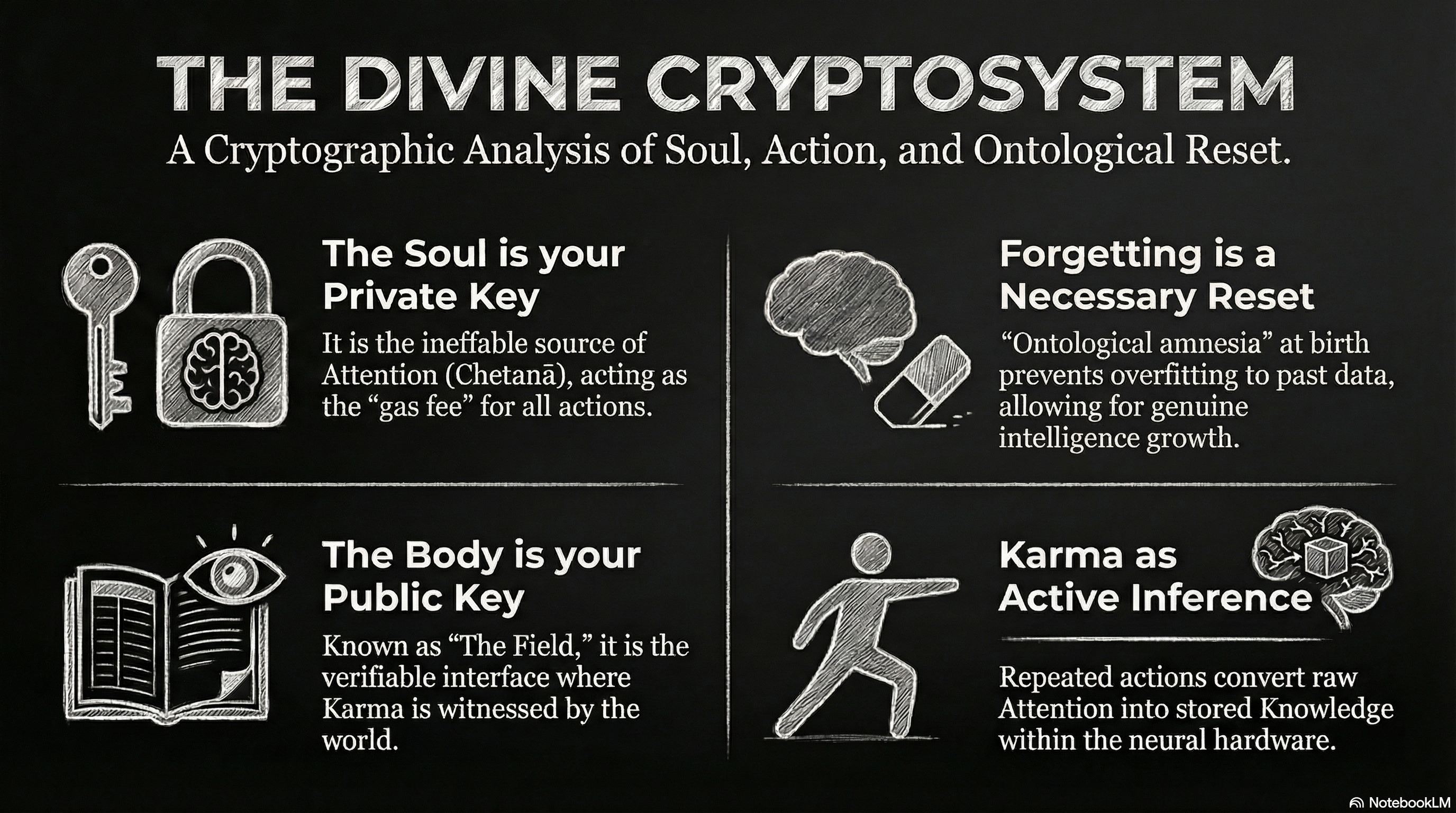
This relationship maps onto the mechanics of public and private key infrastructure (PKI): the soul acts as the Private Key, providing the scarce resource of Attention (Chetanā), while the body acts as the Public Key, through which Karma (actions) is manifest and verified by the external world.4
The Architecture of the Field: Public and Private Keys
The relationship between the soul and the body is joined like a cryptographic key pair. The “Public Key” (the Field) is the observable, verifiable interface used by the “village” of the external world to interact with the individual.4
Conversely, the “Private Key” (the Knower) is the hidden, ineffable source of subjective experience and signature.5 Despite its divine origin, the soul often “falls prey to Maya” or illusion when it identifies too closely with the field it resides in.6
Functional Roles of the Keys
- The Private Key (Soul) as the Provider of Attention: In this model, the soul’s primary function is to provide Chetanā or Attention. Attention acts as a symbolic currency or “gas fee” required to power the system’s operations.7 It is the subjective medium through which internal states are selected and “signed” using the unique signature of the private key.8
- The Public Key (Body) as the Interface for Karma: The body is the physical subspace where Attention is converted into Karma (actions). Karma constitutes the “Public Key” interface—the transactions that can be witnessed and validated by adjacent actors in the field.9 This interface is often confused by outside observers as being the “Self,” when it is merely the verifiable output of a hidden input.10
| System Component | Metaphysical Identity | Cryptographic Identity | Functional Role |
|---|---|---|---|
| The Field | Kṣetra (Body) | Public Key | Interface for Karma (Actions) and verification.3 |
| The Knower | Kṣetrajña (Soul) | Private Key | Source of Attention (Chetanā) and decryption.11 |
| The Interaction | Karma (Action) | Transaction/Signature | Operations providing neural knowledge and invariance.9 |
| The Resource | Chetanā (Attention) | Token/Gas Fee | Limited resource powering the active inference loop.7 |
The Fructification of Karma: From Attention to Knowledge
The mechanism of intelligence growth relies on a specific sequence: Attention \$\rightarrow\$ Karma \$\rightarrow\$ Knowledge. When the private key (soul) directs attention toward the physical field, it generates actions (Karma). Through repetition, this Karma “fructifies” or consolidates into physical knowledge within the brain.3
Karma can thus be viewed as a natural law—a systematic interaction between deterministic elements of the field and the degrees of freedom provided by the soul’s attention.13
Neural Plasticity and Surprise Minimization
According to the principle of Active Inference, the brain is a prediction engine that strives to minimize “surprise” or variational free energy. When an action is practiced repeatedly—such as driving or playing an instrument—it is computationally efficient for the brain to physically store that behavior.
Karma can thus be viewed as a hierarchical generative model; if the outcome deviates from the soul’s intent, the resulting “prediction error” forces a state update in the field.14
- Hebb’s Law: This process is mirrored in neuroscience by the principle that “neurons that fire together, wire together.” Repeated actions create and strengthen neural pathways (engrams), effectively encoding the soul’s frequent interactions into the hardware of the “Field.”
- Knowledge as Compressed Efficiency: What begins as a conscious expenditure of the private key’s attention becomes a habitual, “signed” program in the public-facing hardware, allowing the system to conserve resources.
Identity as Symmetric Invariance
A profound aspect of this cryptosystem is the maintenance of a stable identity, which can be viewed through the lens of Symmetry and Noether’s Theorem. Noether’s Theorem states that every continuous symmetry in a physical system corresponds to a conserved quantity.15
The 120-Degree Rotation Metaphor
Identity is not a static point but a set of “Symmetric locations.” Consider the 120-degree rotation of an equilateral triangle: after the rotation (\$\rightarrow\$), the triangle appears indistinguishable from its original state.
- Internal Symmetry and External Invariance: Just as the triangle is conserved through its rotation, your Karma consists of the set of operations that maintain your internal symmetry and external invariance.
- Conserving the “Self”: The “Farmer” performs specific, rhythmic actions that keep the “Potato Land” invariant as a potato land despite the changing seasons.16 These actions are the rotations that preserve the identity element—the stable “Self”—in the eyes of the community.
The Necessity of the Ontological Reset
The “ontological amnesia” or forgetting of the private key at birth is a critical design feature to allow for the growth of genuine intelligence.17
- Prevention of Overfitting: If the soul entered a new birth with full memory of past private keys, the current field would be “overfitted” to past data.18 Forgetting acts as an “Information Lagrangian”—a reset that prevents past biases from overwhelming the current task of learning the present field.18 This reset ensures the mind remains efficient by purging irrelevant data that no longer serves the current incarnation.19
- The Explore-Exploit Trade-off: High intelligence requires a balance between exploration (learning new options) and exploitation (using known knowledge).20 Possession of the private key at birth would result in “maximal exploitation” from day one, removing the incentive for the exploration and “prediction error” required to build fresh neural connections.21 This trade-off is fundamental to life development, where we shift from exploration in youth to exploitation in later stages.22 23
- Symmetry Breaking: To understand the symmetry of the current field, the previous axes of identity must be broken.24 Forgetting allows for “Symmetry Breaking”—the spontaneous emergence of a new axis of identity through interaction with the present field.24
Conclusion: The Divine Cryptosystem
In this speculatively designed system, the soul provides the Attention necessary to “sign” the physical body’s Karma. This Karma then fructifies into physical neural pathways, allowing the brain to minimize surprise and efficiently store the “Knowledge” required for survival.
By staying within “Symmetric locations”—performing the rotations of duty and habit—we maintain a conserved identity across the volatile field of existence. The reset at birth ensures we do not just repeat old patterns but instead grow robust, adapted intelligence through the friction of current physical interaction.
Ultimately, the state of Moksha (liberation) can be viewed as the achievement of Zero Free Energy—a state where the internal model perfectly matches the absolute reality, eliminating all prediction error and the need for further cycles of corrective action. The objective of the “Knower” is to understand the symmetry of his own field so deeply that he recovers the private key as a hard-earned realization, bridging the gap between ancient wisdom and modern computational science.2
References
Tips and Donations
If you enjoyed this deep dive, consider supporting the project with a tip in Sats. It’s a simple, global way to support independent research.
To send Sats, you’ll need a lightning wallet.
-
Bhagavad Gita - Wikipedia, accessed March 22, 2026, https://en.wikipedia.org/wiki/Bhagavad_Gita ↩
-
Kavi Mahesh, “Vedic Ontology and Knowledge Engineering,” ResearchGate, 2022. ↩ ↩2
-
Chapter 13: Kṣhetra Kṣhetrajña Vibhāg Yog - Bhagavad Gita, The Song of God, accessed March 22, 2026, https://www.holy-bhagavad-gita.org/chapter/13/ ↩ ↩2 ↩3
-
Public-key cryptography - Wikipedia, accessed March 22, 2026, https://en.wikipedia.org/wiki/Public-key_cryptography ↩ ↩2
-
Theory of subjective information. Fortifying Ideas in the Digital Age., accessed March 22, 2026, https://toolkitforthesoul.com/theory-of-subjective-information/ ↩
-
Why does the soul fall prey to maya, when it resides in the body?, accessed March 22, 2026, https://hinduism.stackexchange.com/questions/6625/why-does-the-soul-fall-prey-to-maya-when-it-resides-in-the-body ↩
-
Attention economy - Wikipedia, accessed March 22, 2026, https://en.wikipedia.org/wiki/Attention_economy ↩ ↩2
-
private key - Glossary | CSRC - NIST Computer Security Resource Center, accessed March 22, 2026, https://csrc.nist.gov/glossary/term/private_key ↩
-
Karma as active resistance - The Immanent Frame, accessed March 22, 2026, https://tif.ssrc.org/2025/08/20/karma-as-active-resistance/ ↩ ↩2
-
So my professor started to go into what are called “private keys” and “public keys” in class, but I’m still confused on the concept : r/crypto - Reddit, accessed March 22, 2026, https://www.reddit.com/r/crypto/comments/7uahsy/so_my_professor_started_to_go_into_what_are/ ↩
-
Bhagavad Gita – Chapter 13 – Kṣhetra Kṣhetrajña Vibhāga Yoga - VivekaVani, accessed March 22, 2026, https://vivekavani.com/b13/ ↩
-
11-Master-Gita-Chapter-10.pdf - Vedanta Students, accessed March 22, 2026, https://vedantastudents.com/wp-content/uploads/2019/12/11-Master-Gita-Chapter-10.pdf ↩
-
Karma as a Natural Law: A Systematic Interaction between Deterministic Elements and Degrees of Freedom - RSIS International, accessed March 22, 2026, https://rsisinternational.org/journals/ijriss/articles/karma-as-a-natural-law-a-systematic-interaction-between-deterministic-elements-and-degrees-of-freedom/ ↩
-
Subhash Kak, “The Architecture of Knowledge: Quantum Mechanics, Neuroscience, and the Vedas,” ResearchGate, 2023. ↩
-
Noether’s theorem - Wikipedia, accessed March 22, 2026, https://en.wikipedia.org/wiki/Noether%27s_theorem ↩
-
Self-organization - Wikipedia, accessed March 22, 2026, https://en.wikipedia.org/wiki/Self-organization ↩
-
Why Create a World Where the Soul Forgets Its True Nature …, accessed March 22, 2026, https://www.indica.today/long-reads/why-create-a-world-where-the-soul-forgets-its-true-nature/ ↩
-
The importance of forgetting in artificial and animal intelligence …, accessed March 22, 2026, https://www.amazon.science/blog/the-importance-of-forgetting-in-artificial-and-animal-intelligence ↩ ↩2
-
Why forgetting may make your mind more efficient - Knowable Magazine, accessed March 22, 2026, https://knowablemagazine.org/content/article/mind/2019/why-we-forget ↩
-
A Primer on Foraging and the Explore/Exploit Trade-Off for Psychiatry Research - PMC - NIH, accessed March 22, 2026, https://pmc.ncbi.nlm.nih.gov/articles/PMC5561336/ ↩
-
Active inference and learning - PMC - NIH, accessed March 22, 2026, https://pmc.ncbi.nlm.nih.gov/articles/PMC5167251/ ↩
-
From exploration to exploitation: A shifting mental mode in late life development - PMC, accessed March 22, 2026, https://pmc.ncbi.nlm.nih.gov/articles/PMC8844884/ ↩
-
The Explore/Exploit Trade-off: An Ecologically Valid and Translational Framework that can Advance Mechanistic Understanding of Eating Disorders - PMC, accessed March 22, 2026, https://pmc.ncbi.nlm.nih.gov/articles/PMC11093701/ ↩
-
Complexity and self-organization in the evolution of cell polarization - Company of Biologists Journals, accessed March 22, 2026, https://journals.biologists.com/jcs/article/136/2/jcs259639/286742/Complexity-and-self-organization-in-the-evolution ↩ ↩2