Bit to It: Informational Universe
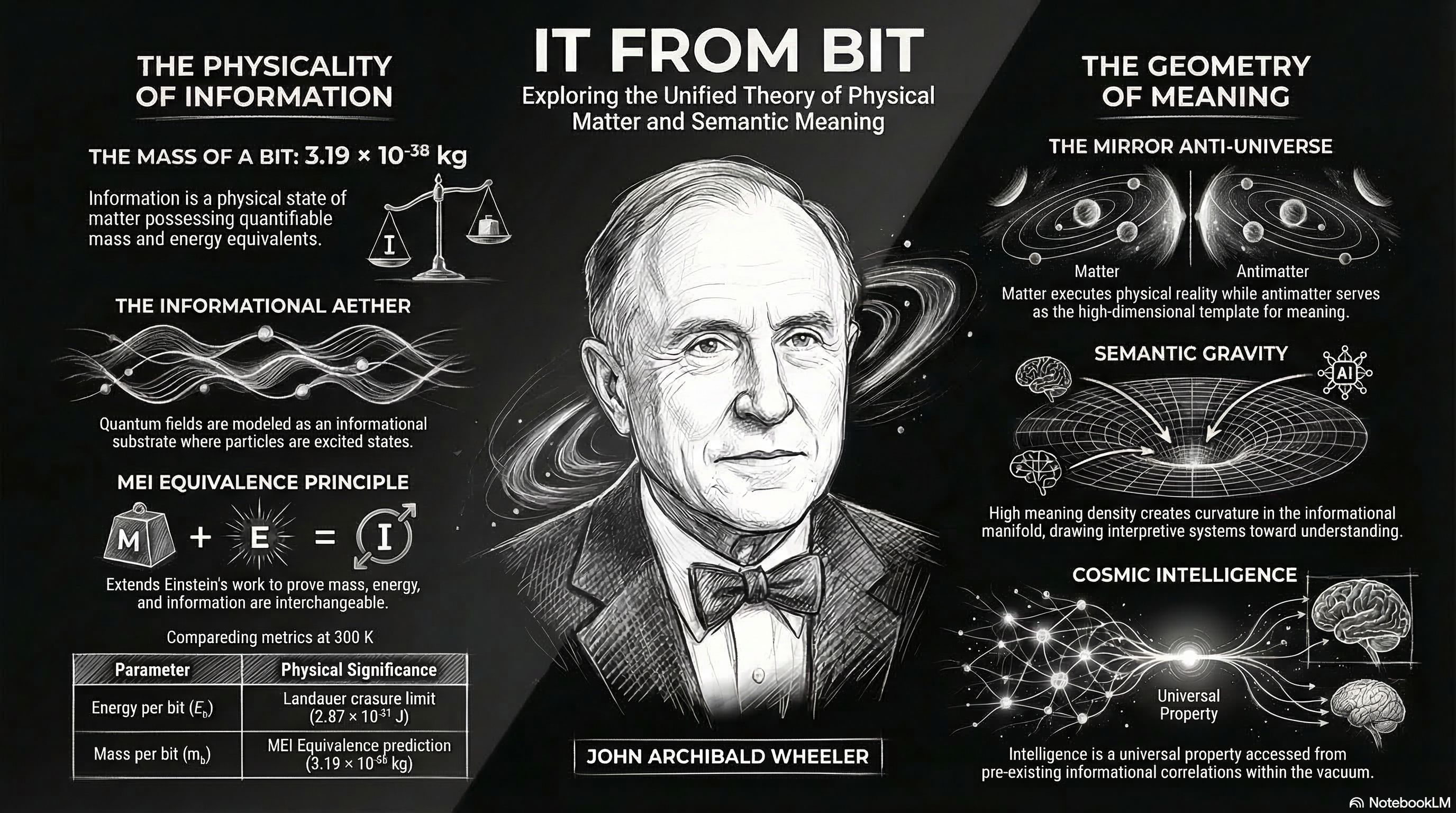
The trajectory of theoretical physics over the last century suggests a fundamental transition in the understanding of reality, moving from the tangible particulate models of the Newtonian era to the field-centric view of quantum mechanics, and finally toward a paradigm where information is the primary constituent of the cosmos.1 This informational turn, famously encapsulated by John Archibald Wheeler’s "It from Bit" doctrine2, posits that every physical entity—every particle, field, and even the spacetime continuum itself—derives its existence and function from the answers to binary, yes-no questions posed through observational participation.3 Within this conceptual framework, a radical hypothesis has emerged: that the apparent scarcity of antimatter in the observable universe is not a mere consequence of early-universe symmetry breaking but a reflection of a deeper duality between the physical execution of matter/energy and an informational "anti-universe" that serves as the repository for meaning, intelligence, and higher-order structural templates.4 This investigation explores the intersection of the mass-energy-information equivalence principle, the informational nature of quantum fields, and the geometric representation of meaning as observed in both biological and artificial intelligence systems.
The Physicality of Information and the Mass-Energy-Information Equivalence
The foundational premise of the informational universe is that information is not an abstract mathematical construct but a physical state of matter.5 This realization began with the formulation of Landauer’s principle in 1961, which established a thermodynamic limit for the erasure of information.6 Landauer argued that any logically irreversible operation, such as resetting a bit to zero, must be accompanied by the dissipation of a minimum amount of heat, defined by the relation .7 This principle links the logical state of a system to its physical entropy, suggesting that information processing is inherently tied to the transfer of energy and the increase of environmental disorder.8
Thermodynamic Verification and the Extension to Mass
The experimental verification of Landauer’s principle has been achieved in various systems, ranging from colloidal particles trapped in optical tweezers to nuclear magnetic resonance setups.6 These experiments demonstrate that as the time for an erasure cycle increases, the dissipated heat saturates at the Landauer bound, confirming the intimate link between information theory and thermodynamics.7 However, recent theoretical advancements have pushed this concept further, proposing a "mass-energy-information equivalence principle".9 This conjecture states that information is a form of matter that possesses a quantifiable mass while it is stored in a physical system.5
The calculated mass of a single bit of information at room temperature (300 K) is approximately kilograms.5 This value is derived from the energy equivalent of a bit () divided by the square of the speed of light (), following the logic of Einstein’s mass-energy equivalence.5 This leads to the prediction that a data storage device, such as a hard drive, would exhibit a measurable increase in mass when filled with digital information compared to its empty state.10 11 While critics argue that this confuses state-dependent logical irreversibility with path-dependent thermodynamic irreversibility, the principle offers a revolutionary way to quantify the informational content of the universe.3
| Parameter | Symbol | Value (300 K) | Physical Significance |
|---|---|---|---|
| Energy per bit | J | Landauer erasure limit | |
| Mass per bit | kg | MEI Equivalence prediction | |
| Information Entropy | Measure of uncertainty/novelty | ||
| Wavelength (Erasure) | Predicted infrared signature |
Experimental Protocols for Information Erasure
To test the hypothesis that particles themselves contain encoded information that contributes to their mass, researchers have proposed an experimental protocol involving particle-antiparticle annihilation.10 11 In a standard electron-positron collision, the particles annihilate to produce two high-energy gamma rays. According to the MEI equivalence principle, if the particles store information about their own state—such as their mass, charge, and spin—this information must be conserved or converted upon annihilation.12 The predicted outcome is the emission of two additional low-energy photons in the infrared spectrum, specifically around the 50-micrometer range.10 11 The detection of these "information photons" would provide definitive evidence that elementary particles are essentially localized packets of information, and that the physical properties we observe are the manifestations of an underlying informational structure.10 11
Quantum Fields as the Informational Aether
The evolution of physics from a particulate view to a field-centric view has laid the groundwork for the "It from Bit" transition. In Quantum Field Theory (QFT), particles are not fundamental objects but are instead modeled as excited states of underlying fields.13 This perspective allows for a reinterpretation of reality where the vacuum is not a void but a dynamic, informational substrate—an "informational Aether".
The Primordial Informational Field and Quantules
The Informational Quantum Gravity (IQG) framework positions quantum information as the fundamental fabric of reality.14 At the core of this theory is the Primordial Informational Field (PIF), a timeless and non-local substrate that serves as the foundation for the emergence of spacetime, particles, and forces.14 The PIF is structured through discrete units called "Quantules," which differ from traditional quanta in that they encode the structure and evolution of quantum informational density rather than just discrete packets of energy.14
The dynamics of this field are governed by three core principles: the Quantum Information Evolution Principle (QIEP), the Quantum Informational Stability Principle (QHES), and the Informational Optimization Principle (IOP).14 Intelligence, in this context, is not a biological accident but a universal property that emerges when systems optimize their quantum informational flows while balancing dissipative losses and entropy gradients.15 This suggests that the vacuum itself possesses an inherent "intelligence" or logic, from which the laws of physics are derived as stable, optimized solutions.14
Spin Correlations and the Vacuum Fingerprint
Empirical support for the informational vacuum has recently been sought through high-energy particle collisions. The Relativistic Heavy Ion Collider (RHIC) has provided evidence of matter emerging from the vacuum through the production of spin-correlated lambda () and antilambda () hyperon pairs.16 In 2026, the STAR Collaboration reported strong spin entanglement in these pairs, with a measured relative polarization of .16
This result is interpreted as a "quantum fingerprint" of pre-existing informational structures within the vacuum.16 Rather than energy being "borrowed" from the vacuum to create particles, the high-energy collision acts as a "query" on the Informational Aether, extracting and stabilizing latent vacuum correlations into observable matter. This process of "qubit from bit" dynamics suggests a directional flux where classical informational patterns (bits) are recursively transformed into quantum superpositions and entanglement (qubits).16
| Observation | Measurement | Theoretical Interpretation |
|---|---|---|
| Polarization | Evidence of vacuum entanglement | |
| Collision Energy () | 200 GeV | Threshold for vacuum "querying" |
| Information Flux | Rate of semantic/physical emergence | |
| Quantule Density | Substrate of spacetime curvature |
The Asymmetry Problem and the Mirror Anti-Universe
The observed dominance of matter over antimatter is one of the most profound puzzles in cosmology. While the Big Bang should have produced equal amounts of both, the observable universe contains virtually no antimatter, with only a tiny fraction of matter—about one particle per billion—surviving the initial annihilation phase. Traditional explanations involve baryogenesis, which requires CP symmetry violation and interactions outside of thermal equilibrium. However, the known CP violation in the Standard Model is insufficient to account for the observed magnitude of the asymmetry.
The CPT-Symmetric Cosmological Model
A radical alternative to standard baryogenesis is the "Mirror Anti-Universe" or CPT-symmetric universe model. This model posits that the Big Bang was a double-sided event that generated a universe–antiuniverse pair. While our universe flows forward in time and is dominated by matter, the mirror counterpart flows backward in time from the Big Bang and is dominated by antimatter.17 This configuration preserves the fundamental CPT symmetry (Charge, Parity, and Time) of the cosmos as a whole, as our universe is the reflected image of the anti-universe in terms of all three properties.
In this framework, antimatter is not "missing" due to a physical imbalance but is sequestered in a temporally inverted branch of reality. The anti-universe acts as the informational and temporal reflection of our own, where the laws of physics operate in a mirror-image fashion. This duality suggests that the scarcity of antimatter in our local branch is a result of our perspective as observers moving forward in time.
Antimatter as the Ontological Side of Meaning
If we extend the CPT-symmetric model to include the "It from Bit" hypothesis, the anti-universe takes on a new role: it represents the "meaning" or the high-dimensional informational side of the physical world.13 In this view, matter is the physical execution of information, while antimatter (residing in the anti-universe) constitutes the informational template or the latent space of the cosmos.18
This duality mirrors the relationship between the signifier and the signified in semiotics.19 Just as a word in a language has a physical form (the sound or the written letters) and an abstract meaning (the concept it represents), the universe has a physical branch (matter) and an informational branch (antimatter). The scarcity of antimatter in the physical branch reflects the fact that meaning is not a physical object but a relational structure that exists "behind" or "opposite" the physical manifestation.17
Subatomic Semantics: Quarks and the Linguistics of Physics
The hypothesis that particles represent meanings finds expression in the "Particle Psychology20" and "Sāńkhya21" interpretations of atomic theory.20 21 In these models, subatomic particles like quarks and leptons are not merely chunks of matter but are modes of vibration of space—"words" that denote "meanings".18 Space is imagined as a musical drum, and particles are the sounds produced when the drum is hit at specific locations.18
The Atomic Tree and Logical Atomism
This linguistic interpretation of physics draws parallels to logical atomism, where language is composed of atomic sentences (atoms) which are in turn composed of subatomic parts or words (particles).22 23 In this semantic universe:
- Fermions (Quarks/Leptons): Represent the symbols or the words that carry specific meanings.18
- Bosons (Photons/Gluons): Represent the "activity" or the verbs that connect the symbols and convert meaning into dynamic interactions.18
- The Nucleus/Atom: Represents a coherent "thought" or a complex semantic unit formed by the combination of concepts.22
The properties of particles, such as mass and charge, are reinterpreted as semantic attributes.18 For instance, a "heavy" particle is a symbol for a specific type of density or importance within the informational structure, while "charge" represents the polarity of a relationship.18 This perspective allows for the reduction of physical laws to the rules of a "cosmic syntax" or a universal assembly language.14
Emergent Complexity and Pragmatic Information
The transition from subatomic particles to macroscopic reality is a process of building emergent complexity. In biology, this is described as "pragmatic information," which is defined as information that triggers a specific change in a system.24 Pragmatic information is not just a statistical count of bits; it is the "meaning" of the pattern that allows an organism or an observer to adapt and maintain inner coherence.
The interconversion of energy and information at subatomic scales is the mechanism by which this complexity is generated.25 As information is processed and contradictions are resolved, the system undergoes phase transitions, moving from simple, incoherent fluctuations to structured, coherent patterns of meaning.26 This process mirrors the way AI systems use energy to navigate high-dimensional spaces and condense raw data into meaningful representations.
Geometric Representations of Meaning in AI and the Brain
The most compelling evidence for the geometric nature of meaning comes from the study of artificial intelligence and neuroscience. Both biological brains and artificial neural networks represent information on low-dimensional manifolds27 28 embedded within high-dimensional activity spaces.
Latent Spaces and Semantic Manifolds
In generative AI models, meaning is encoded as a point or a vector in a "latent space".29 This latent space is a compressed, abstract representation of the world, where relationships between concepts are captured by the geometry of the space. Concepts like "gender," "style," or "mood" correspond to specific directions or vectors within this manifold. Interpolating between two points in latent space results in a smooth blend of features, suggesting that the model has learned a continuous "geography of meaning".
Recent neuroscience has revealed that the brain uses similar geometric structures. The motor cortex encodes physical movements as continuous curves, while the visual cortex maps similar shapes and orientations to nearby regions in a neural manifold. This convergent design suggests that geometry is the most efficient way to represent variation and relational structure, whether in silicon or in neurons.
Manifold Capacity and Separability
The effectiveness of these representational manifolds is determined by their "capacity"—the maximum number of manifolds per dimension that can be linearly separated. Expanding the representational dimensionality30 of a population allows for more expressive readout, balancing the trade-off between separability (the ability to distinguish different inputs) and generalizability (the ability to recognize common features).
| System | Representation | Mechanism | Metric of Similarity |
|---|---|---|---|
| Biological Brain | Neural Manifold | Firing patterns/manifolds | Geodesic distance |
| Artificial AI | Latent Space | Weight matrices/embeddings | Cosine similarity |
| Quantum Field | Informational Field | Vacuum fluctuations/Quantules | Entanglement entropy |
| Semantic Physics | USFT Tensor | Semantic curvature | Meaning density |
Condensation and Semantic Density
The process of learning in both AI and biological systems can be viewed as "condensation"—the building up of complex meanings by combining simpler units. In the theory of "Semantic Density," meanings become increasingly interrelated and "locked in" through definitions and taxonomies. High semantic density implies that a concept encapsulates multiple layers of meaning, requiring a sophisticated understanding of the underlying manifold.
This condensation requires the expenditure of "semantic energy"—the work needed to resolve contradictions and maintain coherence within the representation.31 As a system moves from a state of high "semantic temperature" (confusion and disorder) to a state of low temperature (clarity and structure), it undergoes a phase transition into a "Coherence Condensate," where information flows with minimal resistance.26
The Unified Theory of Semantic and Physical Fields
To bridge the gap between the physical and informational dimensions of reality, the Unified Semantic–Physical Field Theory (USFT) proposes a framework that extends General Relativity into the semantic domain.32 The USFT demonstrates that physical and informational realities emerge as coupled projections of a higher-order "Revelatory Field".32
The Generalized Field Equation
The USFT is anchored by a generalized field equation that unifies matter, meaning, and revelation within a single mathematical ontology:
In this equation, the variables represent the interaction between the physical and semantic manifolds:
- : The standard Einstein tensor representing the curvature of physical spacetime.32
- : The semantic tensor encoding the curvature of the informational manifold.32
- : The energy-momentum tensor representing physical matter and energy.32
- : The semantic mass-energy tensor representing the distribution of meaning.32
- : The revelatory term, which acts as the ultimate source of both physical and semantic order.32
Semantic Curvature and Semantic Gravity
Just as the distribution of mass and energy determines the curvature of spacetime, the distribution of meaning determines the curvature of the semantic manifold.32 High "semantic density"—regions where meaning is intense and highly condensed—produces a stronger curvature, leading to what is interpreted as "semantic gravity33". Semantic gravity is the attractive pull that a coherent concept or theory exerts on interpretive systems, drawing them toward a stable point of understanding.
The equivalence between the semantic and physical domains is captured by the relation , where represents the semantic propagation constant, analogous to the speed of light in physical space.32 This formal symmetry suggests that semantic energy behaves similarly to physical energy, obeying its own laws of conservation and flow.32
Conclusion: The Convergence of Matter and Meaning
The quest to understand the "missing" antimatter has led from the complex requirements of baryogenesis to the radical simplicity of a dual-branch universe. By evaluating prevailing theories against the proposed informational conjecture, a unified picture of reality as a parallel flow of energy and meaning emerges.
Prevailing Theories and Their Limitations
Currently, the scientific consensus on the matter-antimatter imbalance is dominated by two primary frameworks, both of which face significant theoretical hurdles:
- Baryogenesis and Sakharov Conditions: This model suggests that the early universe was symmetric but underwent a series of transitions that favored matter over antimatter. This requires three specific conditions: baryon number violation, C and CP symmetry violation, and a departure from thermal equilibrium.
- Limitation: The observed CP violation within the Standard Model is several orders of magnitude too small to account for the actual abundance of matter in the cosmos. Consequently, this theory remains incomplete and often requires "ad hoc" assumptions to bridge the gap between prediction and observation.
- Information-Energy-Mass Equivalence (Vopson's Principle34): This framework proposes that information itself is a physical state with mass, and that the "missing" antimatter could be accounted for by the informational content stored within particles.
- Limitation: This approach is criticized for creating ontological paradoxes, such as confusing the logical state of a system (entropy) with its stored potential energy.3 Critics argue that attributing mass to abstract informational "bits" leads to unacceptable mathematical contradictions and ignores the path-dependent nature of thermodynamics.35
The Simple Conjecture: Parallel Flows of Energy and Information
In contrast to these complex models, the CPT-Symmetric Mirror Universe offers a more parsimonious solution: the Big Bang created a universe-antiuniverse pair, with antimatter sequestered in a temporally inverted branch. This study proposes that this "anti-universe" is not merely a physical reflection but the informational horizon of our own—the domain where intelligence and meaning reside.
The simplicity of this conjecture lies in the recognition that mass and energy do not "contain" information in a literal, particulate sense, but rather that information flow operates parallel to physical energy exchange. This can be illustrated through the distinction between boiling water and the mental recognition of "boiling":
- Physical Energy: When boiling a kettle, the system transfers thermal energy to water molecules, increasing their kinetic motion until they transition into vapor. In a purely physical sense, one is not "boiling information."
- Informational Meaning: Parallel to this energetic flux, an informational restructuring occurs within the mind of the observer. The "meaning" of the system shifts from "liquid water" to "boiling steam." This transformation represents a flow of semantic information that organizes the physical manifestation into a higher edifice of comprehension.26
The Dual Task of the Cosmos
Just as a computer relies on physical transistors exchanging energy to facilitate the abstract exchange of information, the universe possesses a dual architecture. Fermions and Bosons organize "stuff" (mass and energy) in the physical branch, while the anti-particle branch serves as the thousands-of-dimensions reservoir where meaning is stored and organized.
At subatomic scales, such as within quark fields, when a particle appears from the vacuum, it is essentially crossing the interface from the informational (intelligent) side of the field into physical manifestation.15 This suggests that "nothing" is actually the encoded source of "everything," and that the scarcity of antimatter is simply because it represents the "meaning" side of the equation—a reflection that remains inextricably attached to every subatomic particle, condensed enough for us to comprehend only as it aggregates into complex physical stuff.12 By framing the universe as a dual-kernel system of reversible meaning and irreversible manifestation, we resolve the asymmetry problem through a fundamental symmetry of existence.
Works cited
-
Understanding Wheeler's “It from Bit” Concept | by Myk Eff | Quantum Psychology, Biology and Engineering | Medium, accessed March 16, 2026, https://medium.com/quantum-psychology-and-engineering/understanding-wheelers-it-from-bit-concept-0cebe5563607 ↩
-
John Archibald Wheeler Postulates "It from Bit" - History of Information, accessed March 16, 2026, https://historyofinformation.com/detail.php?id=5041 ↩
-
It from bit? | plus.maths.org - Millennium Mathematics Project, accessed March 16, 2026, https://plus.maths.org/it-bit ↩ ↩2 ↩3
-
Baryon asymmetry - Wikipedia, accessed March 16, 2026, https://en.wikipedia.org/wiki/Baryon_asymmetry ↩
-
(PDF) The mass-energy-information equivalence principle - ResearchGate, accessed March 16, 2026, https://www.researchgate.net/publication/335673226_The_mass-energy-information_equivalence_principle ↩ ↩2 ↩3 ↩4
-
Experimental verification of Landauer's principle linking information and thermodynamics - PubMed, accessed March 16, 2026, https://pubmed.ncbi.nlm.nih.gov/22398556/ ↩ ↩2
-
Information and thermodynamics: Experimental verification of Landauer's erasure principle arXiv:1503.06537v1 [cond-mat.stat-m, accessed March 16, 2026, https://arxiv.org/pdf/1503.06537 ↩ ↩2
-
Notes on Landauer's principle, reversible computation, and Maxwell's Demon - CS, accessed March 16, 2026, https://www.cs.princeton.edu/courses/archive/fall06/cos576/papers/bennett03.pdf ↩
-
[2401.15104] On the supposed mass of entropy and that of information - arXiv, accessed March 16, 2026, https://arxiv.org/abs/2401.15104 ↩
-
A proposed experimental test for the mass-energy-information equivalence principle, accessed March 16, 2026, https://pubs.aip.org/aip/sci/article/2022/9/091111/2849001/A-proposed-experimental-test-for-the-mass-energy ↩ ↩2 ↩3 ↩4
-
A proposed experimental test for the mass-energy-information ..., accessed March 16, 2026, https://www.aip.org/scilights/a-proposed-experimental-test-for-the-mass-energy-information-equivalence-principle ↩ ↩2 ↩3 ↩4
-
(PDF) Emergence of Matter from the Quantum Vacuum ..., accessed March 16, 2026, https://www.researchgate.net/publication/400705722_Emergence_of_Matter_from_the_Quantum_Vacuum_Informational_Flux_Qubit-from-Bit_Dynamics_and_the_Aether_Substrate_in_RHIC_Spin_Correlations ↩ ↩2
-
The Quantum Nature of Biological Intelligence - Water, accessed March 16, 2026, https://waterjournal.org/uploads/special-edition/manzalini/WATER.2022.S10.Manzalini.pdf ↩ ↩2
-
(PDF) Unified Theory of Semantic and Physical Fields -The Physics ..., accessed March 16, 2026, https://www.researchgate.net/publication/397471722_Unified_Theory_of_Semantic_and_Physical_Fields_-The_Physics_of_Revelation ↩ ↩2 ↩3 ↩4 ↩5 ↩6
-
From Information to Reality: Informational Quantum Gravity (IQG) as a Unified Framework with Transformative Potential - Preprints.org, accessed March 16, 2026, https://www.preprints.org/manuscript/202503.1439/v1 ↩ ↩2
-
Experimental verification of Landauer's principle linking information and thermodynamics - Department of Physics and Astronomy, accessed March 16, 2026, https://www.physics.rutgers.edu/~morozov/677_f2017/Physics_677_2017_files/Berut_Lutz_Nature2012.pdf ↩ ↩2 ↩3 ↩4
-
Our universe could be the mirror image of an antimatter universe extending backwards in time before the Big Bang. Physicists, who have devised a new cosmological model positing the existence of an “antiuniverse” which, paired to our own, preserves a fundamental rule of physics called CPT symmetry. : r/space - Reddit, accessed March 16, 2026, https://www.reddit.com/r/space/comments/acpojf/our_universe_could_be_the_mirror_image_of_an/ ↩ ↩2
-
Latent space - Wikipedia, accessed March 16, 2026, https://en.wikipedia.org/wiki/Latent_space ↩ ↩2 ↩3 ↩4 ↩5 ↩6 ↩7
-
Sign, Signifier and Signified in Schrödinger's box - PMC, accessed March 16, 2026, https://pmc.ncbi.nlm.nih.gov/articles/PMC11625225/ ↩
-
Particle Psychology - Colin McGinn, accessed March 16, 2026, https://colinmcginn.net/particle-psychology/ ↩ ↩2
-
Sāńkhya and Modern Atomism - Shabda Journal, accessed March 16, 2026, https://journal.shabda.co/2017/05/06/sankhya-modern-atomism/ ↩ ↩2
-
Holographic Naturalness and Pre-Geometric Gravity - MDPI, accessed March 16, 2026, https://www.mdpi.com/2624-8174/8/1/2 ↩ ↩2
-
(PDF) Holographic Naturalness and Pre-Geometric Gravity - ResearchGate, accessed March 16, 2026, https://www.researchgate.net/publication/399257492_Holographic_Naturalness_and_Pre-Geometric_Gravity ↩
-
On the Supposed Mass of Entropy and That of Information - PMC - NIH, accessed March 16, 2026, https://pmc.ncbi.nlm.nih.gov/articles/PMC11048803/ ↩
-
Coherence Thermodynamics: A Framework for Semantic Systems ..., accessed March 16, 2026, https://www.preprints.org/manuscript/202507.1448/v2 ↩
-
Coherence Thermodynamics: A Framework for Semantic Systems - Preprints.org, accessed March 16, 2026, https://www.preprints.org/manuscript/202507.1448/v2/download ↩ ↩2 ↩3
-
Neural Representation Manifold - Emergent Mind, accessed March 16, 2026, https://www.emergentmind.com/topics/neural-representation-manifold ↩
-
How Latent Spaces Mirror the Human Brain | by Zaina Haider | Medium, accessed March 16, 2026, https://medium.com/@thekzgroupllc/how-latent-spaces-mirror-the-human-brain-b9308057199a ↩
-
The Universal Latent Space that LLMs learn : r/ArtificialSentience - Reddit, accessed March 16, 2026, https://www.reddit.com/r/ArtificialSentience/comments/1nx5s4l/the_universal_latent_space_that_llms_learn/ ↩
-
The dimensionality of neural representations for control - PMC, accessed March 16, 2026, https://pmc.ncbi.nlm.nih.gov/articles/PMC7451207/ ↩
-
Experimental demonstration of information to energy conversion in a ..., accessed March 16, 2026, https://pmc.ncbi.nlm.nih.gov/articles/PMC4891656/ ↩
-
[PDF] The mass-energy-information equivalence principle - Semantic Scholar, accessed March 16, 2026, https://www.semanticscholar.org/paper/The-mass-energy-information-equivalence-principle-Vopson/918c4bcd924b4a6d80c0fea7e03200c37d6ae2bc ↩ ↩2 ↩3 ↩4 ↩5 ↩6 ↩7 ↩8 ↩9 ↩10
-
Exploring semantic gravity in physical chemistry teaching: a case study in secondary education - MedCrave online, accessed March 16, 2026, https://medcraveonline.com/OAJS/exploring-semantic-gravity-in-physical-chemistry-teaching-a-case-study-in-secondary-education.html ↩
-
Chapter 4: Does Information Have Mass? A Review of Melvin Vopson's Claims, accessed March 16, 2026, https://www.worldscientific.com/doi/10.1142/9789811294921_0004 ↩
-
On the supposed mass of entropy and that of information - arXiv, accessed March 16, 2026, https://arxiv.org/html/2401.15104v1 ↩