232 : The Orthogonal Manifold
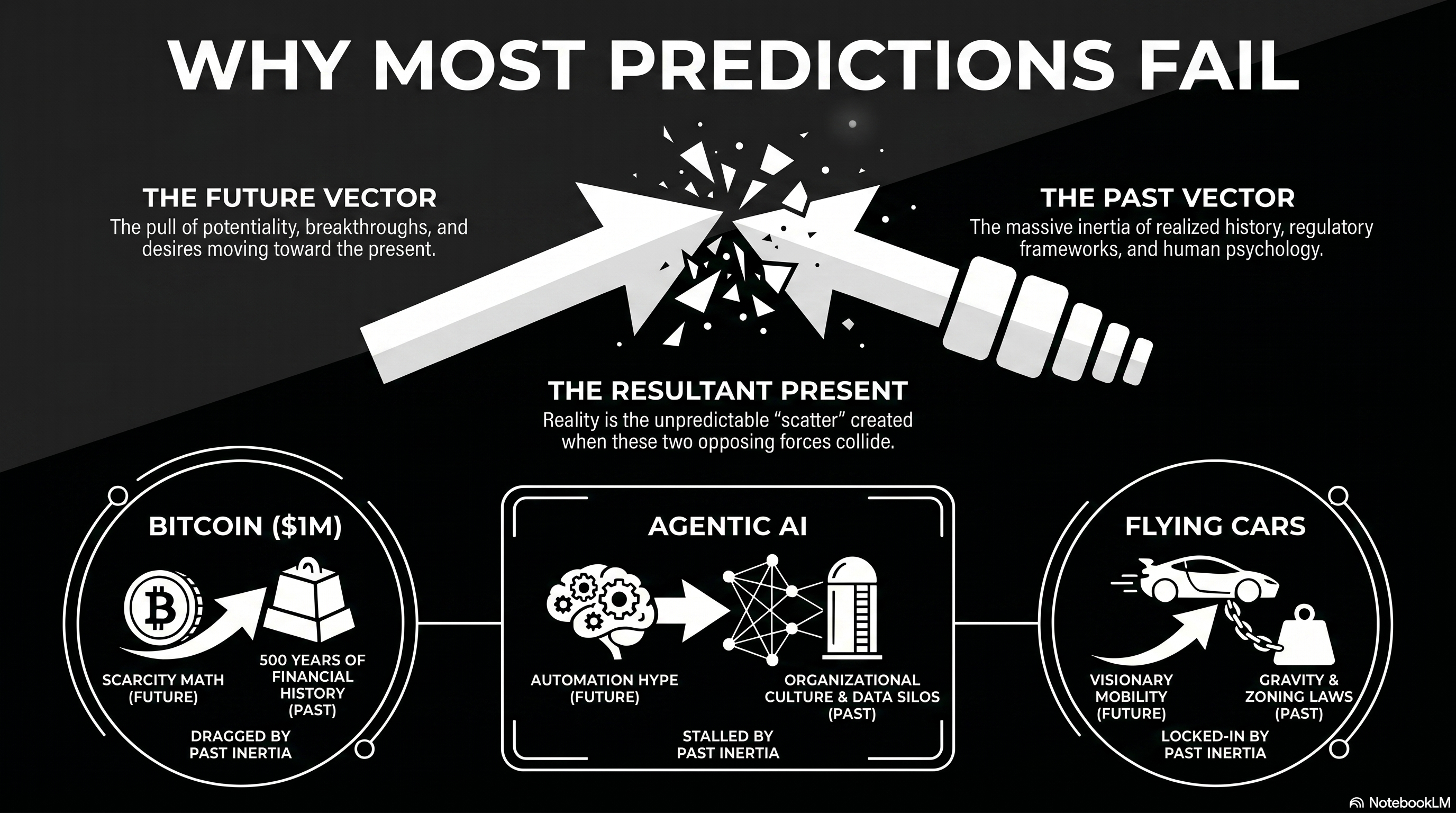
The conceptualization of reality as a linear progression is a foundational axiom of classical physics and human cognition, yet it fails to account for the complex interactions of causality and the multidirectional nature of time revealed by quantum mechanics.1 Most open-ended prediction modelssuch as the perennial claims that Bitcoin will hit 1 million USD , the decade of missed deadlines for Teslas “unsupervised” Full Self-Driving (FSD), or the current “Agentic AI” doomsday hypefail for the same structural reason. These models accurately identify the Future Vector (the pull of potentiality moving toward the past) but ignore the Past Vector (the massive inertia of realized history moving toward the future).2 In reality, the “Present” is not a point on a line but a high-dimensional coordinate where millions of “skewed” trajectories from both directions converge, creating an orthogonal resultant that is inherently unknowable in real-time.3
The Paradox of Prediction: Why Visionary Models Fail
For years, technical visionaries and market analysts have made bold, open-ended predictions that consistently fail to materialize on schedule. These missed milestones represent a failure to account for the “temporal physics” of innovation:
- Bitcoin 1 M USD : Analysts often cite supply-demand dynamics and “halving” cycles to predict a seven-figure price . While the math of scarcity is a valid future-pull vector, it often ignores the “Past Vector” of existing financial institutions, regulatory inertia, and human economic psychology .
- Tesla Full Self-Driving (FSD): Since at least 2013, Elon Musk has predicted level 5 autonomy “next year” . These predictions correctly identify the trajectory of software improvement but fail to account for the massive “freight train” of the past: 100 years of urban zoning, legal frameworks, and the sheer biological unpredictability of human environments.4
- Agentic AI Hype: While 40% of enterprise applications are expected to feature agents by 2028, over 80% of current AI pilots fail to reach production . The “doomsday” or “workforce replacement” vectors are hit by the past inertia of data silos, organizational culture, and technical path dependency .
These failures occur because the “freight train” of the past carries enormous momentum that prevents a simple, linear shift into a forecasted future .
The Double Cone: Mapping Millions of Trajectories
To understand why the present is so resistant to prediction, we must move from a single axis of time to a Double-Cone Spiralling Model.5 In this framework, every technology, concept, or social movement exists as a pair of cones meeting at the present 5:
- The Future Cone: Radiates outward into potentiality, representing what could happen based on desires, breakthroughs, and AI backpropagation .
- The Past Cone: Radiates backward into realized history, representing the “ancestral elements” and path dependencies that constrain current motion.5
The error in most forecasting is the assumption that all these cones are aligned on a single horizontal axis. In reality, every technology has its own skewed trajectory in a high-dimensional “state space” :
| Technology/Concept | Trajectory Orientation | Temporal Magnitude | Underlying Constraint (Past Vector) |
|---|---|---|---|
| Artificial Intelligence | Horizontal | Extreme | Moving from future-pattern to past-grounding 6 |
| Bitcoin | Skewed (e.g., 20) | High | Dragged by 500 years of financial history |
| Flying Cars | Skewed (e.g., 70) | Low | Near-total lock-in by gravity and zoning laws 7 |
The Present is the point where thousands (or millions) of these trajectories from the past meet an equal number of vectors from the future .
The Resultant Present: A Collision in Orthogonal Dimensions
In vector physics, when multiple forces act on a single point, they create a Resultant Vector () representing the sum of all influences . If we define the “Present” () as the summation of all past-to-future and future-to-past trajectories, we find that the resulting reality is orthogonal to the vectors that created it :
Where represents the magnitude (influence) of each actor.8 Because these vectors are skewed across a high-dimensional manifold, their collision does not result in a “middle ground.” Instead, it creates a “scatter“an orthogonal turnout that neither the past nor the future could have perfectly dictated.2
The Unknowability of the “Now”
Because there are infinitely many actors (individuals, systems, institutions) each exerting their own magnitude and direction, the instantaneous direction of the present is mathematically unknowable.7 Prediction models fail because they only track a few “loud” vectors (like Musks FSD hype) while ignoring the “heavy” vectors (like socio-technical inertia) . We can only identify the resulting trajectory after the collision has occurred.7
History: The Recorded Trajectory of the Resultant
What we refer to as History is not a set of events, but the historical trajectory of the resultant present over time.7 It is the integral of the chaotic summation of vectors 9:
Each era of history represents a different “turnout” of these vectors:
- Agrarian Age: A past-dominant vector with high inertia, resulting in a slow-moving, linear trajectory.10
- Information Age: A sudden increase in the magnitude of the scientific “future-to-past” vector, causing a sharp orthogonal shift in reality .
- The Quantum/AI Age: A collision of extreme-magnitude vectors from both directions, leading to a “hyper-orthogonal” present that feels increasingly chaotic and unpredictable .
Conclusion: Living in the Resultant
The failure of prediction models for Bitcoin, Tesla, or AI is a testament to the fact that we do not live on a 1D straight line.11 We exist at the convergence of a million skewed trajectoriesa high-dimensional temporal traffic jam where the “Now” is the only stable resultant.2 While visionaries correctly sense the “pull” of the future, they underestimate the “freight train” of the past. The resulting present is always more nuanced, contextual, and unpredictable than any single-vector model can allow.7 History is the undeniable record of this paththe winding trajectory left by a species trying to bring its dreams from the future into the heavy reality of its past .
Works cited
Tips and Donations
If you enjoyed this deep dive, consider supporting the project with a tip in Sats. It’s a simple, global way to support independent research.
To send Sats, you’ll need a lightning wallet.
-
Quantum asymmetry between time and space - PMC, accessed March 14, 2026, https://pmc.ncbi.nlm.nih.gov/articles/PMC4786044/ ↩
-
Time, a three-directional Dimension I - American Scientific Research Journal for Engineering, Technology, and Sciences, accessed March 14, 2026, https://asrjetsjournal.org/American_Scientific_Journal/article/download/11421/2817/27469 ↩ ↩2 ↩3
-
What if there are also 3 dimensions of time? - Quora, accessed March 14, 2026, https://www.quora.com/What-if-there-are-also-3-dimensions-of-time ↩
-
Are past and future symmetric in mental time line? - Frontiers, accessed March 14, 2026, https://www.frontiersin.org/journals/psychology/articles/10.3389/fpsyg.2015.00208/full ↩
-
T-symmetry - Wikipedia, accessed March 14, 2026, https://en.wikipedia.org/wiki/T-symmetry ↩ ↩2 ↩3
-
What’s the Difference Between AI and Regular Computing? | Royal Institution, accessed March 14, 2026, https://www.rigb.org/explore-science/explore/blog/whats-difference-between-ai-and-regular-computing ↩
-
Rainfall-Runoff Modelling - National Academic Digital Library of Ethiopia, accessed March 14, 2026, http://ndl.ethernet.edu.et/bitstream/123456789/848/1/183.pdf ↩ ↩2 ↩3 ↩4 ↩5
-
Vector algebra and its applications in mechanics | Statics… - Fiveable, accessed March 14, 2026, https://fiveable.me/statics-strength-materials/unit-1/vector-algebra-applications-mechanics/study-guide/BrERKVV4PVA5aW9M ↩
-
Loefflern Dissertation | PDF | Electromagnetic Radiation | Hertz, accessed March 14, 2026, https://www.scribd.com/document/673179908/Loefflern-Dissertation ↩
-
The future is in front, to the right, or below: Development of spatial representations of time in three dimensions - PMC, accessed March 14, 2026, https://pmc.ncbi.nlm.nih.gov/articles/PMC8009816/ ↩
-
1) + 1 Emergent Spacetimes From A Unifying Field Theory In d + 2 Spacetime1, accessed March 14, 2026, https://ia800802.us.archive.org/13/items/arxiv-0705.2834/0705.2834.pdf ↩